


Page 980 - Hematology_ Basic Principles and Practice ( PDFDrive )
P. 980
Chapter 57  Pharmacology and Molecular Mechanisms of Antineoplastic Agents for Hematologic Malignancies  863


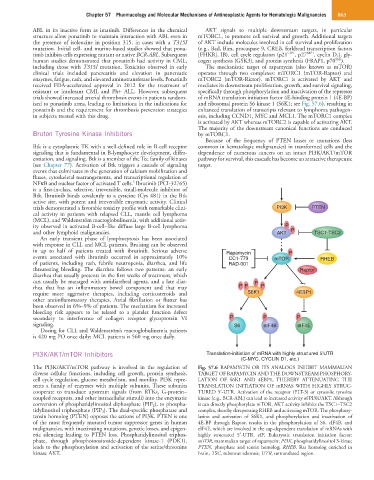
            ABL  in  its  inactive  form  as  imatinib.  Differences  in  the  chemical   AKT  signals  to  multiple  downstream  targets,  in  particular
            structure allow ponatinib to maintain interaction with ABL even in   mTORC1, to promote cell survival and growth. Additional targets
            the  presence  of  isoleucine  in  position  315,  in  cases  with  a  T315I   of AKT include molecules involved in cell survival and proliferation
            mutation. Initial cell- and murine-based studies showed that pona-  (e.g., Bad, Bim, procaspase 9, CREB, forkhead transcription factors
            tinib inhibits cells expressing mutant or native BCR-ABL. Subsequent   [FHKR], IB), cell cycle regulators (p21 CIP1 , p27 KIP1 , cyclin D 1 ), gly-
                                                                                                               S6K
            human studies demonstrated that ponatinib had activity in CML,   cogen synthesis (GSK3), and protein synthesis (FRAP1, p70 ).
            including those with T315I mutation. Toxicities observed in early   The  mechanistic  target  of  rapamycin  (also  known  as  mTOR)
            clinical  trials  included  pancreatitis  and  elevation  in  pancreatic   operates  through  two  complexes:  mTORC1  (mTOR-Raptor)  and
            enzymes, fatigue, rash, and elevated aminotransferase levels. Ponatinib   mTORC2  (mTOR-Rictor).  mTORC1  is  activated  by  AKT  and
            received  FDA-accelerated  approval  in  2012  for  the  treatment  of   mediates its downstream proliferation, growth, and survival signaling,
            resistant  or  intolerant  CML  and  Ph+  ALL.  However,  subsequent   specifically through phosphorylation and inactivation of the repressor
            trials showed increased arterial thrombosis events in patients random-  of mRNA translation initiation factor 4E-binding protein 1 (4E-BP)
            ized to ponatinib arms, leading to limitations in the indications for   and ribosomal protein S6 kinase 1 (S6K1; see Fig. 57.6), resulting in
            ponatinib and the requirement for thrombosis prevention strategies   enhanced translation of transcripts relevant to lymphoma pathogen-
            in subjects treated with this drug.                   esis, including CCND1, MYC and MCL1. The mTORC1 complex
                                                                  is activated by AKT whereas mTORC2 is capable of activating AKT.
                                                                  The majority of the downstream canonical functions are conduced
            Bruton Tyrosine Kinase Inhibitors                     by mTORC1.
                                                                    Because  of  the  frequency  of  PTEN  losses  or  mutations  (less
            Btk is a cytoplasmic TK with a well-defined role in B-cell receptor   common in hematologic malignancies) in transformed cells and the
            signaling that is fundamental in B-lymphocyte development, differ-  dependence  of  numerous  cancers  on  an  intact  PI3K/AKT/mTOR
            entiation, and signaling. Btk is a member of the Tec family of kinases   pathway for survival, this cascade has become an attractive therapeutic
            (see Chapter 77). Activation of Btk triggers a cascade of signaling   target.
            events that culminates in the generation of calcium mobilization and
            fluxes, cytoskeletal rearrangements, and transcriptional regulation of
                                            5
            NFκB and nuclear factor of activated T cells.  Ibrutinib (PCI-32765)
            is  a  first-in-class,  selective,  irreversible,  small-molecule  inhibitor  of
            Btk. Ibrutinib binds covalently to a cysteine (Cys 481) in the Btk
            active site, with potent and irreversible enzymatic activity. Clinical
            trials demonstrated a favorable toxicity profile with remarkable clini-        PI3K        PTEN
            cal  activity  in  patients  with  relapsed  CLL,  mantle  cell  lymphoma
            (MCL), and Waldenström macroglobulinemia, with additional activ-
            ity observed in activated B-cell–like diffuse large B-cell lymphoma               P
            and other lymphoid malignancies.                                                AKT  P      TSC1-TSC2
              An  early  transient  phase  of  lymphocytosis  has  been  associated
            with response in CLL and MCL patients. Bruising can be observed
            in  up  to  half  of  patients  treated  with  ibrutinib.  Serious  adverse   Rapamycin  P
            events  associated  with  ibrutinib  occurred  in  approximately  10%   CC1-779  mTOR         RHEB
            of  patients,  including  rash,  febrile  neutropenia,  diarrhea,  and  life   RAD-001
            threatening  bleeding.  The  diarrhea  follows  two  patterns:  an  early              Raptor
            diarrhea that usually presents in the first weeks of treatment, which
            can usually be managed with antidiarrheal agents, and a late diar-      P
            rhea  that  has  an  inflammatory  bowel  component  and  that  may   P P  P
            require  more  aggressive  therapies,  including  corticosteroids  and   S6K1         4EBP1
            other  antiinflammatory  therapies.  Atrial  fibrillation  or  flutter  has
            been observed in 6%–9% of patients. The mechanism for increased
            bleeding  risk  appears  to  be  related  to  a  platelet  function  defect
            secondary  to  interference  of  collagen  receptor  glycoprotein  VI     P  P        P
            signaling.                                                        S6       eIF4B      eIF4E
              Dosing for CLL and Waldenström’s macroglobulinemia patients
            is 420 mg PO once daily; MCL patients is 560 mg once daily.

            PI3K/AKT/mTOR Inhibitors                                 Translation-initiation of mRNA with highly structured 5'UTR
                                                                                (C-MYC, CYCLIN D1, etc.)
            The  PI3K/AKT/mTOR  pathway  is  involved  in  the  regulation  of   Fig.  57.6  RAPAMYCIN  OR  ITS  ANALOGS  INHIBIT  MAMMALIAN
            diverse  cellular  functions,  including  cell  growth,  protein  synthesis,   TARGET OF RAPAMYCIN AND THE DOWNSTREAM PHOSPHORY-
            cell cycle regulation, glucose metabolism, and motility. PI3K repre-  LATION  OF  S6K1  AND  4EBP1,  THEREBY  ATTENUATING  THE
            sents  a  family  of  enzymes  with  multiple  subunits. These  subunits   TRANSLATION  INITIATION  OF  mRNAS WITH  HIGHLY  STRUC-
            cooperate  to  transduce  upstream  signals  (from  RTKs,  G-protein–  TURED 5′-UTR. Activation of the receptor (FLT-3) or cytosolic tyrosine
            coupled receptors, and other intracellular stimuli) into the enzymatic   kinase (e.g., BCR-ABL) can lead to increased activity of PI3K/AKT. Although
            conversion of phosphatidylinositol diphosphate (PIP 2), to phospha-  it can directly phosphorylate mTOR, AKT activity inhibits the TSC1–TSC2
            tidylinositol triphosphate (PIP 3). The dual-specific phosphatase and   complex, thereby derepressing RHEB and activating mTOR. The phosphory-
            tensin homolog (PTEN) opposes the actions of PI3K. PTEN is one   lation  and  activation  of  S6K1,  and  phosphorylation  and  inactivation  of
            of the most frequently mutated tumor suppressor genes in human   4E-BP  through  Raptor,  results  in  the  phosphorylation  of  S6,  eIF4B,  and
            malignancies, with inactivating mutations, genetic losses, and epigen-  eIF4E, which are involved in the cap-dependent translation of mRNAs with
            etic  silencing  leading  to  PTEN  loss.  Phosphatidylinositol  triphos-  highly  structured  5′-UTR.  eIF,  Eukaryotic  translation  initiation  factor;
            phate,  through  phosphoinositoside-dependent  kinase-1  (PDK1),   mTOR, mammalian target of rapamycin; PI3K, phosphatidylinositol 3-kinas;
            leads to the phosphorylation and activation of the serine/threonine   PTEN,  phosphate  and  tensin  homolog;  RHEB,  Ras  homolog  enriched  in
            kinase AKT.                                           brain; TSC, tuberous sclerosis; UTR, untranslated region.

