


Page 979 - Hematology_ Basic Principles and Practice ( PDFDrive )
P. 979
862    Part VII  Hematologic Malignancies


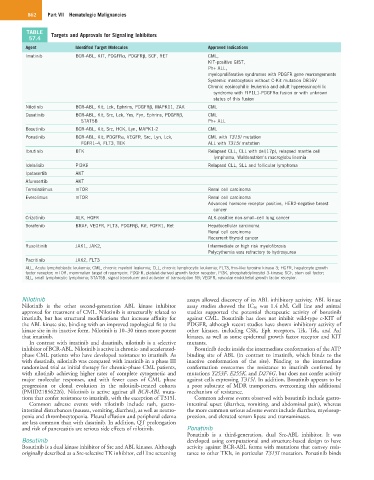
          TABLE   Targets and Approvals for Signaling Inhibitors
          57.4
         Agent            Identified Target Molecules                Approved Indications
         Imatinib         BCR-ABL, KIT, PDGFRα, PDGFRβ, SCF, RET     CML,
                                                                     KIT-positive GIST,
                                                                     Ph+ ALL,
                                                                     myeloproliferative syndromes with PDGFR gene rearrangements
                                                                     Systemic mastocytosis without C-Kit mutation D816V
                                                                     Chronic eosinophilic leukemia and adult hypereosinophilic
                                                                       syndrome with FIP1L1-PDGFRα fusion or with unknown
                                                                       status of this fusion
         Nilotinib        BCR-ABL, Kit, Lck, Ephrins, PDGFRβ, MAPK11, ZAK  CML
         Dasatinib        BCR-ABL, Kit, Src, Lck, Yes, Fyn, Ephrins, PDGFRβ,   CML
                            STAT5B                                   Ph+ ALL
         Bosutinib        BCR-ABL, Kit, Src, HCK, Lyn, MAPK1-2       CML
         Ponatinib        BCR-ABL, Kit, PDGFRα, VEGFR, Src, Lyn, Lck,   CML with T315I mutation
                            FGFR1–4, FLT3, TEK                       ALL with T315I mutation
         Ibrutinib        BTK                                        Relapsed CLL, CLL with del(17p), relapsed mantle cell
                                                                       lymphoma, Waldenström’s macroglobulinemia
         Idelalisib       PI3Kδ                                      Relapsed CLL, SLL and follicular lymphoma
         Ipatasertib      AKT
         Afuresertib      AKT
         Temsirolimus     mTOR                                       Renal cell carcinoma
         Everolimus       mTOR                                       Renal cell carcinoma
                                                                     Advanced hormone receptor positive, HER2-negative breast
                                                                       cancer
         Crizotinib       ALK, HGFR                                  ALK-positive non-small–cell lung cancer
         Sorafenib        BRAF, VEGFR, FLT3, PDGFRβ, Kit, FGFR1, Ret  Hepatocellular carcinoma
                                                                     Renal cell carcinoma
                                                                     Recurrent thyroid cancer
         Ruxolitinib      JAK1, JAK2,                                Intermediate or high risk myelofibrosis
                                                                     Polycythemia vera refractory to hydroxyurea
         Pacritinib       JAK2, FLT3
         ALL, Acute lymphoblastic leukemia; CML, chronic myeloid leukemia; CLL, chronic lymphocytic leukemia; FLT3, fms-like tyrosine kinase 3; HGFR, hepatocyte growth
         factor receptor; mTOR, mammalian target of rapamycin; PDGFR, platelet-derived growth factor receptor, PI3K, phosphatidylinositol 3-kinase; SCF, stem cell factor;
         SLL, small lymphocytic lymphoma; STAT5B, signal transducer and activator of transcription 5B; VEGFR, vascular endothelial growth factor receptor.


        Nilotinib                                             assays allowed discovery of its ABL inhibitory activity. ABL kinase
        Nilotinib  is  the  other  second-generation  ABL  kinase  inhibitor   assay  studies  showed  the  IC 50   was  1.4 nM.  Cell  line  and  animal
        approved for treatment of CML. Nilotinib is structurally related to   studies  supported  the  potential  therapeutic  activity  of  bosutinib
        imatinib, but has structural modifications that increase affinity for   against  CML.  Bosutinib  has  does  not  inhibit  wild-type  c-KIT  of
        the ABL kinase site, binding with an improved topological fit to the   PDGFR, although recent studies have shown inhibitory activity of
        kinase site in its inactive form. Nilotinib is 10–30 times more potent   other  kinases,  including  CSK,  Eph  receptors,  Trk,  Tek,  and  Axl
        that imatinib.                                        kinases, as well as some epidermal growth factor receptor and KIT
           In  contrast  with  imatinib  and  dasatinib,  nilotinib  is  a  selective   mutants.
        inhibitor of BCR-ABL. Nilotinib is active in chronic- and accelerated-  Bosutinib docks inside the intermediate conformation of the ATP
        phase CML patients who have developed resistance to imatinib. As   binding  site  of  ABL  (in  contrast  to  imatinib,  which  binds  to  the
        with dasatinib, nilotinib was compared with imatinib in a phase III   inactive  conformation  of  the  site).  Binding  to  the  intermediate
        randomized trial as initial therapy for chronic-phase CML patients,   conformation  overcomes  the  resistance  to  imatinib  conferred  by
        with  nilotinib  achieving  higher  rates  of  complete  cytogenetic  and   mutations Y253F, E255K, and D276G, but does not confer activity
        major  molecular  responses,  and  with  fewer  cases  of  CML  phase   against cells expressing T315I. In addition, Bosutinib appears to be
        progression  or  clonal  evolution  in  the  nilotinib-treated  cohorts   a poor substrate of MDR transporters, overcoming this additional
        (PMID21856226).  Nilotinib  is  active  against  all  BCR-ABL  muta-  mechanism of resistance.
        tions that confer resistance to imatinib, with the exception of T315I.  Common adverse events observed with bosutinib include gastro-
           Common  adverse  events  with  nilotinib  include  rash,  gastro-  intestinal upset (diarrhea, vomiting, and abdominal pain), whereas
        intestinal disturbances (nausea, vomiting, diarrhea), as well as neutro-  the more common serious adverse events include diarrhea, myelosup-
        penia and thrombocytopenia. Pleural effusion and peripheral edema   pression, and elevated serum lipase and transaminases.
        are less common than with dasatinib. In addition, QT prolongation
        and risk of pancreatitis are serious side effects of nilotinib.  Ponatinib
                                                              Ponatinib  is  a  third-generation,  dual  Src-ABL  inhibitor.  It  was
        Bosutinib                                             developed using computational and structure-based design to have
        Bosutinib is a dual kinase inhibitor of Src and ABL kinases. Although   activity against BCR-ABL forms with mutations that convey resis-
        originally described as a Src-selective TK inhibitor, cell line screening   tance to other TKIs, in particular T315I mutation. Ponatinib binds

