


Page 993 - Hematology_ Basic Principles and Practice ( PDFDrive )
P. 993
876    Part VII  Hematologic Malignancies


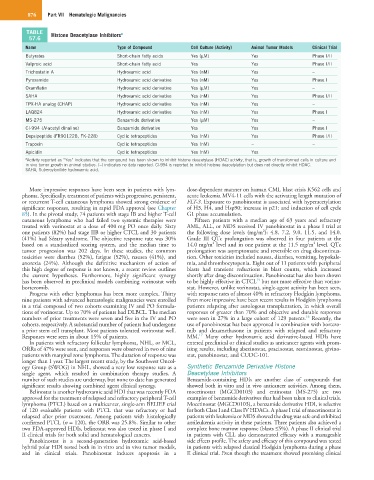
          TABLE   Histone Deacetylase Inhibitors a
          57.6
         Name                          Type of Compound        Cell Culture (Activity)  Animal Tumor Models  Clinical Trial
         Butyrates                     Short-chain fatty acids  Yes (µM)           Yes                 Phase I/II
         Valproic acid                 Short-chain fatty acid   Yes                Yes                 Phase I/II
         Trichostatin A                Hydroxamic acid          Yes (nM)           Yes                 –
         Pyroxamide                    Hydroxamic acid derivative  Yes (nM)        Yes                 Phase I
         Oxamflatin                    Hydroxamic acid derivative  Yes (µM)        Yes                 –
         SAHA                          Hydroxamic acid derivative  Yes (nM)        Yes                 Phase I/II
         TPX-HA analog (CHAP)          Hydroxamic acid derivative  Yes (nM)        Yes                 –
         LAQ824                        Hydroxamic acid derivative  Yes (nM)        Yes                 Phase I
         MS-275                        Benzamide derivative     Yes (µM)           Yes                 –
         CI-994 (N-acetyl dinaline)    Benzamide derivative     Yes                Yes                 Phase I
         Depsipeptide (FR901228, FK-228)  Cyclic tetrapeptides  Yes (nM)           Yes                 Phase I/II
         Trapoxin                      Cyclic tetrapeptides     Yes (nM)           –                   –
         Apicidin                      Cyclic tetrapeptides     Yes (nM)           Yes                 –
         a Activity reported as “Yes” indicates that the compound has been shown to inhibit histone deacetylase (HDAC) activity, that is, growth of transformed cells in culture and
         in vivo tumor growth in animal studies. (–) indicates no data reported. CI-994 is reported to inhibit histone deacetylation but does not directly inhibit HDAC.
         SAHA, Suberoylanilide hydroxamic acid.


           More impressive responses have been seen in patients with lym-  dose-dependent manner on human CML blast crisis K562 cells and
        phoma. Specifically, treatment of patients with progressive, persistent,   acute leukemia MV4-11 cells with the activating length mutation of
        or recurrent T-cell cutaneous lymphoma showed strong evidence of   FLT-3. Exposure to panobinostat is associated with hyperacetylation
        significant responses, resulting in rapid FDA approval (see Chapter   of H3, H4, and Hsp90; increase in p21; and induction of cell cycle
        85). In the pivotal study, 74 patients with stage IB and higher T-cell   G1 phase accumulation.
        cutaneous  lymphoma  who  had  failed  two  systemic  therapies  were   Fifteen  patients  with  a  median  age  of  63  years  and  refractory
        treated  with  vorinostat  at  a  dose  of  400 mg  PO  once  daily.  Sixty   AML, ALL, or MDS received IV panobinostat in a phase I trial at
                                                                                       2
        one patients (82%) had stage IIB or higher CTCL and 30 patients   the  following  dose  levels  (mg/m ):  4.8,  7.2,  9.0,  11.5,  and  14.0.
        (41%) had Sézary syndrome. The objective response rate was 30%   Grade  III  QTc  prolongation  was  observed  in  four  patients  at  the
                                                                                                        2
                                                                       2
        based  on  a  standardized  scoring  system,  and  the  median  time  to   14.0 mg/m  level and in one patient at the 11.5 mg/m  level. QTc
        tumor  progression  was  202  days.  In  these  studies,  the  common   prolongation was asymptomatic and reversible on drug discontinua-
        toxicities  were  diarrhea  (52%),  fatigue  (52%),  nausea  (41%),  and   tion. Other toxicities included nausea, diarrhea, vomiting, hypokale-
        anorexia  (24%).  Although  the  definitive  mechanism  of  action  of   mia, and thrombocytopenia. Eight out of 11 patients with peripheral
        this high degree of response is not known, a recent review outlines   blasts  had  transient  reductions  in  blast  counts,  which  increased
        the  current  hypotheses.  Furthermore,  highly  significant  synergy   shortly after drug discontinuation. Panobinostat has also been shown
                                                                                     15
        has been observed in preclinical models combining vorinostat with     to be highly effective in CTCL  but not more effective than vorino-
        bortezomib.                                           stat. However, unlike vorinostat, single-agent activity has been seen,
           Progress with other lymphomas has been more complex. Thirty   with response rates of almost 40% in refractory Hodgkin lymphoma.
        nine patients with advanced hematologic malignancies were enrolled   Even more impressive have been recent results in Hodgkin lymphoma
        in a trial composed of two cohorts examining IV and PO formula-  patients relapsing after autologous transplantation, in which overall
        tions of vorinostat. Up to 70% of patients had DLBCL. The median   responses of greater than 70% and objective and durable responses
                                                                                                     16
        numbers of prior treatments were seven and five in the IV and PO   were seen in 27% in a large cohort of 129 patents.  Recently, the
        cohorts, respectively. A substantial number of patients had undergone   use of panobinostat has been approved in combination with bortezo-
        a prior stem cell transplant. Most patients tolerated vorinostat well.   mib  and  dexamethasone  in  patients  with  relapsed  and  refractory
                                                                  17
        Responses were seen in about 15% of patients.         MM.   Many  other  hydroxamic  acid  derivative-based  HDIs  have
           In patients with refractory follicular lymphoma, NHL, or MCL,   entered preclinical or clinical studies as anticancer agents with prom-
        ORRs of 47% were seen, and responses were observed in two of nine   ising results, including abexinostat, pracinostat, resminostat, givino-
        patients with marginal zone lymphoma. The duration of response was   stat, panobinostat, and CUDC-101.
        longer than 1 year. The largest recent study, by the Southwest Oncol-
        ogy Group (SWOG) in NHL, showed a very low response rate as a   Synthetic Benzamide Derivative Histone
        single  agent,  which  resulted  in  combination  therapy  studies.  A   Deacetylase Inhibitors
        number of such studies are underway, but none to date has generated   Benzamide-containing  HDIs  are  another  class  of  compounds  that
        significant results showing combined agent clinical synergy.  showed both in vitro and in vivo anticancer activities. Among them,
           Belinostat is another hydroxamic acid HDI that was recently FDA   mocetinostat  (MGCD0103)  and  entinostat  (MS-275)  are  two
        approved for the treatment of relapsed and refractory peripheral T-cell   examples of benzamide derivatives that had been taken to clinical trials.
        lymphoma (PTCL) based on a multicenter, single-arm BELIEF trial   Mocetinostat (MGCD0103), a benzamide derivative HDI, is selective
        of  120  evaluable  patients  with  PTCL  that  was  refractory  or  had   for both Class I and Class IV HDACs. A phase I trial of mocetinostat in
        relapsed  after  prior  treatment.  Among  patients  with  histologically   patients with leukemia or MDS showed the drug was safe and exhibited
        confirmed PTCL (n = 120), the ORR was 25.8%. Similar to other   antileukemia activity in these patients. Three patients also achieved a
        two FDA-approved HDIs, belinostat was also tested in phase I and   complete bone marrow response (blasts ≤5%). A phase II clinical trial
        II clinical trials for both solid and hematological cancers.  in patients with CLL also demonstrated efficacy with a manageable
           Panobinostat  is  a  second-generation  hydroxamic  acid-based   side effects profile. The safety and efficacy of this compound was tested
        hybrid polar HDI tested both in in vitro and in vivo tumor models,   in patients with relapsed classical Hodgkin lymphoma during a phase
        and  in  clinical  trials.  Panobinostat  induces  apoptosis  in  a   II clinical trial. Even though the treatment showed promising clinical

