


Page 996 - Hematology_ Basic Principles and Practice ( PDFDrive )
P. 996
Chapter 57  Pharmacology and Molecular Mechanisms of Antineoplastic Agents for Hematologic Malignancies  879


            P-Glycoprotein (ABC-B1 Transporter)                   gene has 28 exons and codes for a protein of 1280 amino acids. The
                                                                  PGP molecule has two homologous halves, each with a hydrophobic
                                                                  region  containing  six  transmembrane  domains  and  a  hydrophilic
            Structure and Function                                region containing an ATP-binding site. N-linked glycosylation occurs
                                                                  on the extracellular side (Fig. 57.10). PGP is a member of the ABC
            The ABC superfamily of membrane transporters mediates the cross-  superfamily, which includes, among more than 100 others, the MRP;
            membrane flux of xenobiotics, naturally occurring toxic compounds,   the pfmdr pump in Plasmodium falciparum, which results in chloro-
            drugs, peptides, and ions. The ABC family has a profound impact   quine  resistance;  STE6,  the  transporter  of  the  “a”  peptide  mating
            on homeostasis and is critically important to proliferation and dif-  factor in yeast; the cystic fibrosis transmembrane conductance regula-
            ferentiation signals in normal progenitor cells. It also mediates drug   tor  (CFTR);  and  the  TAP-1  and  TAP-2  proteins  that  transport
            sensitivity. The terminology remains challenging because many earlier   antigenic peptides for association with class I molecules and surface
            works referred to PGP and MRP, but the more recent consensus on   antigen presentation. MRP has been demonstrated in several MDR
            the  ABC  superfamily  has  created  a  more  simple  approach  going   mammalian cell lines and in human tumors (see later), but a recent
            forward. PGP (ABC-B1 transporter) has been the subject of intense   study  in  human  tumor  cell  lines  has  shown  TAP  overexpression
            biochemical and clinical studies since it was first discovered in drug-  associated with MRP, as well as drug resistance resulting from trans-
            resistant cell lines more than 20 years ago. The biochemistry of PGP   fection of the TAP genes.
            has been reviewed in detail by several investigators. This phosphory-  PGP has a broad specificity for hydrophobic compounds and can
            lated glycoprotein has a molecular mass of approximately 170 kDa   both reduce the influx of drugs into the cytosol and increase efflux
            and is localized to the plasma membrane, where it functions as a drug   from  the  cytosol.  To  accomplish  the  former,  this  “hydrophobic
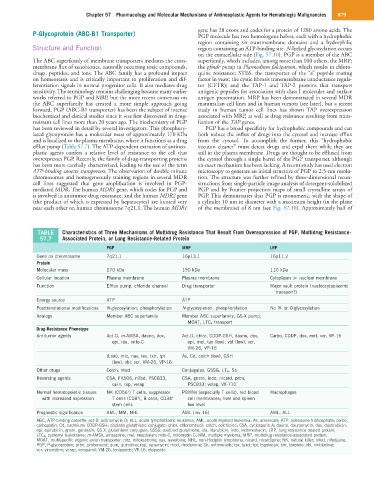
            efflux pump (Table 57.7). The ATP-dependent extrusion of antineo-  vacuum cleaner” must detect drugs and expel them while they are
            plastic  agents  confers  a  relative  level  of  resistance  to  the  cell  that   still in the plasma membrane. Drugs are thought to be effluxed from
            overexpresses PGP. Recently, the family of drug-transporting proteins   the cytosol through a single barrel of the PGP transporter, although
            has been more carefully characterized, leading to the use of the term   an exact mechanism has been lacking. A recent study has used electron
            ATP-binding cassette transporters. The observation of double-minute   microscopy to generate an initial structure of PGP to 2.5-nm resolu-
            chromosomes and homogeneously staining regions in several MDR   tion. The structure was further refined by three-dimensional recon-
            cell  lines  suggested  that  gene  amplification  is  involved  in  PGP-  structions from single-particle image analysis of detergent-solubilized
            mediated MDR. The human MDR1 gene, which codes for PGP and   PGP and by Fourier projection maps of small crystalline arrays of
            is involved in antitumor drug resistance, and the human MDR2 gene   PGP. This demonstrates that PGP is monomeric, with the shape of
            (the product of which is expressed by hepatocytes) are located very   a cylinder 10 nm in diameter with a maximum height (in the plane
            near each other on human chromosome 7q21.1. The human MDR1   of the membrane) of 8 nm (see Fig. 57.10). Approximately half of


             TABLE   Characteristics of Three Mechanisms of Multidrug Resistance That Result From Overexpression of PGP, Multidrug Resistance-
              57.7   Associated Protein, or Lung Resistance-Related Protein
                                    PGP                      MRP                         LRP
             Gene on chromosome     7q21.1                   16p13.1                     16p11.2
             Protein
             Molecular mass         170 kDa                  190 kDa                     110 kDa
             Cellular location      Plasma membrane          Plasma membrane             Cytoplasm ≫ nuclear membrane
             Function               Efflux pump, chloride channel  Drug transporter      Major vault protein (nucleocytoplasmic
                                                                                           transport?)
             Energy source          ATP                      ATP
             Posttranslational modifications  N-glycosylation, phosphorylation  N-glycosylation, phosphorylation  No N- or O-glycosylation
             Analogs                Member ABC superfamily   Member ABC superfamily; GS-X pump,
                                                              MOAT, LTC 4  transport
             Drug-Resistance Phenotype
             Antitumor agents       Act-D, m-AMSA, dauno, dox,   Act-D, chlor, CDDP-GSH, dauno, dox,   Carbo, CDDP, dox, mel, vcr, VP-16
                                      epi, ida, mito-C        epi, mel, tax (low), vbl (low), vcr,
                                                              VM-26, VP-16
                                    (Low), mtz, nav, tax, txtr, tpt   As, Cd, colch (low), GSH
                                      (low), vbl, vcr, VM-26, VP-16
             Other drugs            Colch, rhod              Conjugates, GSSG, LT 4 , Sb
             Reversing agents       CSA, FK506, nifed, PSC833,   CSA, gnstn, indo, nicard, prbn,
                                      quin, rap, verap        PSC833, verap, VX-710
                                           +
             Normal hematopoietic tissues   NK (CD56 ) T cells, suppressor   PBMNs (especially T cells), red blood   Macrophages
                                                         +
                                              +
               with increased expression  T cells (CD8 ), B cells, CD34    cell membranes; liver and spleen
                                      stem cells              low level
             Prognostic significance  AML, MM, NHL           AML (inv 16)                AML, ALL
             ABC, ATP-binding cassette; act-D, actinomycin D; ALL, acute lymphoblastic leukemia; AML, acute myeloid leukemia; As, arsenicals; ATP, adenosine triphosphate; carbo,
             carboplatin; Cd, cadmium; CDDP-GSH; cisplatin glutathione conjugate; chlor, chlorambucil; colch, colchicine; CSA, cyclosporin A; dauno, daunomycin; dox, doxorubicin;
             epi, epirubicin; gnstn, genistein; GS-X, glutathione conjugate; GSSG, oxidized glutathione; ida, idarubicin; indo, indomethacin; LRP, lung resistance-related protein;
             LTC 4, cysteinyl leukotriene; m-AMSA, amsacrine; mel, melphalan; mito-C, mitomycin C; MM, multiple myeloma; MRP, multidrug resistance-associated protein;
             MOAT, multispecific organic anion transporter; mtz, mitoxantrone; nav, navelbine; NHL, non-Hodgkin lymphoma; nicard, nicardipine; NK, natural killer; nifed, nifedipine;
             PGP, P-glycoprotein; prbn, probenecid; quin, quinidine; rap, rapamycin; rhod, rhodamine; Sb, antimonials; tax, taxol; tpt, topotecan; txtr, taxotere; vbl, vinblastine;
             vcr, vincristine; verap, verapamil; VM-26, teniposide; VP-16, etoposide.

