


Page 997 - Hematology_ Basic Principles and Practice ( PDFDrive )
P. 997
880    Part VII  Hematologic Malignancies


                 A                                            B
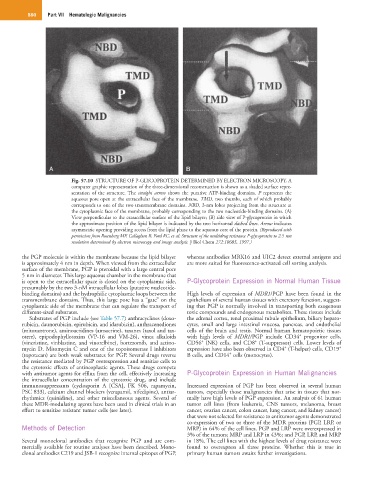
                        Fig. 57.10  STRUCTURE OF P-GLYCOPROTEIN DETERMINED BY ELECTRON MICROSCOPY. A
                        computer graphic representation of the three-dimensional reconstruction is shown as a shaded surface repre-
                        sentation  of  the  structure. The  straight  arrow  shows  the  putative  ATP-binding  domains.  P  represents  the
                        aqueous pore open at the extracellular face of the membrane. TMD, two thumbs, each of which probably
                        corresponds to one of the two transmembrane domains. NBD, 3-nm lobes projecting from the structure at
                        the cytoplasmic face of the membrane, probably corresponding to the two nucleotide-binding domains. (A)
                        View perpendicular to the extracellular surface of the lipid bilayer; (B) side view of P-glycoprotein in which
                        the approximate position of the lipid bilayer is indicated by the two horizontal dashed lines. Arrow indicates
                        asymmetric opening providing access from the lipid phase to the aqueous core of the protein. (Reproduced with
                        permission from Rosenberg MF, Callaghan R, Ford RC, et al: Structure of the multidrug resistance P-glycoprotein to 2.5 nm
                        resolution determined by electron microscopy and image analysis. J Biol Chem 272:10685, 1997.)

        the PGP molecule is within the membrane because the lipid bilayer   whereas antibodies MRK16 and UIC2 detect external antigens and
        is approximately 4 nm in depth. When viewed from the extracellular   are more suited for fluorescence-activated cell sorting analysis.
        surface of the membrane, PGP is pteroidal with a large central pore
        5 nm in diameter. This large aqueous chamber in the membrane that
        is open to the extracellular space is closed on the cytoplasmic side,   P-Glycoprotein Expression in Normal Human Tissue
        presumably by the two 3-nM intracellular lobes (putative nucleotide-
        binding domains) and the hydrophilic cytoplasmic loops between the   High  levels  of  expression  of  MDR1/PGP  have  been  found  in  the
        transmembrane domains. Thus, this large pore has a “gate” on the   epithelium of several human tissues with excretory function, suggest-
        cytoplasmic side of the membrane that can regulate the transport of   ing that PGP is normally involved in transporting both exogenous
        different-sized substrates.                           toxic compounds and endogenous metabolites. These tissues include
           Substrates of PGP include (see Table 57.7) anthracyclines (doxo-  the adrenal cortex, renal proximal tubule epithelium, biliary hepato-
        rubicin, daunorubicin, epirubicin, and idarubicin), anthracenediones   cytes, small and large intestinal mucosa, pancreas, and endothelial
        (mitoxantrone), aminoacridines (amsacrine), taxanes (taxol and tax-  cells of  the  brain  and  testis.  Normal  human hematopoietic tissues
                                                                                                   +
        otere),  epipodophyllotoxins  (VP-16  and  VM-26),  vinca  alkaloids   with  high  levels  of  MDR1/PGP  include  CD34   progenitor  cells,
                                                                                    +
                                                                   +
        (vincristine, vinblastine, and vinorelbine), bortezomib, and actino-  CD56  (NK) cells, and CD8  (T-suppressor) cells. Lower levels of
                                                                                              +
                                                                                                                +
        mycin D. Mitomycin C and one of the topoisomerase I inhibitors   expression have also been observed in CD4  (T-helper) cells, CD19
                                                                            +
        (topotecan) are both weak substrates for PGP. Several drugs reverse   B cells, and CD14  cells (monocytes).
        the resistance mediated by PGP overexpression and sensitize cells to
        the cytotoxic effects of antineoplastic agents. These drugs compete
        with antitumor agents for efflux from the cell, effectively increasing   P-Glycoprotein Expression in Human Malignancies
        the  intracellular  concentration  of  the  cytotoxic  drug,  and  include
        immunosuppressants  (cyclosporin  A  [CSA],  FK  506,  rapamycin,   Increased  expression  of  PGP  has  been  observed  in  several  human
        PSC 833), calcium channel blockers (verapamil, nifedipine), antiar-  tumors, especially those malignancies that arise in tissues that nor-
        rhythmics  (quinidine),  and  other  miscellaneous  agents.  Several  of   mally have high levels of PGP expression. An analysis of 61 human
        these MDR-modulating agents have been used in clinical trials in an   tumor  cell  lines  (from  leukemia,  CNS  tumors,  melanoma,  breast
        effort to sensitize resistant tumor cells (see later).  cancer, ovarian cancer, colon cancer, lung cancer, and kidney cancer)
                                                              that were not selected for resistance to antitumor agents demonstrated
                                                              co-expression of two or three of the MDR proteins (PGP, LRP, or
        Methods of Detection                                  MRP) in 64% of the cell lines. PGP and LRP were overexpressed in
                                                              3% of the tumors; MRP and LRP in 43%; and PGP, LRP, and MRP
        Several  monoclonal  antibodies  that  recognize  PGP  and  are  com-  in 18%. The cell lines with the highest levels of drug resistance were
        mercially available for routine analyses have been described. Mono-  found  to  overexpress  all  three  proteins.  Whether  this  is  true  in
        clonal antibodies C219 and JSB-1 recognize internal epitopes of PGP,   primary human tumors awaits further investigations.

