


Page 998 - Hematology_ Basic Principles and Practice ( PDFDrive )
P. 998
Chapter 57  Pharmacology and Molecular Mechanisms of Antineoplastic Agents for Hematologic Malignancies  881

            Acute Myeloid Leukemia                                patients older than the age of 60 years. No benefit in response rate
                                                                  or survival was noted. Likewise, in a CALGB study, in adults with
            An earlier meta-analysis of studies that examined the expression of   untreated leukemia younger than the age of 60 years, PSC833 also
            MDR1/PGP in blasts of patients with AML found that 40% (105   did not improve survival or response rates. Thus, the future role of
            out of 261 patients) who were PGP positive achieved a CR, but 81%   modulation of PGP in leukemia management remains ill defined.
            (192 out of 238) of PGP-negative patients obtained a CR. An analysis
            of  96  untreated  patients  with  AML  showed  that  PGP  expression   Multidrug Resistance-Associated Protein (ABC G2
            predicted induction failure (p < .0001) and decreased OS (p < .001),
            as did unfavorable cytogenetics. PGP expression was not detected in   Transporter)
            patients with favorable cytogenetic abnormalities [t(15;17), inv(16),
            t(8;21)], was found in 29% of those samples with a normal karyotype,   Structure and Function
            and was expressed in 62% of patients with an unfavorable cytogenetic
            abnormality. PGP was also detected in 63% of those with secondary   The MRP was first described in 1992 in the doxorubicin-selected
            AML compared with 25% of those with de novo disease. PGP analysis   small-cell lung cancer cell line, and its biochemical characteristics and
                                                                                               18
            with the  MRK16 antibody  in 211  elderly patients (older  than  55   biologic properties have been reviewed.  It has now been classified
            years)  with  untreated  AML  again  showed  that  PGP  expression  is   within  the  larger  context  of  ABC  transporters,  termed  ABC  G2
            significantly associated with a decreased CR rate and resistant disease.   transporters. Because much of the literature uses the MRP nomencla-
            Patients in this report with de novo PGP-negative AML with favor-  ture, we refer to this herein except for the studies using the ABC
            able cytogenetics have a CR rate of 81% compared with 12% for   terminology. This N-glycosylated plasma membrane phosphoprotein
            those with secondary AML, which is PGP positive and has unfavor-  has a molecular mass of 190 kDa (1531 amino acids) and is a member
            able cytogenetics. Clinical trials using the PGP substrate Valspodar   of the ABC transporter superfamily (see Table 57.7 and Fig. 57.11).
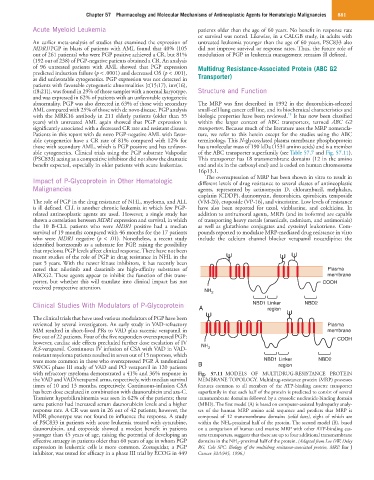
            (PSC833) acting as a competitive inhibitor did not show the dramatic   This transporter has 18 transmembrane domains (12 in the amino
            benefit expected, especially in older patients with acute leukemias.  end and six in the carboxyl end) and is coded on human chromosome
                                                                  16p13.1.
                                                                    The overexpression of MRP has been shown in vitro to result in
            Impact of P-Glycoprotein in Other Hematologic         different levels of drug resistance to several classes of antineoplastic
            Malignancies                                          agents,  represented  by  actinomycin  D,  chlorambucil,  melphalan,
                                                                  cisplatin (CDDP), daunomycin, doxorubicin, epirubicin, teniposide
            The role of PGP in the drug resistance of NHL, myeloma, and ALL   (VM-26), etoposide (VP-16), and vincristine. Low levels of resistance
            is ill defined. CLL is another chronic leukemia in which few PGP-  have  also  been  reported  for  taxol,  vinblastine,  and  colchicine.  In
            related antineoplastic agents are used. However, a single study has   addition to antitumoral agents, MRPs (and its isoforms) are capable
            shown a correlation between MDR1 expression and survival, in which   of transporting heavy metals (arsenicals, cadmium, and antimonials)
            the  10  B-CLL  patients  who  were  MDR1  positive  had  a  median   as  well  as  glutathione  conjugates  and  cysteinyl  leukotriene.  Com-
            survival of 19 months compared with 46 months for the 17 patients   pounds reported to modulate MRP-mediated drug resistance in vitro
            who  were  MDR1  negative  (p  <  .01).  Nonetheless,  a  recent  study   include  the  calcium  channel  blocker  verapamil  nocardipine;  the
            identified bortezomib as a substrate for PGP, raising the possibility
            that myeloma PGP levels affect clinical response. There have not been
            recent studies of the role of PGP in drug resistance in NHL in the
            past 5 years. With the newer kinase inhibitors, it has recently been
            noted  that  nilotinib  and  dasatinib  are  high-affinity  substrates  of                      Plasma
            ABCG2. These agents appear to inhibit the function of this trans-                               membrane
            porter, but whether this will translate into clinical impact has not                           COOH
            received prospective attention.
                                                                    NH
                                                                      2
            Clinical Studies With Modulators of P-Glycoprotein    A                 NBD1 Linker      NBD2
                                                                                        region
            The clinical trials that have used various modulators of PGP have been
            reviewed by several investigators. An early study in VAD-refractory                             Plasma
            MM resulted in short-lived PRs to VAD plus racemic verapamil in                                 membrane
            five out of 22 patients. Four of the five responders overexpressed PGP;                            COOH
            however, cardiac side effects precluded further dose escalation of IV   NH
            R,S-verapamil. Continuous IV infusion of CSA with VAD in VAD-  2
            resistant myeloma patients resulted in seven out of 15 responses, which
            were more common in those who overexpressed PGP. A randomized   B          NBD1 Linker       NBD2
            SWOG phase III study of VAD and PO verapamil in 120 patients                    region
            with refractory myeloma demonstrated a 41% and 36% response in   Fig.  57.11  MODELS  OF  MULTIDRUG-RESISTANCE  PROTEIN
            the VAD and VAD/verapamil arms, respectively, with median survival   MEMBRANE TOPOLOGY. Multidrug-resistance protein (MRP) possesses
            times of 10 and 13 months, respectively. Continuous-infusion CSA   features  common  to  all  members  of  the  ATP-binding  cassette  transporter
            has been dose escalated in combination with daunorubicin and ara-C.   superfamily in that each half of the protein is predicted to consist of several
            Transient hyperbilirubinemia was seen in 62% of the patients; these   transmembrane domains followed by a cytosolic nucleotide-binding domain
            same patients had increased serum daunorubicin levels and a higher   (MBD). The first model (A) is based on computer-assisted hydropathy analy-
            response rate. A CR was seen in 26 out of 42 patients; however, the   ses  of  the  human  MRP  amino  acid  sequence  and  predicts  that  MRP  is
            MDR phenotype was not found to influence the response. A study   composed  of  12  transmembrane  domains  (solid  bars),  eight  of  which  are
            of PSC833 in patients with acute leukemia treated with cytarabine,   within the NH 2 -proximal half of the protein. The second model (B), based
            daunorubicin,  and  etoposide  showed  a  modest  benefit  in  patients   on a comparison of human and murine MRP with other ATP-binding cas-
            younger than 45 years of age, raising the potential of developing an   sette transporters, suggests that there are up to four additional transmembrane
            effective strategy in patients older than 60 years of age in whom PGP   domains in the NH 2-proximal half of the protein. (Adapted from Loe DW, Deley
            expression in leukemic cells is more common. Zosuquidar, a PGP   RG, Cole SPC: Biology of the multidrug resistance-associated protein, MRP. Eur J
            inhibitor, was tested for efficacy in a phase III trial by ECOG in 449   Cancer 32A:945, 1996.)

