


Page 1024 - Williams Hematology ( PDFDrive )
P. 1024
998  Part VII:  Neutrophils, Eosinophils, Basophils, and Mast Cells  Chapter 65:  Neutropenia and Neutrophilia        999


                                           Marrow pools      Blood pools   Mechanism            Causes
                                   Mitotic Maturation  Storage  Marginal &
                                                             circulating

                                                               MP
                                    M.P.   MaP       SP                  Normal
                                                                CP
                                                                                          Acute disorders—
                                                                                             stress,
                                                                         Marrow storage      intoxications,
                                                                         pool shift          hypoxia,
                                                                                             infections, etc.
                                                                                          Endotoxins
                                                                                          Corticosteroids
                                                                                          Etiocholanolone
                                                                                          Acute disorders—
                                                                         Marginal             stress,
                                                                         pool shift
                                                                                              intoxications,
                                                                                              hypoxia,
                                                                                              infections, etc.
                                                                                          Exercise
                                                                         Egress from      Adrenalin
                                                                         circulating pool  Corticosteroids


                                                                                          Chronic disorders—
                                                                                              infections,
                                                                                              tumors,
                                                                         Proliferation        endocrinopathies,
                                                                                              inflammation, etc.
                                                                                          Postneutropenia
                                                                                          Myeloproliferative
                                                                                          disorders
                                                                         Proliferation
                                                                             +            Chronic myelogenous
                                                                                          leukemia
                                                                         peripheral
                                                                         granulocyte
                                                                         survival
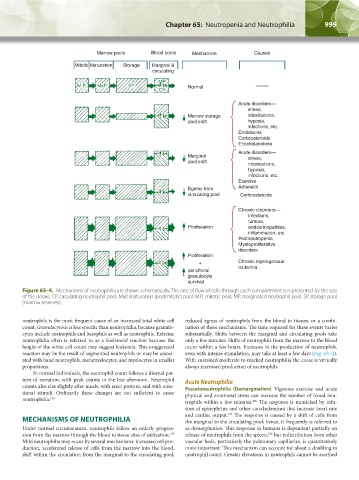
                  Figure 65–4.  Mechanisms of neutrophilia are shown schematically. The rate of flow of cells through each compartment is represented by the size
                  of the arrows. CP, circulating neutrophil pool; MaP, maturation (postmitotic) pool; M.P., mitotic pool; MP, marginated neutrophil pool; SP, storage pool
                  (marrow reserves).


                  neutrophils is the most frequent cause of an increased total white cell   reduced egress of neutrophils from the blood to tissues, or a combi-
                  count. Granulocytosis is less specific than neutrophilia, because granulo-  nation of these mechanisms. The time required for these events varies
                  cytes include eosinophils and basophils as well as neutrophils. Extreme   substantially. Shifts between the marginal and circulating pools take
                  neutrophilia often is referred to as a  leukemoid reaction because the   only a few minutes. Shifts of neutrophils from the marrow to the blood
                  height of the white cell count may suggest leukemia. This exaggerated   occur within a few hours. Increases in the production of neutrophils,
                  reaction may be the result of segmented neutrophils or may be associ-  even with intense stimulation, may take at least a few days (Fig. 65–4).
                  ated with band neutrophils, metamyelocytes, and myelocytes in smaller   With sustained moderate to marked neutrophilia the cause is virtually
                  proportions.                                          always increased production of neutrophils.
                     In normal individuals, the neutrophil count follows a diurnal pat-
                  tern of variation, with peak counts in the late afternoon. Neutrophil   Acute Neutrophilia
                  counts also rise slightly after meals, with erect posture, and with emo-  Pseudoneutrophilia (Demargination)  Vigorous exercise and acute
                  tional stimuli. Ordinarily these changes are not sufficient to cause   physical and emotional stress can increase the number of blood neu-
                  neutrophilia. 134
                                                                                               136
                                                                        trophils  within  a  few  minutes.   The  response  is  mimicked by  infu-
                                                                        sion of epinephrine and other catecholamines that increase heart rate
                                                                        and cardiac output.  The response is caused by a shift of cells from
                                                                                       137
                    MECHANISMS OF NEUTROPHILIA                          the marginal to the circulating pool; hence, it frequently is referred to
                  Under normal circumstances, neutrophils follow an orderly progres-  as demargination. This response in humans is dependent partially on
                  sion from the marrow through the blood to tissue sites of utilization.    release of neutrophils from the spleen,  but redistribution from other
                                                                                                    138
                                                                   135
                  Mild neutrophilia may occur by several mechanisms: increased cell pro-  vascular beds, particularly the pulmonary capillaries, is quantitatively
                  duction, accelerated release of cells from the marrow into the blood,   more important. This mechanism can account for about a doubling in
                  shift within the circulation from the marginal to the circulating pool,   neutrophil count. Greater elevations in neutrophils cannot be ascribed


          Kaushansky_chapter 65_p0991-1004.indd   999                                                                   9/17/15   6:44 PM

