


Page 1025 - Williams Hematology ( PDFDrive )
P. 1025
1000           Part VII:  Neutrophils, Eosinophils, Basophils, and Mast Cells                                                                                                Chapter 65:  Neutropenia and Neutrophilia           1001


               solely to this mechanism. The increase in lymphocytes, monocytes, and   cell production follows stimulation of cell divisions within the mitotic
               neutrophils that occurs with demargination may be helpful in distin-  precursor pool, that is, divisions of promyelocytes and myelocytes. Sub-
               guishing this type of neutrophilia from the response to infections, pro-  sequently, the size of the postmitotic pool increases. The changes cause
               tracted stress, or glucocorticoid administration. With these conditions,   an increase in the marrow granulocytic to erythroid ratio. In humans,
               neutrophil counts are elevated, but lymphocyte and monocyte counts   the neutrophil production rate increases severalfold with chronic infec-
               generally are depressed.                               tions. Even greater increases may occur in polycythemia vera, chronic
                   Marrow Storage Pool Shift  Acute neutrophilia occurs as a con-  myelogenous leukemia, and leukemoid reactions in response to nonhe-
                                                                                       142
               sequence of release of neutrophils from the marrow storage pool, the   matologic malignancies  and to exogenously administered hematopoi-
                                    139
               marrow neutrophil reserves.   This  mechanism  produces  acute  neu-  etic growth factors such as G-CSF, 140,141  with a maximum response taking
               trophilia  in  response  to  inflammation  and  infections.  The  marrow   at least 1 week to develop.
               reserve pool consists principally of segmented neutrophils and bands.   Neutrophilia resulting from decreased egress from the vascular
               Metamyelocytes are not released to the blood except under extreme   compartment occurs infrequently. A prototype disorder illustrating
               circumstances. The postmitotic  marrow  neutrophil  pool  is  approx-  this mechanism occurs in patients with the neutrophil cell membrane
                                                                                             143
               imately 10 times the size of the blood neutrophil pool, and approx-  defect CD11a/CD18 deficiency.  The neutrophils do not adhere to
                                                                 135
               imately half of these cells are band and segmented neutrophils.     the capillary endothelium normally, but cell production and marrow
               In neutrophil production disorders, chronic inflammatory diseases,   release apparently are normal. Because these patients cannot mobilize
               and malignancies, and with cancer chemotherapy, the size of this   neutrophils to sites of inflammation when they develop infections,
               pool is reduced and the capacity to develop neutrophilia is impaired.    extreme neutrophilia is observed (Chap. 66). Glucocorticoids may pro-
               Exposure of blood to foreign surfaces, such as hemodialysis mem-  duce a functionally similar state, with neutrophils accumulating in the
               branes, activates the complement system and causes transient neu-  blood, at least transiently, after each dose is administered.  In patients
                                                                                                               144
               tropenia, followed by neutrophilia resulting from release of marrow   recovering from infections, as the “tissue demand” for neutrophils
               neutrophils. Colony-stimulating factors (G-CSF and GM-CSF) cause   diminishes, the persistence of neutrophilia may be attributed to this
               acute and chronic neutrophilia by mobilizing cells from the marrow   same mechanism. In chronic myelogenous leukemia, accumulation of
               reserves and stimulating neutrophil production. 140,141  neutrophils with a longer than normal half-life in the blood partially
                                                                      explains the extreme neutrophilia. 145
               Chronic Neutrophilia
               Chronic neutrophilia follows a prolonged stimulus to proliferation of   DISORDERS ASSOCIATED WITH NEUTROPHILIA
               neutrophil precursors. It can be studied experimentally with repeated
               doses of endotoxin, glucocorticoids, or colony-stimulating factors.   Neutrophilia in Response to Inflammation and Stress
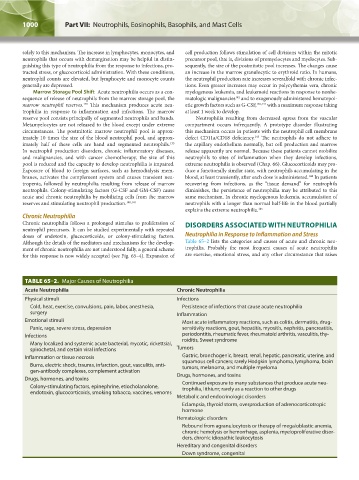
               Although the details of the mediators and mechanisms for the develop-  Table 65–2 lists the categories and causes of acute and chronic neu-
               ment of chronic neutrophilia are not understood fully, a general scheme   trophilia. Probably the most frequent causes of acute neutrophilia
               for this response is now widely accepted (see Fig. 65–4). Expansion of   are exercise, emotional stress, and any other circumstance that raises


                TABLE 65–2.  Major Causes of Neutrophilia
                Acute Neutrophilia                                 Chronic Neutrophilia
                Physical stimuli                                   Infections
                   Cold, heat, exercise, convulsions, pain, labor, anesthesia,      Persistence of infections that cause acute neutrophilia
                  surgery                                          Inflammation
                Emotional stimuli                                     Most acute inflammatory reactions, such as colitis, dermatitis, drug-
                   Panic, rage, severe stress, depression            sensitivity reactions, gout, hepatitis, myositis, nephritis, pancreatitis,
                Infections                                           periodontitis, rheumatic fever, rheumatoid arthritis, vasculitis, thy-
                   Many localized and systemic acute bacterial, mycotic, rickettsial,   roiditis, Sweet syndrome
                  spirochetal, and certain viral infections        Tumors
                Inflammation or tissue necrosis                       Gastric, bronchogenic, breast, renal, hepatic, pancreatic, uterine, and
                   Burns, electric shock, trauma, infarction, gout, vasculitis, anti-  squamous cell cancers; rarely Hodgkin lymphoma, lymphoma, brain
                                                                     tumors, melanoma, and multiple myeloma
                  gen-antibody complexes, complement activation
                Drugs, hormones, and toxins                        Drugs, hormones, and toxins
                   Colony-stimulating factors, epinephrine, etiocholanolone,      Continued exposure to many substances that produce acute neu-
                                                                     trophilia, lithium; rarely as a reaction to other drugs
                  endotoxin, glucocorticoids, smoking tobacco, vaccines, venoms
                                                                   Metabolic and endocrinologic disorders
                                                                      Eclampsia, thyroid storm, overproduction of adrenocorticotropic
                                                                     hormone
                                                                   Hematologic disorders
                                                                      Rebound from agranulocytosis or therapy of megaloblastic anemia,
                                                                     chronic hemolysis or hemorrhage, asplenia, myeloproliferative disor-
                                                                     ders, chronic idiopathic leukocytosis
                                                                   Hereditary and congenital disorders
                                                                     Down syndrome, congenital


          Kaushansky_chapter 65_p0991-1004.indd   1000                                                                  9/17/15   6:44 PM

