


Page 1032 - Williams Hematology ( PDFDrive )
P. 1032
1006  Part VII:  Neutrophils, Eosinophils, Basophils, and Mast Cells  Chapter 66:  Disorders of Neutrophil Function  1007


                                                                   2        3       4

                                                1


                                                                                        Basal membrane
                                                    Stroma
                                                                       Chemokines
                                           MΦ                                             6
                                                                       Bacteria
                                                                                5
                                                                     7
                                        PMN
                                                        Chemokines
                                                                              Prim.
                                                                               gr.  Sec. gr.
                                               T cells
                                                                                       Tert. gr.


                                                                          8


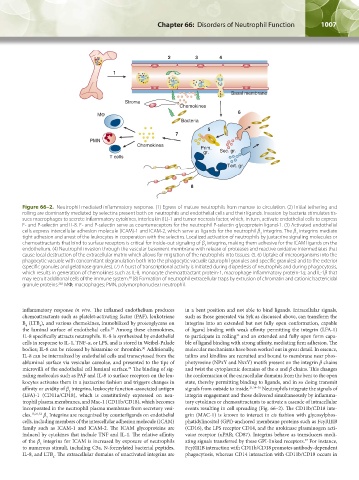
                  Figure 66–2.  Neutrophil-mediated inflammatory response. (1) Egress of mature neutrophils from marrow to circulation. (2) Initial tethering and
                  rolling are dominantly mediated by selectins present both on neutrophils and endothelial cells and their ligands. Invasion by bacteria stimulates tis-
                  sues macrophages to secrete inflammatory cytokines, interleukin (IL)-1 and tumor necrosis factor, which, in turn, activate endothelial cells to express
                  E- and P-selectin and IL-8. E- and P-selectin serve as counterreceptors for the neutrophil P-selectin glycoprotein ligand-1. (3) Activated endothelial
                  cells express intercellular adhesion molecule (ICAM)-1 and ICAM-2, which serve as ligands for the neutrophil β  integrins. The β  integrins mediate
                                                                                                              2
                                                                                                  2
                  tight adhesion and arrest of the leukocytes in cooperation with the selectins. Localized activation of neutrophils by juxtacrine signaling molecules or
                  chemoattractants that bind to surface receptors is critical for inside-out signaling of β  integrins, making them adhesive for the ICAM ligands on the
                                                                               2
                  endothelium. (4) Neutrophil invasion through the vascular basement membrane with release of proteases and reactive oxidative intermediates that
                  cause local destruction of the extracellular matrix which allows for migration of the neutrophils into tissues. (5, 6) Uptake of microorganisms into the
                  phagocytic vacuole with concomitant degranulation both into the phagocytic vacuole (azurophil granules and specific granules) and to the exterior
                  (specific granules and gelatinase granules). (7) A burst of transcriptional activity is initiated during diapedesis of neutrophils and during phagocytosis,
                  which results in generation of chemokines such as IL-8, monocyte chemoattractant protein-1, macrophage inflammatory protein-1α, and IL-1β that
                  may recruit additional cells of the immune system.  (8) Formation of neutrophil extracellular traps by extrusion of chromatin and cationic bactericidal
                                                     58
                  granule proteins.  MΦ, macrophages; PMN, polymorphonuclear neutrophil.
                              262
                  inflammatory  response  in vivo.  The  inflamed  endothelium  produces   in a bent position and not able to bind ligands. Intracellular signals,
                  chemoattractants such as platelet-activating factor (PAF), leukotriene   such as those generated via Syk as discussed above, can transform the
                  B  (LTB ), and various chemokines, immobilized by proteoglycans on   integrins into an extended but not fully open conformation, capable
                        4
                   4
                  the luminal surface of endothelial cells.  Among these chemokines,   of ligand binding with weak affinity permitting the integrin (LFA-1)
                                               29
                  IL-8 specifically attracts neutrophils. IL-8 is synthesized by endothelial   to participate in rolling  and an extended and fully open form capa-
                                                                                          33
                  cells in response to IL-1, TNF-α, or LPS, and is stored in Weibel-Palade   ble of ligand binding with strong affinity, mediating firm adhesion. The
                  bodies; IL-8 can be released by histamine or thrombin.  Additionally,   molecular mechanisms have been worked out in great detail. In essence,
                                                          30
                  IL-8 can be internalized by endothelial cells and transcytosed from the   tailins and kindlins are recruited and bound to membrane near phos-
                  abluminal surface via vesicular caveolae, and presented to the tips of   photyrosine (NPxY and NxxY) motifs present on the integrin β chains
                  microvilli of the endothelial cell luminal surface.  The binding of sig-  and twist the cytoplasmic domains of the α and β chains. This changes
                                                     31
                  naling molecules such as PAF and IL-8 to surface receptors on the leu-  the conformation of the extracellular domains from the bent to the open
                  kocytes activates them in a juxtacrine fashion and triggers changes in   state, thereby permitting binding to ligands, and in so doing transmit
                  affinity or avidity of β  integrins, leukocyte function-associated antigen   signals from outside to inside. 21,34–36  Neutrophils integrate the signals of
                                 2
                  (LFA)-1 (CD11a/CD18), which is constitutively expressed on neu-  integrin engagement and those delivered simultaneously by inflamma-
                  trophil plasma membranes, and Mac-1 (CD11b/CD18), which becomes   tory cytokines or chemoattractants to activate a cascade of intracellular
                  incorporated in the neutrophil plasma membrane from secretory vesi-  events resulting in cell spreading (Fig. 66–2). The CD11b/CD18 inte-
                  cles. 13,21,32  β  Integrins are recognized by counterligands on endothelial   grin (MAC-1) is known to interact in cis fashion with glycosylphos-
                          2
                  cells, including members of the intercellular adhesion molecule (ICAM)   phatidylinositol (GPI)-anchored membrane proteins such as FcγRIIIB
                  family such as ICAM-1 and ICAM-2. The ICAM glycoproteins are   (CD16), the LPS receptor CD14, and the urokinase plasminogen acti-
                  induced by cytokines that include TNF and IL-1. The relative affinity   vator receptor (uPAR; CD87). Integrins behave as transducers medi-
                  of the β  integrins for ICAM is increased by exposure of neutrophils   ating signals transferred by these GPI-linked receptors.  For instance,
                                                                                                                 37
                        2
                  to numerous stimuli, including C5a, N-formylated bacterial peptides,   FcγRIIIB interaction with CD11b/CD18 promotes antibody-dependent
                  IL-8, and LTB . The extracellular domains of unactivated integrins are   phagocytosis, whereas CD14 interaction with CD11b/CD18 occurs in
                            4


          Kaushansky_chapter 66_p1005-1042.indd   1007                                                                  9/21/15   10:47 AM

