


Page 1035 - Williams Hematology ( PDFDrive )
P. 1035
1010           Part VII:  Neutrophils, Eosinophils, Basophils, and Mast Cells                                                                                              Chapter 66:  Disorders of Neutrophil Function         1011


               processed. The MMPs of peroxidase-negative granules are stored as a   Targeting by Biosynthetic Timing
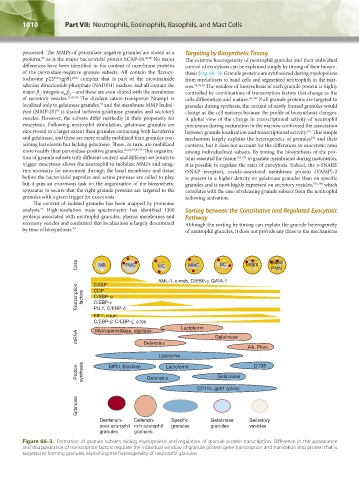
               proform,  as is the major bactericidal protein hCAP-18. 89,90  No major   The extreme heterogeneity of neutrophil granules and their individual
                      88
               differences have been identified in the content of membrane proteins   control of exocytosis can be explained simply by timing of their biosyn-
               of the peroxidase-negative granule subsets. All contain the flavocy-  thesis (Fig. 66–3). Granule proteins are synthesized during myelopoiesis
               tochrome p22 phox /gp91 phox  complex that is part of the nicotinamide   from myeloblasts to band cells and segmented neutrophils in the mar-
               adenine dinucleotide phosphate (NADPH) oxidase, and all contain the   row. 75,76,98  The window of biosynthesis of each granule protein is highly
               major β -integrin α β —and these are even shared with the membrane   controlled by combinations of transcription factors that change as the
                             M 2
                     2
               of secretory vesicles. 32,91,92  The divalent cation transporter  Nramp1 is   cells differentiate and mature. 99,100  If all granule proteins are targeted to
               localized only to gelatinase granules,  and the membrane MMP leukol-  granules during synthesis, the content of newly formed granules would
                                         93
               ysin (MMP-25)  is shared between gelatinase granules and secretory   change as the cell matures because the profile of biosynthesis changes.
                           94
               vesicles. However, the subsets differ markedly in their propensity for   A global view of the change in  transcriptional activity of  neutrophil
               exocytosis. Following neutrophil stimulation, gelatinase granules are   precursors during maturation in the marrow confirmed the association
               exocytosed to a larger extent than granules containing both lactoferrin   between granule localization and transcriptional activity.  This simple
                                                                                                               101
               and gelatinase, and these are more readily mobilized than granules con-  mechanism largely explains the heterogeneity of granules  and their
                                                                                                                102
               taining lactoferrin but lacking gelatinase. These, in turn, are mobilized   contents, but it does not account for the differences in exocytotic rates
               more readily than peroxidase-positive granules. 62,66,79,87,95  This organiza-  among individualized subsets. By timing the biosynthesis of the pro-
               tion of granule subsets with different content and different set points to   teins essential for fusion 103,104  to granule membranes during maturation,
               trigger exocytosis allows the neutrophil to mobilize MMPs and integ-  it is possible to regulate the rates of exocytosis. Indeed, the v-SNARE
               rins necessary for movement through the basal membrane and tissue   (SNAP receptor), vesicle-associated membrane protein (VAMP)-2
               before the bactericidal peptides and serine protease are called to play,   is present in a higher density on gelatinase granules than on specific
               but it puts an enormous task on the organization of the biosynthetic   granules and is most highly expressed on secretory vesicles, 105,106  which
               apparatus to secure that the right granule proteins are targeted to the   correlates with the ease of releasing granule subsets from the neutrophil
               granules with a given trigger for exocytosis.          following activation.
                   The content of isolated granules has been mapped by proteome
                     96
               analysis.  High-resolution mass spectrometry has identified 1300   Sorting between the Constitutive and Regulated Exocytotic
               proteins associated with neutrophil granules, plasma membranes and   Pathway
               secretory vesicles and confirmed that localization is largely determined   Although the sorting by timing can explain the granule heterogeneity
               by time of biosynthesis. 97                            of neutrophil granules, it does not provide any clues to the mechanisms


               Figure 66–3.  Formation of granule subsets during myelopoiesis and regulation of granule protein transcription. Difference in the appearance
               and disappearance of transcription factors regulate the individual window of granule protein gene transcription and translation into protein that is
               targeted to forming granules, explaining the heterogeneity of neutrophil granules.


          Kaushansky_chapter 66_p1005-1042.indd   1010                                                                  9/21/15   10:47 AM

