


Page 1037 - Williams Hematology ( PDFDrive )
P. 1037
1012           Part VII:  Neutrophils, Eosinophils, Basophils, and Mast Cells                                                                                              Chapter 66:  Disorders of Neutrophil Function         1013


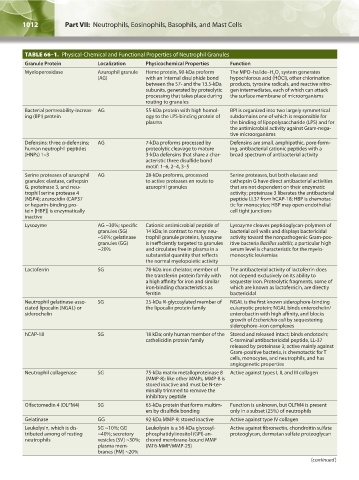
                TABLE 66–1.  Physical-Chemical and Functional Properties of Neutrophil Granules
                Granule Protein          Localization    Physicochemical Properties  Function
                Myeloperoxidase          Azurophil granule   Heme protein, 90-kDa proform   The MPO–halide–H O  system generates
                                                                                                    2
                                                                                                     2
                                         (AG)            with an internal disulphide bond   hypochlorous acid (HOCl), other chlorination
                                                         between the 57- and the 13.5-kDa   products, tyrosine radicals, and reactive nitro-
                                                         subunits, generated by proteolytic   gen intermediates, each of which can attack
                                                         processing that takes place during   the surface membrane of microorganisms
                                                         routing to granules
                Bacterial permeability-increas- AG       55-kDa protein with high homol-  BPI is organized into two largely symmetrical
                ing (BPI) protein                        ogy to the LPS-binding protein of   subdomains one of which is responsible for
                                                         plasma                      the binding of lipopolysaccharide (LPS) and for
                                                                                     the antimicrobial activity against Gram-nega-
                                                                                     tive microorganisms
                Defensins: three α-defensins;   AG       7-kDa proforms processed by   Defensins are small, amphipathic, pore-form-
                human neutrophil peptides                proteolytic cleavage to mature   ing, antibacterial cationic peptides with a
                (HNPs) 1–3                               3-kDa defensins that share a char-  broad spectrum of antibacterial activity
                                                         acteristic three disulfide bond
                                                         motif: 1–6, 2–4, 3–5
                Serine proteases of azurophil   AG       28-kDa proforms, processed   Serine proteases, but both elastase and
                granules: elastase, cathepsin            to active proteases en route to   cathepsin G have direct antibacterial activities
                G, proteinase 3, and neu-                azurophil granules          that are not dependent on their enzymatic
                trophil serine protease 4                                            activity; proteinase 3 liberates the antibacterial
                (NSP4); azurocidin (CAP37                                            peptide LL37 from hCAP-18; HBP is chemotac-
                or heparin-binding pro-                                              tic for monocytes; HBP may open endothelial
                tein [HBP]) is enzymatically                                         cell tight junctions
                inactive
                Lysozyme                 AG ~30%; specific   Cationic antimicrobial peptide of   Lysozyme cleaves peptidoglycan-polymers of
                                         granules (SG)   14 kDa; in contrast to many neu-  bacterial cell walls and displays bactericidal
                                         ~50%; gelatinase   trophil granule proteins, lysozyme   activity toward the nonpathogenic Gram-pos-
                                         granules (GG)   is inefficiently targeted to granules   itive bacteria Bacillus subtilis; a particular high
                                         ~20%            and circulates free in plasma in a   serum level is characteristic for the myelo-
                                                         substantial quantity that reflects   monocytic leukemias
                                                         the normal myelopoietic activity
                Lactoferrin              SG              78-kDa iron chelator; member of   The antibacterial activity of lactoferrin does
                                                         the transferrin protein family with   not depend exclusively on its ability to
                                                         a high affinity for iron and similar   sequester iron. Proteolytic fragments, some of
                                                         iron-binding characteristics as   which are known as lactoferricin, are directly
                                                         ferritin                    bactericidal
                Neutrophil gelatinase-asso-  SG          25-kDa N-glycosylated member of   NGAL is the first known siderophore-binding
                ciated lipocalin (NGAL) or               the lipocalin protein family  eukaryotic protein; NGAL binds enterochelin/
                siderochelin                                                         enterobactin with high affinity, and blocks
                                                                                     growth of Escherichia coli by sequestering
                                                                                     siderophore–iron complexes
                hCAP-18                  SG              18 kDa; only human member of the  Stored and released intact; binds endotoxin;
                                                         cathelicidin protein family  C-terminal antibactericidal peptide, LL-37
                                                                                     released by proteinase 3; active mainly against
                                                                                     Gram-positive bacteria, is chemotactic for T
                                                                                     cells, monocytes, and neutrophils, and has
                                                                                     angiogenetic properties
                Neutrophil collagenase   SG              75-kDa matrix metalloproteinase 8   Active against types I, II, and III collagen
                                                         (MMP-8); like other MMPs, MMP-8 is
                                                         stored inactive and must be N-ter-
                                                         minally trimmed to remove the
                                                         inhibitory peptide
                Olfactomedin 4 (OLFM4)   SG              65-kDa protein that forms multim-  Function is unknown, but OLFM4 is present
                                                         ers by disulfide bonding    only in a subset (25%) of neutrophils
                Gelatinase               GG              92-kDa MMP-9; stored inactive  Active against type IV collagen
                Leukolysin, which is dis-  SG ~10%; GG   Leukolysin is a 56-kDa glycosyl-  Active against fibronectin, chondroitin sulfate
                tributed among of resting   ~40%; secretory   phosphatidylinositol (GPI)-an-  proteoglycan, dermatan sulfate proteoglycan
                neutrophils              vesicles (SV) ~30%;  chored membrane-bound MMP
                                         plasma mem-     (MT6-MMP/MMP-25)
                                         branes (PM) ~20%
                                                                                                                (continued )


          Kaushansky_chapter 66_p1005-1042.indd   1012                                                                  9/21/15   10:48 AM

