


Page 1038 - Williams Hematology ( PDFDrive )
P. 1038
1012  Part VII:  Neutrophils, Eosinophils, Basophils, and Mast Cells  Chapter 66:  Disorders of Neutrophil Function  1013


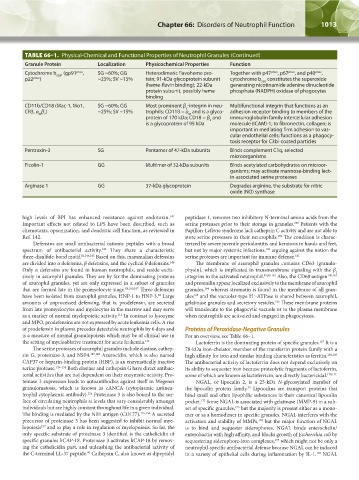
                   TABLE 66–1.  Physical-Chemical and Functional Properties of Neutrophil Granules (Continued)
                   Granule Protein         Localization    Physicochemical Properties  Function
                   Cytochrome b , (gp91 phox ,   SG ~60%; GG   Heterodimeric flavoheme pro-  Together with p47 phox , p67 phox , and p40 phox ,
                             558
                   p22 phox )              ~25%; SV ~15%   tein; 91-kDa glycoprotein subunit   cytochrome b  constitutes the superoxide
                                                                                                  558
                                                           (heme-flavin binding); 22-kDa   generating nicotinamide adenine dinucleotide
                                                           protein subunit, possibly heme   phosphate (NADPH) oxidase of phagocytes
                                                           binding
                   CD11b/CD18 (Mac-1, Mo1,   SG ~60%; GG   Most prominent β -integrin in neu-  Multifunctional integrin that functions as an
                                                                         2
                   CR3, α β )              ~25%; SV ~15%   trophils; CD11B = α  and is a glyco-  adhesion receptor binding to members of the
                       M 2                                                M
                                                           protein of 170 kDa; CD18 = β  and   immunoglobulin family intercellular adhesion
                                                                                 2
                                                           is a glycoprotein of 95 kDa  molecule (ICAM)-1, to fibronectin, collagen; is
                                                                                       important in mediating firm adhesion to vas-
                                                                                       cular endothelial cells; functions as a phagocy-
                                                                                       tosis receptor for C3bi-coated particles
                   Pentraxin-3             SG              Pentamer of 47-kDa subunits  Binds complement C1q, selected
                                                                                       microorganisms
                   Ficolin-1               GG              Multimer of 32-kDa subunits  Binds acetylated carbohydrates on microor-
                                                                                       ganisms; may activate mannose-binding lect-
                                                                                       in-associated serine proteases
                   Arginase 1              GG              37-kDa glycoprotein         Degrades arginine, the substrate for nitric
                                                                                       oxide (NO) synthase


                  high levels of BPI has enhanced resistance against endotoxin.    peptidase 1, removes two inhibitory N-terminal amino acids from the
                                                                   141
                  Important effects not related to LPS have been described, such as   serine proteases prior to their storage in granules.  Patients with the
                                                                                                             158
                  chemotaxis, opsonization, and dendritic cell function, as reviewed in   Papillon-Lefèvre syndrome lack cathepsin C activity and are not able to
                  Ref. 142.                                             store serine proteases in their neutrophils.  The condition is charac-
                                                                                                       159
                     Defensins are small antibacterial cationic peptides with a broad   terized by severe juvenile periodontitis and keratosis in hands and feet,
                  spectrum of antibacterial activity.  They share a characteristic   but not by major systemic infections,  arguing against the notion the
                                            143
                                                                                                   160
                  three-disulfide-bond motif. 82,144,145  Based on this, mammalian defensins   serine proteases are important for immune defense. 161
                  are divided into α defensins, β defensins, and the cyclical θ defensins.    The  membrane  of  azurophil  granules  contains  CD63  (granulo-
                                                                   146
                  Only α defensins are found in human neutrophils, and reside exclu-  physin), which is implicated in transmembrane signaling with the β
                                                                                                                           2
                  sively in azurophil granules. They are by far the dominating proteins   integrins in the activated neutrophil. 85,86,162  Also, the CD68 antigen 100,163
                  of azurophil granules, yet are only expressed in a subset of granules   and presenilin appear localized exclusively to the membrane of azurophil
                  that are formed late in the promyelocyte stage. 83,100,107  Three defensins   granules,  whereas stromatin is found in the membrane of all gran-
                                                                               164
                  have been isolated from azurophil granules, HNP-1 to HNP-3.  Large   ules  and the vacuolar-type H -ATPase is shared between azurophil,
                                                                                               +
                                                                           165
                                                               82
                  amounts of unprocessed defensing, that is, prodefensin, are secreted   gelatinase granules and secretory vesicles.  These membrane proteins
                                                                                                       166
                  from late promyelocytes and myelocytes in the marrow and may serve   will translocate to the phagocytic vacuole or to the plasma membrane
                  as a marker of normal myelopoietic activity.  In contrast to lysozyme   when neutrophils are activated and engaged in phagocytosis.
                                                  111
                  and MPO, prodefensins are not expressed by acute leukemia cells. A rise
                  of prodefensin in plasma precedes detectable neutrophils by 6 days and   Proteins of Peroxidase-Negative Granules
                  is a measure of normal granulopoiesis which may be of clinical use in   For an overview, see Table  66–1.
                  the setting of myeloablative treatment for acute leukemia. 111  Lactoferrin is the dominating protein of specific granules.  It is a
                                                                                                                      167
                     The serine proteases of azurophil granules include elastase, cathep-  78-kDa iron-chelator, member of the transferrin protein family with a
                  sin G, proteinase-3, and NSP4. 147,148  Azurocidin, which is also named   high affinity for iron and similar binding characteristics as ferritin. 168,169
                  CAP37 or heparin-binding protein (HBP), is an enzymatically inactive   The antibacterial activity of lactoferrin does not depend exclusively on
                  serine protease. 149–153  Both elastase and cathepsin G have direct antibac-  its ability to sequester iron because proteolytic fragments of lactoferrin,
                  terial activities that are not dependent on their enzymatic activity. Pro-  some of which are known as lactoferricin, are directly bactericidal. 170,171
                  teinase 3 expression leads to autoantibodies against itself in Wegener   NGAL,  or  lipocalin  2, is  a  25-kDa  N-glycosylated  member of
                  granulomatosis, which is known as cANCA (cytoplasmic antineu-  the lipocalin protein family.  Lipocalins are transport proteins that
                                                                                             79
                  trophil cytoplasmic antibody).  Proteinase 3 is also bound to the sur-  bind small and often lipophilic substances in their canonical lipocalin
                                        154
                  face of circulating neutrophils at levels that vary considerably amongst   pocket.  Some NGAL is associated with gelatinase (MMP-9) in a sub-
                                                                              172
                  individuals but are highly constant throughout life in a given individual.   set of specific granules,  but the majority is present either as a mono-
                                                                                         173
                  The binding is mediated by the NB1 antigen (CD177). 155,156  A secreted   mer or as a homodimer in specific granules. NGAL interferes with the
                  precursor of proteinase 3 has been suggested to inhibit normal mye-  activation and stability of MMPs,  but the major function of NGAL
                                                                                                 174
                  lopoiesis  and to play a role in regulation of myelopoiesis. So far, the   is to bind and sequester siderophores. NGAL binds enterochelin/
                        157
                  only specific substrate of proteinase 3 identified is the cathelicidin of   enterobactin with high affinity, and blocks growth of Escherichia coli by
                  specific granules hCAP-18. Proteinase 3 activates hCAP-18 by remov-  sequestering siderophore-iron complexes,  which might not be only a
                                                                                                      175
                  ing the cathelicidin part, and unleashing the antibacterial activity of   neutrophil-specific antibacterial defense because NGAL can be induced
                  the C-terminal LL-37 peptide.  Cathepsin C, also known as dipeptidyl   in a variety of epithelial cells during inflammation by IL-1.  NGAL
                                        90
                                                                                                                    176
          Kaushansky_chapter 66_p1005-1042.indd   1013                                                                  9/21/15   10:48 AM

