


Page 1040 - Williams Hematology ( PDFDrive )
P. 1040
1014  Part VII:  Neutrophils, Eosinophils, Basophils, and Mast Cells  Chapter 66:  Disorders of Neutrophil Function  1015


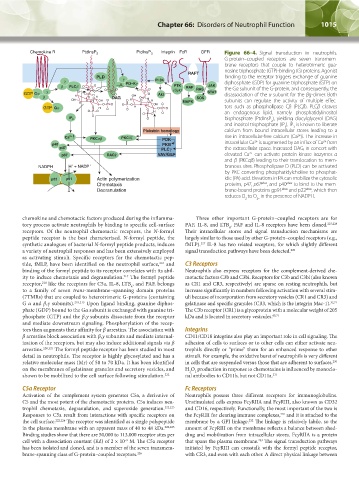
                                                                                      Figure  66–4.  Signal transduction in neutrophils.
                                                                                      G-protein–coupled receptors are seven transmem-
                                                                                      brane receptors that couple to heterotrimeric gua-
                                                                                      nosine triphosphate (GTP)-binding (G) proteins. Agonist
                                                                                      binding to the receptor triggers exchange of guanine
                                                                                      diphosphate (GDP) for guanine triphosphate (GTP) on
                                                                                      the Gα subunit of the G-protein, and consequently, the
                                                                                      disassociation of the α subunit for the βg-dimer. Both
                                                                                      subunits  can  regulate  the  activity  of  multiple  effec-
                                                                                      tors such as phospholipase Cβ (PLCβ). PLCβ cleaves
                                                                                      an endogenous lipid, namely phosphatidylinositol
                                                                                      bisphosphate (PtdInsP ), yielding diacylglycerol (DAG)
                                                                                                     2
                                                                                      and inositol trisphosphate (IP ). IP  is known to liberate
                                                                                                          3
                                                                                                             3
                                                                                      calcium from bound intracellular stores leading to a
                                                                                      rise in intracellular-free calcium (Ca )i. The increase in
                                                                                                              2+
                                                                                                2+
                                                                                      intracellular Ca  is augmented by an influx of Ca  from
                                                                                                                       2+
                                                                                      the extracellular space. Increased DAG, in concert with
                                                                                      elevated Ca  can activate protein kinase isozymes  α
                                                                                              2+
                                                                                      and β (PKCαβ) leading to their translocation to mem-
                                                                                      branous sites. Phospholipase D (PLD) can be activated
                                                                                      by PKC converting phosphatidylcholine to phosphat-
                                                                                      idic (PA) acid. Elevations in PA can mobilize the cytosolic
                                                                                      proteins, p47, p67 phox , and p40 phox  to bind to the mem-
                                                                                      brane-bound proteins gp91 phox  and p22 phox , which then
                                                                                      reduces O  to O  in the presence of NADPH.
                                                                                             2  2–
                  chemokine and chemotactic factors produced during the inflamma-  Three other important G-protein–coupled receptors are for
                  tory process activate neutrophils by binding to specific cell-surface   PAF,  IL-8, and LTB . PAF and IL-8 receptors have been cloned. 227,228
                                                                                       4
                  receptors. Of the neutrophil chemotactic receptors, the  N-formyl   Their intracellular stores and signal transduction mechanisms are
                  peptide receptor is the best characterized.  N-formyl peptide, the   largely similar to those used by other G-protein–coupled receptors (e.g.,
                  synthetic analogues of bacterial N-formyl peptide products, induces   fMLP).  IL-8 has two related receptors, for which slightly different
                                                                              227
                  a variety of neutrophil responses and has been extensively employed   signal transduction pathways have been detected. 229
                  as  activating  stimuli.  Specific  receptors  for  the  chemotactic  pep-
                  tide,  fMLP,  have  been  identified  on  the  neutrophil  surface,   and   C3 Receptors
                                                                216
                  binding of the formyl peptide to its receptor correlates with its abil-  Neutrophils also express receptors for the complement-derived che-
                  ity to induce chemotaxis and degranulation.  The formyl peptide   motactic factors C3b and C3bi. Receptors for C3b and C3bi (also known
                                                    217
                  receptor,  like the receptors for C5a, IL-8, LTB , and PAF, belongs   as CR1 and CR3, respectively) are sparse on resting neutrophils, but
                        218
                                                      4
                  to a family of seven  trans-membrane–spanning domain proteins   increase significantly in numbers following activation with several stim-
                  (7TMRs) that are coupled to heterotrimeric G-proteins (containing   uli because of incorporation from secretory vesicles (CR1 and CR3) and
                  G α and β,γ subunits). 219,213  Upon ligand binding, guanine diphos-  gelatinase and specific granules (CR3, which is the integrin Mac-1). 32,71
                  phate (GDP) bound to the Gα subunit is exchanged with guanine tri-  The C3b receptor (CR1) is a glycoprotein with a molecular weight of 205
                  phosphate (GTP) and the β,γ subunits dissociate from the receptor   kDa and is located in secretory vesicules. 65,71
                  and mediate downstream signaling. Phosphorylation of the recep-
                  tors then augments their affinity for β arrestins. The association with   Integrins
                  β arrestins block association with β,γ subunits and mediate internal-  CD11/CD18 integrins also play an important role in cell signaling. The
                  ization of the receptors, but may also induce additional signals via β   adhesion of cells to surfaces or to other cells can either activate neu-
                  arrestins. 220,221  The formyl peptide receptor has been studied in most   trophils directly or “prime” them for an enhanced response to other
                  detail in neutrophils. The receptor is highly glycosylated and has a   stimuli. For example, the oxidative burst of neutrophils is very different
                  relative molecular mass (Mr) of 50 to 70 kDa. It has been identified   in cells that are suspended versus those that are adherent to surfaces.
                                                                                                                          230
                  on the membranes of gelatinase granules and secretory vesicles, and   H O  production in response to chemotaxins is influenced by monoclo-
                                                                          2
                                                                            2
                  shown to be mobilized to the cell surface following stimulation. 222  nal antibodies to CD11b, but not CD11a. 231
                  C5a Receptor                                          Fc Receptors
                  Activation of the  complement  system  generates  C5a,  a  derivative  of   Neutrophils possess three different receptors for immunoglobulins.
                  C5 and the most potent of the chemotactic proteins. C5a induces neu-  Unstimulated cells express FcγRIIA and FcγRIII, also known as CD32
                  trophil chemotaxis, degranulation, and superoxide generation. 222,223    and CD16, respectively. Functionally, the most important of the two is
                  Responses to C5a result from interactions with specific receptors on   the FcγRIII for clearing immune complexes,  and it is attached to the
                                                                                                        232
                  the cell surface. 222,224  The receptor was identified as a single polypeptide   membrane by a GPI linkage.  The linkage is relatively labile, so the
                                                                                              232
                  in the plasma membrane with an apparent mass of 40 to 48 kDa. 222,225    amount of FcγRIII on the membrane reflects a balance between shed-
                  Binding studies show that there are 50,000 to 113,000 receptor sites per   ding and mobilization from intracellular stores. FcγRIIA is a protein
                  cell with a dissociation constant (Kd) of 2 × 10  M. The C5a receptor   that spans the plasma membrane.  The signal transduction pathways
                                                    –9
                                                                                                 233
                  has been isolated and cloned, and is a member of the seven transmem-  initiated by FcγRIII can crosstalk with the formyl peptide receptor,
                  brane-spanning class of G-protein–coupled receptors. 226  with CR3, and even with each other. A direct physical linkage between


          Kaushansky_chapter 66_p1005-1042.indd   1015                                                                  9/21/15   10:48 AM

