


Page 1046 - Williams Hematology ( PDFDrive )
P. 1046
1020  Part VII:  Neutrophils, Eosinophils, Basophils, and Mast Cells  Chapter 66:  Disorders of Neutrophil Function  1021


                  lungs. S. aureus and Pseudomonas aeruginosa have been the most com-  be observed in thermally injured patients or in individuals with myelo-
                  monly observed pathogens, although Candida albicans also has been   dysplasia. 281,308  Treatment of SGD is symptomatic, with the administra-
                  isolated. Specific granule-deficient neutrophils lack gelatinolytic activity   tion of parenteral antibiotics for acute infections and surgical drainage
                  in the tertiary granules; vitamin B -binding protein, lactoferrin, hCAP-  of refractory infections. With aggressive medical management, patients
                                          12
                  18, and collagenase in the specific granules; and defensins in the pri-  may survive into their adult years.
                  mary granules. 301–303  This disorder also extends to eosinophils that lack
                  the characteristic eosinophil granule proteins: major basic protein, eos-  Adhesion Abnormalities
                  inophilic cationic protein, and eosinophil-derived neurotoxin (Chap.   Leukocyte Adhesion Deficiency
                     304
                  62).  Thus, the disorder is a global defect in phagocytic granules rather   Definition and History  Leukocyte adhesion deficiency type I
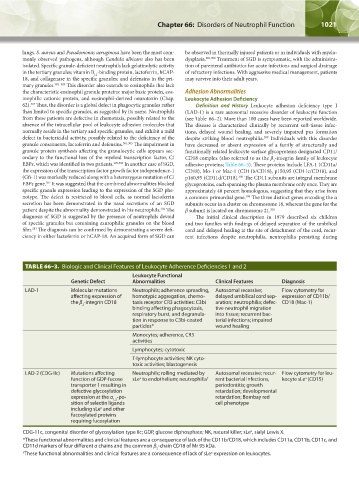
                  than limited to specific granules, as suggested by its name. Neutrophils   (LAD-1) is a rare autosomal recessive disorder of leukocyte function
                  from these patients are defective in chemotaxis, possibly related to the   (see Table  66–2). More than 100 cases have been reported worldwide.
                  absence of the intracellular pool of leukocyte adhesion molecules that   The disease is characterized clinically by recurrent soft-tissue infec-
                  normally reside in the tertiary and specific granules, and exhibit a mild   tions, delayed wound healing, and severely impaired pus formation
                  defect in bactericidal activity, possibly related to the deficiency of the   despite  striking  blood  neutrophilia.   Individuals  with  this  disorder
                                                                                                   309
                  granule constituents, lactoferrin and defensins. 301,305  The impairment in   have decreased or absent expression of a family of structurally and
                  granule protein synthesis affecting the granulocytic cells appears sec-  functionally related leukocyte surface glycoproteins designated CD11/
                  ondary to the functional loss of the myeloid transcription factor, C/  CD18 complex (also referred to as the β -integrin family of leukocyte
                                                                                                      2
                  EBPε, which was identified in two patients. 109,306  In another case of SGD,   adhesive proteins; Table 66–3). These proteins include LFA-1 (CD11a/
                  the expression of the transcription factor growth factor independence-1   CD18), Mo-1 or Mac-1 (CD11b/CD18), p150,95 (CD11c/CD18), and
                  (Gfi-1) was markedly reduced along with a heterozygous mutation of C/  p160,95 (CD11d/CD18).  The CD11 subunits are integral membrane
                                                                                          309
                  EBPε gene.  It was suggested that the combined abnormalities blocked   glycoproteins, each spanning the plasma membrane only once. They are
                          307
                  specific granule expression leading to the expression of the SGD phe-  approximately 40 percent homologous, suggesting that they arise from
                  notype.  The defect is restricted to blood cells, as normal lactoferrin   a common primordial gene.  The three distinct genes encoding the α
                                                                                             309
                  secretion has been demonstrated in the nasal secretions of an SGD   subunits occur in a cluster on chromosome 16, whereas the gene for the
                                                                302
                  patient despite the abnormality demonstrated in his neutrophils.  The   β subunit is located on chromosome 21. 310
                  diagnosis of SGD is suggested by the presence of neutrophils devoid   The initial clinical description in 1979  described six children
                  of specific granules but containing azurophilic granules on the blood   and two families with findings of delayed separation of the umbilical
                  film.  The diagnosis can be confirmed by demonstrating a severe defi-  cord and delayed healing at the site of detachment of the cord, recur-
                     281
                  ciency in either lactoferrin or hCAP-18. An acquired form of SGD can   rent infections despite neutrophilia, neutrophilia persisting during


                   TABLE 66–3.  Biologic and Clinical Features of Leukocyte Adherence Deficiencies 1 and 2
                                                       Leukocyte Functional
                                  Genetic Defect       Abnormalities               Clinical Features     Diagnosis
                   LAD-1          Molecular mutations   Neutrophils; adherence spreading,  Autosomal recessive;   Flow cytometry for
                                  affecting expression of   homotypic aggregation, chemo-  delayed umbilical cord sep- expression of CD11b/
                                  the β -integrin CD18  taxis receptor CR3 activities: C3bi   aration; neutrophilia; defec- CD18 (Mac-1)
                                      2
                                                       binding affecting phagocytosis,   tive neutrophil migration
                                                       respiratory burst, and degranula-  into tissue; recurrent bac-
                                                       tion in response to C3bi-coated   terial infections; impaired
                                                       particles*                  wound healing
                                                       Monocytes; adherence, CR3
                                                       activities
                                                       Lymphocytes; cytotoxic
                                                       T-lymphocyte activities; NK cyto-
                                                       toxic activities; blastogenesis
                   LAD-2 (CDG-IIc)  Mutations affecting   Neutrophils; rolling mediated by   Autosomal recessive; recur-  Flow cytometry for leu-
                                                                                                                 x
                                  function of GDP-fucose   sLe  to endothelium; neutrophilia †  rent bacterial infections,   kocyte sLe  (CD15)
                                                         x
                                  transporter 1 resulting in                       periodontitis; growth
                                  defective glycosylation                          retardation; developmental
                                  expression at the α -po-                         retardation; Bombay red
                                                1,3
                                  sition of selectin ligands                       cell phenotype
                                            x
                                  including sLe  and other
                                  fucosylated proteins
                                  requiring fucosylation
                  CDG-11c, congenital disorder of glycosylation type IIc; GDP, glucose diphosphate; NK, natural killer; sLe , sialyl Lewis X.
                                                                                              x
                  *These functional abnormalities and clinical features are a consequence of lack of the CD11b/CD18, which includes CD11a, CD11b, CD11c, and
                  CD11d markers of four different α chains and the common β -chain CD18 of Mr 95 kDa.
                                                               2
                  † These functional abnormalities and clinical features are a consequence of lack of sLe  expression on leukocytes.
                                                                                 x


          Kaushansky_chapter 66_p1005-1042.indd   1021                                                                  9/21/15   10:48 AM

