


Page 1044 - Williams Hematology ( PDFDrive )
P. 1044
1018  Part VII:  Neutrophils, Eosinophils, Basophils, and Mast Cells  Chapter 66:  Disorders of Neutrophil Function  1019


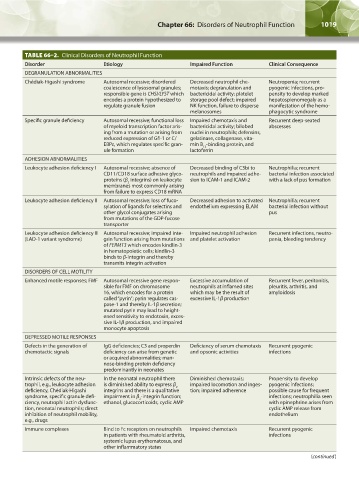
                   TABLE 66–2.  Clinical Disorders of Neutrophil Function
                   Disorder                  Etiology                     Impaired Function         Clinical Consequence
                   DEGRANULATION ABNORMALITIES
                   Chédiak-Higashi syndrome  Autosomal recessive; disordered   Decreased neutrophil che-  Neutropenia; recurrent
                                             coalescence of lysosomal granules;   motaxis; degranulation and   pyogenic infections, pro-
                                             responsible gene is CHSI/LYST which  bactericidal activity; platelet   pensity to develop marked
                                             encodes a protein hypothesized to   storage pool defect; impaired   hepatosplenomegaly as a
                                             regulate granule fusion      NK function, failure to disperse   manifestation of the hemo-
                                                                          melanosomes               phagocytic syndrome
                   Specific granule deficiency  Autosomal recessive; functional loss  Impaired chemotaxis and   Recurrent deep-seated
                                             of myeloid transcription factor aris-  bactericidal activity; bilobed   abscesses
                                             ing from a mutation or arising from   nuclei in neutrophils; defensins,
                                             reduced expression of Gfi-1 or C/  gelatinase, collagenase, vita-
                                             EBPε, which regulates specific gran-  min B -binding protein, and
                                                                              12
                                             ule formation                lactoferrin
                   ADHESION ABNORMALITIES
                   Leukocyte adhesion deficiency I  Autosomal recessive; absence of   Decreased binding of C3bi to   Neutrophilia; recurrent
                                             CD11/CD18 surface adhesive glyco-  neutrophils and impaired adhe-  bacterial infection associated
                                             proteins (β  integrins) on leukocyte   sion to ICAM-1 and ICAM-2  with a lack of pus formation
                                                     2
                                             membranes most commonly arising
                                             from failure to express CD18 mRNA
                   Leukocyte adhesion deficiency II  Autosomal recessive; loss of fuco-  Decreased adhesion to activated  Neutrophilia; recurrent
                                             sylation of ligands for selectins and   endothelium expressing ELAM  bacterial infection without
                                             other glycol conjugates arising                        pus
                                             from mutations of the GDP-fucose
                                             transporter
                   Leukocyte adhesion deficiency III  Autosomal recessive; impaired inte-  Impaired neutrophil adhesion   Recurrent infections, neutro-
                   (LAD-1 variant syndrome)  grin function arising from mutations  and platelet activation  penia, bleeding tendency
                                             of FERMT3 which encodes kindlin-3
                                             in hematopoietic cells; kindlin-3
                                             binds to β-integrin and thereby
                                             transmits integrin activation
                   DISORDERS OF CELL MOTILITY
                   Enhanced motile responses; FMF  Autosomal recessive gene respon-  Excessive accumulation of    Recurrent fever, peritonitis,
                                             sible for FMF on chromosome   neutrophils at inflamed sites   pleuritis, arthritis, and
                                             16, which encodes for a protein   which may be the result of   amyloidosis
                                             called “pyrin”; pyrin regulates cas-  excessive IL-1β production
                                             pase-1 and thereby IL-1β secretion;
                                             mutated pyrin may lead to height-
                                             ened sensitivity to endotoxin, exces-
                                             sive IL-1β production, and impaired
                                             monocyte apoptosis
                   DEPRESSED MOTILE RESPONSES
                   Defects in the generation of    IgG deficiencies; C3 and properdin   Deficiency of serum chemotaxis   Recurrent pyogenic
                   chemotactic signals       deficiency can arise from genetic   and opsonic activities  infections
                                             or acquired abnormalities; man-
                                             nose-binding protein deficiency
                                             predominantly in neonates
                   Intrinsic defects of the neu-  In the neonatal neutrophil there   Diminished chemotaxis;   Propensity to develop
                   trophil, e.g., leukocyte adhesion   is diminished ability to express β    impaired locomotion and inges-  pyogenic infections;
                                                                     2
                   deficiency, Chédiak-Higashi   integrins and there is a qualitative   tion; impaired adherence  possible cause for frequent
                   syndrome, specific granule defi-  impairment in β -integrin function;            infections; neutrophilia seen
                                                         2
                   ciency, neutrophil actin dysfunc-  ethanol, glucocorticoids, cyclic AMP          with epinephrine arises from
                   tion, neonatal neutrophils; direct                                               cyclic AMP release from
                   inhibition of neutrophil mobility,                                               endothelium
                   e.g., drugs
                   Immune complexes          Bind to Fc receptors on neutrophils   Impaired chemotaxis  Recurrent pyogenic
                                             in patients with rheumatoid arthritis,                 infections
                                             systemic lupus erythematosus, and
                                             other inflammatory states
                                                                                                                   (continued )


          Kaushansky_chapter 66_p1005-1042.indd   1019                                                                  9/21/15   10:48 AM

