


Page 1045 - Williams Hematology ( PDFDrive )
P. 1045
1020           Part VII:  Neutrophils, Eosinophils, Basophils, and Mast Cells                                                                                              Chapter 66:  Disorders of Neutrophil Function         1021


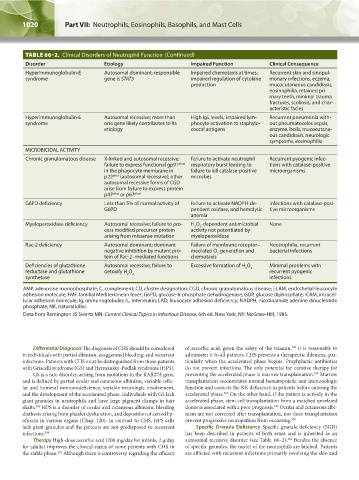
                TABLE 66–2.  Clinical Disorders of Neutrophil Function (Continued)
                Disorder                   Etiology                     Impaired Function         Clinical Consequence
                Hyperimmunoglobulin-E      Autosomal dominant; responsible   Impaired chemotaxis at times;   Recurrent skin and sinopul-
                syndrome                   gene is STAT3                impaired regulation of cytokine   monary infections, eczema,
                                                                        production                mucocutaneous candidiasis,
                                                                                                  eosinophilia, retained pri-
                                                                                                  mary teeth, minimal trauma
                                                                                                  fractures, scoliosis, and char-
                                                                                                  acteristic facies
                Hyperimmunoglobulin-E      Autosomal recessive; more than   High IgE levels, impaired lym-  Recurrent pneumonia with-
                syndrome                   one gene likely contributes to its   phocyte activation to staphylo-  out pneumatoceles sepsis,
                                           etiology                     coccal antigens           enzyme, boils, mucocutane-
                                                                                                  ous candidiasis, neurologic
                                                                                                  symptoms, eosinophilia
                MICROBICIDAL ACTIVITY
                Chronic granulomatous disease  X-linked and autosomal recessive;   Failure to activate neutrophil   Recurrent pyogenic infec-
                                           failure to express functional gp91 phox   respiratory burst leading to   tions with catalase-positive
                                           in the phagocyte membrane in   failure to kill catalase-positive   microorganisms
                                           p22 phox  (autosomal recessive); other   microbes
                                           autosomal recessive forms of CGD
                                           arise from failure to express protein
                                           p47 phox  or p67 phox
                G6PD deficiency            Less than 5% of normal activity of   Failure to activate NADPH-de-  Infections with catalase-posi-
                                           G6PD                         pendent oxidase, and hemolytic   tive microorganisms
                                                                        anemia
                Myeloperoxidase deficiency  Autosomal recessive; failure to pro-  H O -dependent antimicrobial   None
                                                                           2
                                                                         2
                                           cess modified precursor protein    activity not potentiated by
                                           arising from missense mutation  myeloperoxidase
                Rac-2 deficiency           Autosomal dominant; dominant   Failure of membrane receptor–  Neutrophilia, recurrent
                                           negative inhibition by mutant pro-  mediated O  generation and   bacterial infections
                                                                                 2
                                           tein of Rac-2–mediated functions  chemotaxis
                Deficiencies of glutathione   Autosomal recessive; failure to   Excessive formation of H O 2  Minimal problems with
                                                                                          2
                reductase and glutathione   detoxify H O 2                                        recurrent pyogenic
                                                  2
                synthetase                                                                        infections
                AMP, adenosine monophosphate; C, complement; CD, cluster designation; CGD, chronic granulomatous disease; ELAM, endothelial-leukocyte
                adhesion molecule; FMF, familial Mediterranean fever; G6PD, glucose-6-phosphate dehydrogenase; GDP, glucose diphosphate; ICAM, intracel-
                lular adhesion molecule; Ig, immunoglobulin; IL, interleukin; LAD, leukocyte adhesion deficiency; NADPH, nicotinamide adenine dinucleotide
                phosphate; NK, natural killer.
                Data from Remington JS Swartz MN: Current Clinical Topics in Infectious Disease, 6th ed. New York, NY: McGraw-Hill; 1985.


                                                                                                          286
                   Differential Diagnosis The diagnosis of CHS should be considered   of ascorbic acid, given the safety of the vitamin,  it is reasonable to
               in individuals with partial albinism, exaggerated bleeding, and recurrent   administer it to all patients. CHS presents a therapeutic dilemma, par-
               infections. Patients with CHS must be distinguished from those patients   ticularly when the accelerated phase begins. Prophylactic antibiotics
               with Griscelli syndrome (GS) and Hermansky-Pudlak syndrome (HPS).  do not prevent infections. The only potential for curative therapy for
                   GS is a rare disorder, arising from mutations in the RAB27A gene,   preventing the accelerated phase is marrow transplantation.  Marrow
                                                                                                                 299
               and is defined by partial ocular and cutaneous albinism, variable cellu-  transplantation reconstitutes normal hematopoietic and immunologic
               lar and humeral immunodeficiency, variable neurologic involvement,   function and corrects the NK deficiency in patients before entering the
                                                                                   299
               and the development of the accelerated phase. Individuals with GS lack   accelerated phase.  On the other hand, if the patient is actively in the
               giant granules in neutrophils and have large pigment clumps in hair   accelerated phase, stem cell transplantation from a matched unrelated
                                                                                                    299
                    286
               shafts.  HPS is a disorder of ocular and cutaneous albinism, bleeding   donor is associated with a poor prognosis.  Ocular and cutaneous albi-
               diathesis arising from platelet dysfunction, and deposition of ceroid lip-  nism are not corrected after transplantation, nor does transplantation
               ofuscin in various organs (Chap. 120). In contrast to CHS, HPS cells   prevent progressive neuropathies from occurring. 300
               lack giant granules and the patients are not predisposed to recurrent   Specific Granule Deficiency  Specific  granule deficiency (SGD)
               infections. 286                                        has been described in patients of both sexes and is inherited as an
                                                                                                        281
                   Therapy High-dose ascorbic acid (200 mg/day for infants, 2 g/day   autosomal recessive disorder (see Table  66–2).  Besides the absence
               for adults) improves the clinical status of some patients with CHS in   of specific granules, the nuclei of the neutrophils are bilobed. Patients
                           281
               the stable phase.  Although there is controversy regarding the efficacy   are afflicted with recurrent infections primarily involving the skin and


          Kaushansky_chapter 66_p1005-1042.indd   1020                                                                  9/21/15   10:48 AM

