


Page 1127 - Williams Hematology ( PDFDrive )
P. 1127
1102           Part VIII:  Monocytes and Macrophages                                                                                                              Chapter 71:  Inflammatory and Malignant Histiocytosis          1103


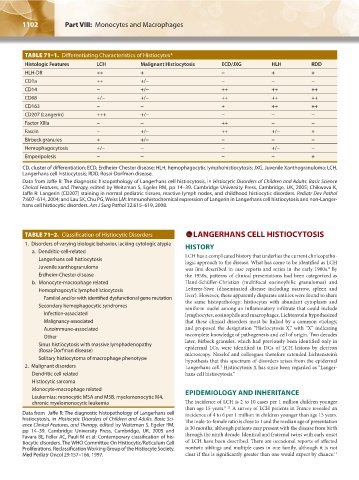
                TABLE 71–1.  Differentiating Characteristics of Histiocytes*
                Histologic Features     LCH            Malignant Histiocytosis    ECD/JXG          HLH          RDD
                HLH-DR                  ++             +                          −                +            +
                CD1a                    ++             +/−                        −                −            −
                CD14                    −              +/−                        ++               ++           ++
                CD68                    +/−            +/−                        ++               ++           ++
                CD163                   −              −                          +                ++           ++
                CD207 (Langerin)        +++            +/−                        −                −            −
                Factor XIIIa            −              −                          ++               −            −
                Fascin                  −              +/−                        ++               +/−          +
                Birbeck granules        +              +/−                        −                −            −
                Hemophagocytosis        +/−            −                          −                +/−          −
                Emperipolesis           −              −                          −                −            +

               CD, cluster of differentiation; ECD, Erdheim-Chester disease; HLH, hemophagocytic lymphohistiocytosis; JXG, Juvenile Xanthogranuloma; LCH,
               Langerhans cell histiocytosis; RDD, Rosai-Dorfman disease.
               Data from Jaffe R: The diagnostic histopathology of Langerhans cell histiocytosis, in Histiocytic Disorders of Children and Adults. Basic Science
               Clinical Features, and Therapy, edited by Weitzman S, Egeler RM, pp 14–39. Cambridge University Press, Cambridge, UK, 2005; Chikwava K,
               Jaffe R: Langerin (CD207) staining in normal pediatric tissues, reactive lymph nodes, and childhood histiocytic disorders. Pediatr Dev Pathol
               7:607–614, 2004; and Lau SK, Chu PG, Weiss LM: Immunohistochemical expression of Langerin in Langerhans cell histiocytosis and non-Langer-
               hans cell histiocytic disorders. Am J Surg Pathol 32:615–619, 2008.


                TABLE 71–2.  Classification of Histiocytic Disorders       LANGERHANS CELL HISTIOCYTOSIS
                1.  Disorders of varying biologic behavior, lacking cytologic atypia  HISTORY
                   a.  Dendritic-cell-related
                     Langerhans cell histiocytosis                    LCH has a complicated history that underlies the current clinicopatho-
                                                                      logic approach to the disease. What has come to be identified as LCH
                     Juvenile xanthogranuloma                         was first described in case reports and series in the early 1900s.  By
                                                                                                                      8
                     Erdheim-Chester disease                          the 1950s, patterns of clinical presentations had been categorized as
                   b.  Monocyte-macrophage related                    Hand-Schüller-Christian (multifocal eosinophilic granulomas) and
                     Hemophagocytic lymphohistiocytosis               Letterer-Siwe (disseminated disease including marrow, spleen and
                       Familial and/or with identified dysfunctional gene mutation  liver). However, these apparently disparate entities were found to share
                                                                      the same histopathology: histiocytes with abundant cytoplasm and
                     Secondary hemophagocytic syndromes               reniform nuclei among an inflammatory infiltrate that could include
                       Infection-associated                           lymphocytes, eosinophils and macrophages. Lichtenstein hypothesized
                       Malignancy-associated                          that these clinical disorders must be linked by a common etiology,
                       Autoimmune-associated                          and proposed the designation “Histiocytosis X,” with “X” indicating
                       Other                                          incomplete knowledge of pathogenesis and cell of origin. Two decades
                     Sinus histiocytosis with massive lymphadenopathy   later, Birbeck granules, which had previously been identified only in
                                                                      epidermal LCs, were identified in DCs of LCH lesions by electron
                     (Rosai-Dorfman disease)                          microscopy. Nezelof and colleagues therefore extended Lichtenstein’s
                     Solitary histiocytoma of macrophage phenotype    hypothesis that this spectrum of disorders arises from the epidermal
                2.  Malignant disorders                               Langerhans cell.  Histiocytosis X has since been regarded as “Langer-
                                                                                  3
                   Dendritic cell related                             hans cell histiocytosis.”
                   Histiocytic sarcoma
                   Monocyte-macrophage related                        EPIDEMIOLOGY AND INHERITANCE
                   Leukemias: monocytic M5A and M5B, myelomonocytic M4,
                   chronic myelomonocytic leukemia                    The incidence of LCH is 2 to 10 cases per 1 million children younger
                                                                      than age 15 years. 9–11  A survey of LCH patients in France revealed an
               Data from  Jaffe R: The diagnostic histopathology of Langerhans cell   incidence of 4 to 6 per 1 million in children younger than age 15 years.
               histiocytosis, in  Histiocytic Disorders of Children and Adults. Basic Sci-  The male-to-female ratio is close to 1 and the median age of presentation
               ence Clinical Features, and Therapy, edited by Weitzman S, Egeler RM,    is 30 months, although patients may present with the disease from birth
               pp 14–39. Cambridge University Press, Cambridge, UK, 2005 and
               Favara BE, Feller AC, Pauli M et al: Contemporary classification of his-  through the ninth decade. Identical and fraternal twins with early onset
               tiocytic disorders. The WHO Committee On Histiocytic/Reticulum Cell   of LCH have been described. There are occasional reports of affected
               Proliferations. Reclassification Working Group of the Histiocyte Society.   nontwin siblings and multiple cases in one family, although it is not
               Med Pediatr Oncol 29:157–166, 1997.                    clear if this is significantly greater than one would expect by chance.
                                                                                                                        12


          Kaushansky_chapter 71_p1101-1120.indd   1102                                                                  9/17/15   3:49 PM

