


Page 1128 - Williams Hematology ( PDFDrive )
P. 1128
1102  Part VIII:  Monocytes and Macrophages          Chapter 71:  Inflammatory and Malignant Histiocytosis           1103


                  The relatively high rate of high-risk multisystem LCH in identical twins   and cytokine and chemokine receptors have been hypothesized to
                  compared to presumed fraternal twins may be explained by shared pre-  play roles in LCH pathogenesis, creating a local “cytokine storm” as
                  cursor cells as well as the possibility of shared genes. An increased fre-  well as increased circulating proinflammatory cytokines, including
                                                    13
                  quency of family members with thyroid disease,  family members with   tumor necrosis factor α, soluble interleukin (IL)-2 receptor α, RANKL
                            14
                                                                    16
                                            15
                  other cancers,  in vitro fertilization,  and parental exposure to metal    (receptor activator of nuclear factor-κB ligand), osteoprotegerin, and
                  have also been reported as potential associations. Although inheritance   osteopontin. 4,30,31  Although MAPK (mitogen-activated protein kinase)
                  of penetrant mendelian “LCH  genes”  in the  majority  of  cases  seems   pathway activation in maturing DCs may drive differentiation of LCH
                  unlikely, it remains possible that there are inherited genes associated   DCs, inflammation likely plays a role in the clinical manifestations and
                  with increased risk of developing LCH.                possibly also in tumor maintenance: A unique phenomenon in LCH
                                                                        is that disruption of solitary LCH lesions often results in spontaneous
                  Molecular Pathology                                   resolution, even without clean margins.
                  The focus of studies and reviews on LCH over the past decades has been
                  on either an immune or a neoplastic disorder. The competing mod-  CLINICAL FEATURES
                  els have been (1) an inappropriate activation of an otherwise normal
                  epidermal LC or (2) a neoplastic transformation of the epidermal LC.   LCH usually presents with a skin rash or painful bone lesion. Systemic
                  Twenty years ago, CD1a+ cells from LCH lesions were described as   symptoms of fever, weight loss, diarrhea, edema, dyspnea, polydipsia,
                  clonal, based on non–random X inactivation. 17,18  Subsequently, somatic   and polyuria may also occur.
                  activating mutations in the BRAF oncogene were reported in 57 percent   In LCH, involvement of specific organs at the time of diagnosis
                                           19
                  of LCH histopathologic specimens,  with subsequent studies validating   determines the designation “high-risk” or “low-risk.” Organs that indi-
                  the recurrent BRAF V600E  mutation at high frequency. 5,20–22  BRAF is the   cate high-risk of progression include liver, spleen, and marrow. Organs
                  central kinase of the RAS/RAF/MEK/ERK pathway, which is essential   that indicate low-risk of progression include skin, bone, lung, lymph
                  to numerous cell functions and is frequently mutated in cancer cells.    nodes, and pituitary gland. Patients may present with disease in one site
                                                                    23
                  Significance of BRAF V600E  as a driver mutation in LCH is supported by   or organ (single site or single system) or in multiple sites or organs (mul-
                  early reports of clinical responses to BRAF inhibition in adults with   tisystem). Treatment decisions for patients are based on whether or not
                  combined LCH and ECD.  Other recurrent somatic mutations in LCH   organs that indicate high-risk or low-risk of progression are involved,
                                    24
                  may be uncovered.                                     and if LCH presents as a single site or as a multisystem disease. Patients
                                                                        can have LCH of the skin, bone, lymph nodes, and pituitary in any com-
                  Cell of Origin                                        bination and still be considered to have a low-risk of progression.
                  The cell of origin of LCH has been assumed to be the epidermal LC
                  based on phenotypic similarities discussed above. However, the tran-  Single-Site Disease Presentation
                  scriptome of CD207+ cells from LCH lesions is more consistent with   In this situation the disease presents with involvement of one site, which
                  an immature myeloid DC phenotype than with the transcriptome of   can be skin, oral mucosa, bone, lymph nodes, pituitary, or thymus.
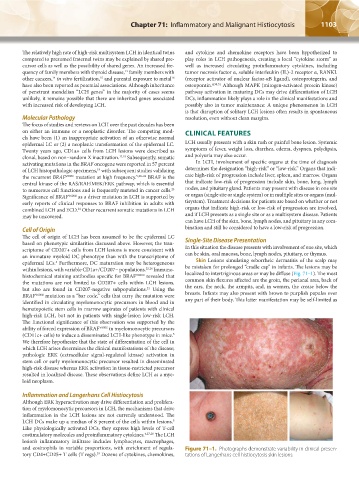
                  epidermal LCs.  Furthermore, DC maturation may be heterogeneous   Skin  Lesions simulating seborrheic dermatitis of the scalp may
                             4
                  within lesions, with variable CD1a+/CD207− populations. 25,26  Immuno-   be mistaken for prolonged “cradle cap” in infants. The lesions may be
                  histochemical staining antibodies specific for BRAF V600E  revealed that   localized to intertriginous areas or may be diffuse (Fig. 71–1). The most
                  the  mutations  are  not  limited  to  CD207+  cells  within  LCH  lesions,   common skin flexures affected are the groin, the perianal area, back of
                  but also are found in CD207-negative subpopulations.  Using the   the ears, the neck, the armpits, and, in women, the crease below the
                                                            21
                  BRAF V600E  mutation as a “bar code,” cells that carry the mutation were   breasts. Infants may also present with brown to purplish papules over
                  identified in circulating myelomonocytic precursors in blood and in   any part of their body. This latter manifestation may be self-limited as
                  hematopoietic stem cells in marrow aspirates of patients with clinical
                  high-risk LCH, but not in patients with single-lesion low-risk LCH.
                  The functional significance of this observation was supported by the
                  ability of forced expression of BRAF V600E  in myelomonocytic precursors
                                                                    5
                  (CD11c+ cells) to induce a disseminated LCH-like phenotype in mice.
                  We therefore hypothesize that the state of differentiation of the cell in
                  which LCH arises determines the clinical manifestations of the disease;
                  pathologic ERK (extracellular signal-regulated kinase) activation in
                  stem cell or early myelomonocytic precursor resulted in disseminated
                  high-risk disease whereas ERK activation in tissue-restricted precursor
                  resulted in localized disease. These observations define LCH as a mye-
                  loid neoplasm.

                  Inflammation and Langerhans Cell Histiocytosis
                  Although ERK hyperactivation may drive differentiation and prolifera-
                  tion of myelomonocytic precursors in LCH, the mechanisms that drive
                  inflammation in the LCH lesions are not currently understood. The
                  LCH DCs make up a median of 8 percent of the cells within lesions.
                                                                    5
                  Like physiologically activated DCs, they express high levels of T-cell
                  costimulatory molecules and proinflammatory cytokines. 4,27,28  The LCH
                  lesion’s inflammatory infiltrate includes lymphocytes, macrophages,
                  and eosinophils in variable proportions, with enrichment of regula-  Figure 71–1.  Photographs demonstrate variability in clinical presen-
                  tory CD4+CD25+ T cells (T regs).  Dozens of cytokines, chemokines,   tations of Langerhans cell histiocytosis skin lesions.
                                           29


          Kaushansky_chapter 71_p1101-1120.indd   1103                                                                  9/17/15   3:49 PM

