


Page 1131 - Williams Hematology ( PDFDrive )
P. 1131
1106           Part VIII:  Monocytes and Macrophages                                                                                                              Chapter 71:  Inflammatory and Malignant Histiocytosis          1107


               higher risk of initial treatment failure, and circulating cells with the   Skull Lesions in the Mastoid, Temporal, Orbital or Base of Skull
               BRAF V600E  mutation to correlate with active disease, though these obser-  Bones (CNS-Risk Lesions) The purpose of treating these patients with
               vations remain to be validated in prospective trials. 5  systemic therapy is to decrease the risk of developing DI. In a large series
                                                                      of patients with CNS-risk lesions who received little or no chemother-
               DIFFERENTIAL DIAGNOSIS                                 apy there was a 20 to 50 percent incidence of DI compared to incidence
                                                                                                                        52
               It is not unusual for infants with LCH skin lesions to have symptoms for   rates of 10 percent in patients treated with systemic chemotherapy.
               longer than 1 year prior to having a diagnostic biopsy.  The varied cuta-  The current standard of care, based on the LCH-III study, is to treat
                                                     34
               neous presentations of LCH may mimic a fungal diaper rash, seborrheic   patients with single or multifocal lesions in CNS risk sites for 12 months
               scalp rash or cradle cap, congenital viral infections, neuroblastoma,   with intravenous vinblastine and oral prednisone: weekly intravenous
                                                                                     2
               contact dermatitis, or psoriasis (see Fig. 71–1). Women or men with   vinblastine (6 mg/m ) for 7 weeks, with daily oral prednisone (40 mg/
                                                                       2
               genital lesions may be thought to have a sexually transmitted disease or   m ) for 4 weeks followed by a 2-week taper. If there is a good response
               other infection. Oral lesions mimic other ulcerative conditions, gingival   by 6 weeks, then vinblastine frequency is decreased to every 3 weeks.
               infections, or dental caries. Copious white or green discharge from the   After the first 6 weeks, oral prednisone is given for 5 days at 40 mg/m   2
               ears resembles otitis externa. Lytic bone lesions are often thought to be   every 3 weeks with the vinblastine intravenous. Patients with subop-
               evidence of a malignancy such as neuroblastoma, rhabdomyosarcoma,   timal responses by 6 weeks are given an additional 6 weeks of weekly
               or Ewing sarcoma. Collapsed vertebrae from LCH may mimic tubercu-  intravenous vinblastine. 39
               losis bone disease, trauma, or osteomyelitis. The interstitial infiltrates   Multiple Bone Lesions or Combinations of Skin, Lymph Node,
               found in LCH patients with pulmonary involvement may resemble a   or Pituitary Gland Involvement with or  Without Bone Lesions
               viral pneumonia. An enlarged thymus or mediastinal lymph nodes can   Patients should be treated for 12 months with intravenous vinblastine
               cause respiratory distress and wheezing similar to asthma. Enlarged   and oral prednisone as outlined for the CNS-risk lesions. Both shorter
               lymph nodes from LCH mimic any infiltrative condition such as lym-  (<6 months) treatment strategies and treatment with only a single agent
               phomas, other histiocytic diseases, infections, or immune-related con-  (e.g., prednisone) are associated with inferior outcomes. A 37 percent
               ditions. Likewise, hepatosplenomegaly of LCH patients can result from   reactivation rate with a two-drug regimen has been reported, versus 50
               the same conditions. Chronic diarrhea in LCH patients may initially   to 80 percent with only surgery or single-drug treatments. 39,53,77
               be considered to be an infectious or inflammatory bowel disease. Iso-  Spleen, Liver, or Marrow (May or May Not Include Skin, Bone,
               lated DI with enlargement of the pituitary may suggest a germinoma,   Lymph Node, or Pituitary Gland Involvement) The standard therapy
               lymphoma, or hypophysitis. LCH should be strongly considered when   used for LCH in high-risk organs (spleen, liver, and/or marrow) is based
               symptoms of other more common conditions do not respond to therapy.  upon the LCH-III results in which oral mercaptopurine was added to
                   Occasionally infiltrates of LC are found in various malignancies   intravenous vinblastine/oral prednisone regimen, outlined for the low-
                                                                                    39
               and as such represent an attempt of the immune system to respond to   risk patients above.  The addition of oral or intravenous methotrexate
               that disease. 65–67  Similarly LCH may be found in the thymus of patients   did not improve the overall survival or risk of reactivation. Another
               with myasthenia gravis. 68                             more intensive regimen (JLSG-96) has been reported that includes
                                                                      intravenous cytarabine, intravenous vincristine, oral prednisolone, and
               TREATMENT                                              methotrexate for good responders or a salvage therapy with intravenous
                                                                      daunorubicin, intravenous cyclophosphamide, intravenous vincristine,
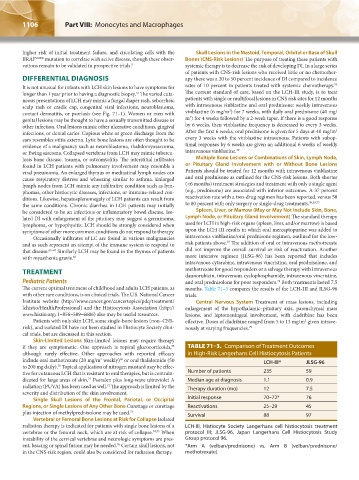
               Pediatric Patients                                     and oral prednisolone for poor responders.  Both treatments lasted 7.5
                                                                                                     78
               The current optimal treatment of childhood and adults LCH patients, as   months. Table 71–3 compares the results of the LCH-III and JLSG-96
               with other rare conditions, is on clinical trials. The U.S. National Cancer   trials.
               Institute website (http://www.cancer.gov/cancertopics/pdq/treatment/  Central Nervous System  Treatment of mass lesions, including
               lchistio/HealthProfessional) and the Histiocytosis Association (http://  enlargement of the hypothalamic–pituitary axis, parenchymal mass
               www.histio.org; 1–856–589–6606) also may be useful resources.  lesions, and leptomeningeal involvement, with cladribine has been
                   Patients with only skin LCH, some single-bone lesions (non–CNS-  effective. Doses of cladribine ranged from 5 to 13 mg/m  given intrave-
                                                                                                              2
               risk), and isolated DI have not been studied in Histiocyte Society clini-  nously at varying frequencies. 79
               cal trials, but are discussed in this section.
                   Skin-Limited Lesions  Skin-limited lesions may require therapy
                                                                 33
               if they are symptomatic. One approach is topical glucocorticoids,    TABLE 71–3.  Comparison of Treatment Outcomes
               although rarely effective. Other approaches with reported efficacy   in High-Risk Langerhans Cell Histiocytosis Patients
                                                69
               include oral methotrexate (20 mg/m  weekly)  or oral thalidomide (50             LCH-III*       JLSG-96
                                          2
                           70
               to 200 mg daily).  Topical application of nitrogen mustard may be effec-
               tive for cutaneous LCH that is resistant to oral therapies, but is contrain-  Number of patients  235  59
                                     71
               dicated for large areas of skin.  Psoralen plus long-wave ultraviolet A   Median age at diagnosis  1.1  0.9
               radiation (PUVA) has been used as well.  The approach is limited by the   Therapy duration (mo)  12  7.5
                                            72
               severity and distribution of the skin involvement.
                   Single Skull Lesions of the Frontal, Parietal, or Occipital   Initial response  70–72*      76
               Regions, or Single Lesions of Any Other Bone Curettage or curettage   Reactivations  25–29      45
               plus injection of methylprednisolone may be used. 73    Survival                 88             97
                   Vertebral or Femoral Bone Lesions at Risk for Collapse Isolated
               radiation therapy is indicated for patients with single bone lesions of a   LCH-III, Histiocyte Society Langerhans cell histiocytosis treatment
               vertebrae or the femoral neck, which are at risk of collapse. 74,75  When   protocol III; JLSG-96, Japan Langerhans Cell Histiocytosis Study
               instability of the cervical vertebrae and neurologic symptoms are pres-  Group protocol 96.
                                               76
               ent, bracing or spinal fusion may be needed.  Certain skull lesions, not   *Arm  A  (velban/prednisone)  vs.  Arm  B  (velban/prednisone/
               in the CNS-risk region, could also be considered for radiation therapy.  methotrexate).


          Kaushansky_chapter 71_p1101-1120.indd   1106                                                                  9/17/15   3:50 PM

