


Page 1206 - Williams Hematology ( PDFDrive )
P. 1206
1180  Part IX:  Lymphocytes and Plasma Cells  Chapter 76:  Functions of T Lymphocytes: T-cell Receptors for Antigen  1181


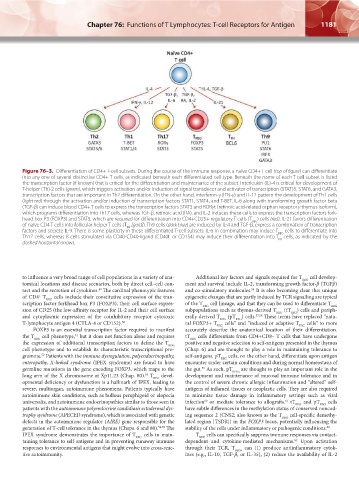
                  Figure 76–3.  Differentiation of CD4+ T-cell subsets. During the course of the immune response, a naïve CD4+ T cell (top of figure) can differentiate
                  into any one of several distinctive CD4+ T cells, as indicated beneath each differentiated cell type. Beneath the name of each T-cell subset is listed
                  the transcription factor (if known) that is critical for the differentiation and maintenance of the subset. Interleukin (IL)-4 is critical for development of
                  T-helper (Th)-2 cells (green), which triggers activation and/or induction of signal transducer and activator of transcription (STAT)5, STAT6, and GATA3,
                  transcription factors that are important in Th2 differentiation. On the other hand, interferon-γ (IFN-γ) and IL-12 pattern the development of Th1 cells
                  (light red) through the activation and/or induction of transcription factors STAT1, STAT4, and T-BET. IL-6 along with transforming growth factor beta
                  (TGF-β) can induce blood CD4+ T cells to express the transcription factors STAT3 and RORγt (retinoic acid-related orphan receptor γ thymus isoform),
                  which programs differentiation into Th17 cells, whereas TGF-β, retinoic acid (RA), and IL-2 induces these cells to express the transcription factors fork-
                  head box P3 (FOXP3) and STAT5, which are required for differentiation into CD4+CD25+ regulatory T cells (T ) cells (red). IL-21 favors differentiation
                                                                                               REG
                  of naïve CD4 T cells into follicular helper T cells (T  [gold]). Th9 cells (dark blue) are induced by IL-4 and TGF-β, express a combination of transcription
                                                     FH
                  factors and secrete IL-9. There is some plasticity in these differentiated T-cell subsets. IL-6 in combination may induce T  cells to differentiate into
                                                                                                        REG
                  Th17 cells, whereas B cells stimulated via CD40-CD40-ligand (CD40L or CD154) may induce their differentiation into T  cells, as indicated by the
                                                                                                        FH
                  dashed horizontal arrows.


                  to influence a very broad range of cell populations in a variety of ana-  Additional key factors and signals required for T REG  cell develop-
                  tomical locations and disease scenarios, both by direct cell–cell con-  ment and survival include IL-2, transforming growth factor-β (TGFβ)
                  tact and the secretion of cytokines.  The cardinal phenotypic features   and co-stimulatory molecules.  It is also becoming clear that unique
                                           49
                                                                                               56
                  of CD4  T REG  cells include their constitutive expression of the tran-  epigenetic changes that are partly induced by TCR signalling are typical
                       +
                  scription factor forkhead box P3 (FOXP3), their cell surface expres-  of the T REG  cell lineage, and that they can be used to differentiate T REG
                  sion of CD25 (the low-affinity receptor for IL-2 and their cell surface    subpopulations such as thymus-derived T REG  (tT REG ) cells and periph-
                  and cytoplasmic expression of the coinhibitory receptor cytotoxic   erally derived T REG  (pT REG ) cells. 57,58  These terms have replaced “natu-
                  T-lymphocyte antigen 4 (CTLA-4 or CD152). 50          ral FOXP3+ T REG  cells” and “induced or adaptive T REG  cells” to more
                     FOXP3 is an essential transcription factor required to manifest   accurately describe the anatomical location of their differentiation.
                  the T REG  cell phenotype,  but it does not function alone and requires   tT REG  cells differentiate from CD4+CD8– T cells that have undergone
                                   51
                  the expression of additional transcription factors to define the T REG    positive and negative selection to self-antigens presented in the thymus
                  cell phenotype and to establish its characteristic transcriptional pro-  (Chap. 6) and are thought to play a role in maintaining tolerance to
                  gramme.  Patients with the immune dysregulation, polyendocrinopathy,   self-antigens. pT REG  cells, on the other hand, differentiate upon antigen
                        52
                  enteropathy, X-linked syndrome (IPEX syndrome) are found to have   encounter under certain conditions and during normal homeostasis of
                  germline mutations in the gene encoding FOXP3, which maps to the   the gut.  As such, pT REGs  are thought to play an important role in the
                                                                              59
                  long arm of the X chromosome at Xp11.23 (Chap. 80).  T REG  devel-  development and maintenance of mucosal immune tolerance and in
                                                           53
                  opmental deficiency or dysfunction is a hallmark of IPEX, leading to   the control of severe chronic allergic inflammation and “altered” self-
                  severe, multiorgan, autoimmune phenomena. Patients typically have   antigens of inflamed tissues or neoplastic cells. They are also required
                  autoimmune skin conditions, such as bullous pemphigoid or alopecia   to minimize tissue damage in inflammatory settings such as viral
                  universalis, and autoimmune endocrinopathies similar to those seen in   infection  or mediate tolerance to allografts.  tT REG  and pT REG  cells
                                                                               60
                                                                                                          61
                  patients with the autoimmune polyendocrine candidiasis ectodermal dys-  have subtle differences in the methylation status of conserved noncod-
                  trophy syndrome (APECED syndrome), which is associated with genetic   ing sequence 2 (CNS2; also known as the T REG  cell-specific demethy-
                  defects in the autoimmune regulator (AIRE) gene responsible for the   lated region [TSDR]) in the FOXP3 locus, potentially influencing the
                  generation of T-cell tolerance in the thymus (Chaps. 6 and 80). 54,55  The   stability of the cells under inflammatory or pathogenic conditions. 62
                  IPEX syndrome demonstrates the importance of T REG  cells in main-  T REG  cells can specifically suppress immune responses via contact-
                  taining tolerance to self-antigens and in preventing runaway immune   dependent and cytokine-mediated mechanisms.  Upon activation
                                                                                                             63
                  responses to environmental antigens that might evolve into cross-reac-  through their TCR, T REGs  can (1) produce antiinflammatory cytok-
                  tive autoimmunity.                                    ines (e.g., IL-10, TGF-β, or IL-35), (2) reduce the availability of IL-2


          Kaushansky_chapter 76_p1175-1188.indd   1181                                                                  9/17/15   4:01 PM

