


Page 1228 - Williams Hematology ( PDFDrive )
P. 1228
1202  Part IX:  Lymphocytes and Plasma Cells             Chapter 79:  Lymphocytosis and Lymphocytopenia              1203


                           A                                    B                          C


                           D                             E                           F
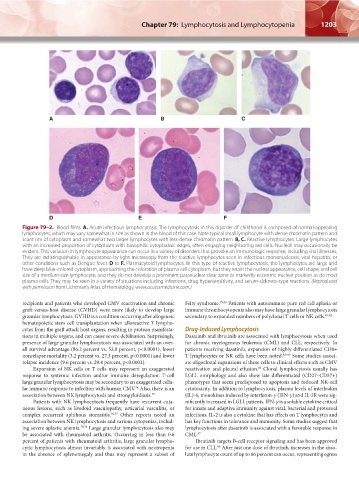
                  Figure 79–2.  Blood films. A. Acute infectious lymphocytosis. The lymphocytosis in this disorder of childhood is composed of normal-appearing
                  lymphocytes, which may vary somewhat in size as shown in the blood of this case. Note typical small lymphocyte with dense chromatin pattern and
                  scant rim of cytoplasm and somewhat two larger lymphocytes with less-dense chromatin pattern. B, C. Reactive lymphocytes. Large lymphocytes
                  with an increased proportion of cytoplasm with basophilic cytoplasmic edges, often engaging neighboring red cells. Nucleoli may occasionally be
                  evident. This variation in lymphocyte appearance can occur in a variety of disorders that provoke an immunologic response, including viral illnesses.
                  They are indistinguishable in appearance by light microscopy from the reactive lymphocytes seen in infectious mononucleosis, viral hepatitis, or
                  other conditions such as Dengue fever. D to F. Plasmacytoid lymphocytes. In this type of reactive lymphocytosis, the lymphocytes are large and
                  have deep blue-colored cytoplasm, approaching the coloration of plasma cell cytoplasm, but they retain the nuclear appearance, cell shape, and cell
                  size of a medium-size lymphocyte, and they do not develop a prominent paranuclear clear zone or markedly eccentric nuclear position as do most
                  plasma cells. They may be seen in a variety of situations including infections, drug hypersensitivity, and serum-sickness-type reactions. (Reproduced
                  with permission from Lichtman’s Atlas of Hematology, www.accessmedicine.com.)

                  recipients and patients who developed CMV reactivation and chronic   Felty syndrome. 79,80  Patients with autoimmune pure red cell aplasia or
                  graft-versus-host disease (GVHD) were more likely to develop large   immune thrombocytopenia also may have large granular lymphocytosis
                  granular lymphocytosis. GVHD is a condition occurring after allogeneic   secondary to expanded numbers of polyclonal T cells or NK cells. 81,82
                  hematopoietic stem cell transplantation when alloreactive T lympho-
                  cytes from the graft attack host organs, resulting in protean manifesta-  Drug-Induced Lymphocytosis
                  tions in multiple organs, and can cause severe debilitation. Surprisingly,   Dasatinib and ibrutinib are associated with lymphocytosis when used
                  presence of large granular lymphocytosis was associated with an over-  for  chronic  myelogenous  leukemia  (CML)  and  CLL,  respectively.  In
                  all survival advantage (86.2 percent vs. 53.8 percent, p<0.0001), lower   patients receiving dasatinib, expansion of highly differentiated CD8+
                  nonrelapse mortality (3.2 percent vs. 27.3 percent, p<0.0001) and lower   T lymphocytes or NK cells have been noted. 83–85  Some studies associ-
                  relapse incidence (9.6 percent vs. 29.4 percent, p<0.0001).  ate oligoclonal expansions of these cells to clinical effects such as CMV
                     Expansion  of  NK  cells  or  T  cells  may  represent  an  exaggerated   reactivation and pleural effusion.  Clonal lymphocytosis usually has
                                                                                                 86
                  response to systemic infection and/or immune deregulation. T-cell   LGLL morphology and also show late differentiated (CD27–CD57+)
                  large granular lymphocytosis may be secondary to an exaggerated cellu-  phenotypes that seem predisposed to apoptosis and reduced NK-cell
                  lar immune response to infection with human CMV.  Also, there is an   cytotoxicity. In addition to lymphocytosis, plasma levels of interleukin
                                                        74
                  association between NK lymphocytosis and strongyloidiasis. 75  (IL)-6, monokines induced by interferon-γ (IFN-γ) and IL-2R were sig-
                     Patients with NK lymphocytosis frequently have recurrent cuta-  nificantly increased in LGLL patients. IFN-γ is a soluble cytokine critical
                  neous lesions, such as livedoid vasculopathy, urticarial vasculitis, or   for innate and adaptive immunity against viral, bacterial and protozoal
                  complex  recurrent  aphthous  stomatitis. 76,77   Other  reports  noted  an   infections. IL-2 is also a cytokine that has effects on T lymphocytes and
                  association between NK lymphocytosis and various cytopenias, includ-  has key functions in tolerance and immunity. Some studies suggest that
                  ing severe aplastic anemia. 70,78  Large granular lymphocytosis also may   lymphocytosis after dasatinib is associated with a favorable response in
                  be associated with rheumatoid arthritis. Occurring in less than 0.6   CML. 87
                  percent of patients with rheumatoid arthritis, large granular lympho-  Ibrutinib targets B-cell receptor signaling and has been approved
                  cytic  lymphocytosis  almost invariably is associated with  neutropenia   for use in CLL.  After just one dose of ibrutinib, increases in the abso-
                                                                                   88
                  in the absence of splenomegaly and thus may represent a subset of   lute lymphocyte count of up to 66 percent can occur, representing egress


          Kaushansky_chapter 79_p1199-1210.indd   1203                                                                  9/17/15   4:07 PM

