


Page 1230 - Williams Hematology ( PDFDrive )
P. 1230
1204  Part IX:  Lymphocytes and Plasma Cells             Chapter 79:  Lymphocytosis and Lymphocytopenia              1205


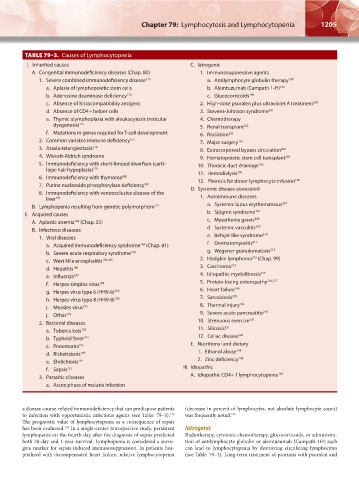
                   TABLE 79–3.  Causes of Lymphocytopenia
                   I.  Inherited causes                                   C.  Iatrogenic
                     A.  Congenital immunodeficiency diseases (Chap. 80)     1.  Immunosuppressive agents
                       1.  Severe combined immunodeficiency disease 175         a.  Antilymphocyte globulin therapy 198
                          a.  Aplasia of lymphopoietic stem cells               b.  Alemtuzumab (Campath 1-H) 199
                          b.  Adenosine deaminase deficiency 176                c.  Glucocorticoids 198
                          c.  Absence of histocompatibility antigens         2.  High-dose psoralen plus ultraviolet A treatment 200
                          d.  Absence of CD4+ helper cells                   3.  Stevens-Johnson syndrome 201
                          e.  Thymic alymphoplasia with aleukocytosis (reticular   4.  Chemotherapy
                            dysgenesis) 177                                  5.  Renal transplant 202
                          f.  Mutations in genes required for T-cell development  6.  Radiation 203
                       2.  Common variable immune deficiency 154             7.  Major surgery 116
                       3.  Ataxia-telangiectasia 178                         8.  Extracorporeal bypass circulation 204
                       4.  Wiskott-Aldrich syndrome                          9.  Hematopoietic stem cell transplant 205
                       5.  Immunodeficiency with short-limbed dwarfism (carti-  10.   Thoracic duct drainage 139
                          lage-hair hypoplasia) 179                          11.   Hemodialysis 206
                       6.  Immunodeficiency with thymoma 180                 12.   Pheresis for donor lymphocyte infusion 140
                       7.  Purine nucleoside phosphorylase deficiency 181  D.  Systemic disease associated
                       8.  Immunodeficiency with venoocclusive disease of the
                          liver 182                                          1.  Autoimmune diseases
                     B.  Lymphopenia resulting from genetic polymorphism 121    a.  Systemic lupus erythematosus 207
                   II.  Acquired causes                                         b.  Sjögren syndrome 142
                     A.  Aplastic anemia  (Chap. 35)                            c.  Myasthenia gravis 208
                                   183
                     B.  Infectious diseases                                    d.  Systemic vasculitis 209
                       1.  Viral diseases                                       e.  Behçet-like syndrome 210
                          a.  Acquired immunodeficiency syndrome  (Chap. 81)    f.  Dermatomyositis 211
                                                         184
                          b.  Severe acute respiratory syndrome 128             g.  Wegener granulomatosis 212
                                                                                               213
                          c.  West Nile encephalitis 158,185                 2.  Hodgkin lymphoma  (Chap. 99)
                          d.  Hepatitis 186                                  3.  Carcinoma 214
                          e.  Influenza 187                                  4.  Idiopathic myelofibrosis 215
                          f.  Herpes simplex virus 188                       5.  Protein-losing enteropathy 216,217
                          g.  Herpes virus type 6 (HHV-6) 189                6.  Heart failure 145
                          h.  Herpes virus type 8 (HHV-8) 190                7.  Sarcoidosis 218
                          i.  Measles virus 191                              8.  Thermal injury 144
                          j.  Other 192                                      9.  Severe acute pancreatitis 219
                       2.  Bacterial diseases                                10.   Strenuous exercise 220
                          a.  Tuberculosis 193                               11.   Silicosis 221
                          b.  Typhoid fever 194                              12.   Celiac disease 222
                          c.  Pneumonia 195                               E.  Nutritional and dietary
                          d.  Rickettsiosis 196                              1.  Ethanol abuse 149
                          e.  Ehrlichiosis 197                               2.  Zinc deficiency 148
                          f.  Sepsis 131                                III.  Idiopathic
                       3.  Parasitic diseases                             A.  Idiopathic CD4+ T lymphocytopenia 153
                          a.  Acute phase of malaria infection


                  a disease course-related immunodeficiency that can predispose patients   (decrease in percent of lymphocytes, not absolute lymphocyte count)
                  to infection with opportunistic infectious agents (see Table   79–3).    was frequently noted. 132
                                                                   130
                  The prognostic value of lymphocytopenia as a consequence of sepsis
                  has been evaluated.  In a single-center retrospective study, persistent   Iatrogenic
                                131
                  lymphopenia on the fourth day after the diagnosis of sepsis predicted   Radiotherapy, cytotoxic chemotherapy, glucocorticoids, or administra-
                  both 28-day and 1-year survival. Lymphopenia is considered a surro-  tion of antilymphocyte globulin or alemtuzumab (Campath-1H) each
                  gate marker for sepsis-induced immunosuppression. In patients hos-  can lead to lymphocytopenia by destroying circulating lymphocytes
                  pitalized with decompensated heart failure, relative lymphocytopenia   (see Table  79–3). Long-term treatment of psoriasis with psoralen and


          Kaushansky_chapter 79_p1199-1210.indd   1205                                                                  9/17/15   4:07 PM

