


Page 1226 - Williams Hematology ( PDFDrive )
P. 1226
1200  Part IX:  Lymphocytes and Plasma Cells             Chapter 79:  Lymphocytosis and Lymphocytopenia              1201


                   TABLE 79–2.  Characteristics of Clinical and Screening Monoclonal B-Cell Lymphocytosis
                                                                       Clinical MBL                  Screening MBL
                   Risk of transformation to CLL-requiring therapy     1–2% per year                 Extremely rare
                   Hematologic followup interval                       6–12 months                   12–18 months
                   Risk of infections                                  Yes                           No
                   Eligible for blood donation                         No                            Yes
                   Eligible for stem-cell donation                     No                            No
                  CLL, chronic lymphocytic leukemia; MBL, monoclonal B-cell lymphocytosis.
                  Adapted with permission from Molica S, Mauro FR, Molica M, et al: Monoclonal B-cell lymphocytosis: a reappraisal of its clinical implications.
                  Leuk Lymphoma  53(9):1660–1665, 2012.


                  genes used by the B cells most commonly have evidence of somatic   selection, suggesting that inappropriate clearance of B cells expressing
                  mutations, implying that the expanded B cells have undergone germinal   low-affinity immunoglobulin receptors plays a role in this disorder. 35
                  center maturation in an immune response(s) to antigen(s). 33,34  Analyses   The cause(s) of this type of lymphocytosis is unknown. Gender
                  of the immunoglobulin variable-region genes expressed by memory-  and genotype may be important in the pathogenesis, as the patients
                  type B cells of patients failed to reveal evidence of positive antigenic   most commonly are young to middle-age women who often are human


                           A                                           B


                           C                                           D
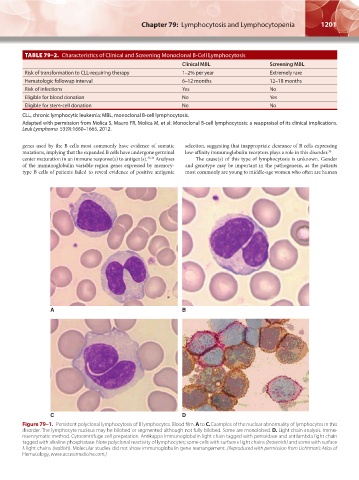
                  Figure 79–1.  Persistent polyclonal lymphocytosis of B lymphocytes. Blood film. A to C. Examples of the nuclear abnormality of lymphocytes in this
                  disorder. The lymphocyte nucleus may be bilobed or segmented although not fully bilobed. Some are monolobed. D. Light chain analysis. Immu-
                  noenzymatic method. Cytocentrifuge cell preparation. Antikappa immunoglobulin light chain tagged with peroxidase and antilambda light chain
                  tagged with alkaline phosphatase. Note polyclonal reactivity of lymphocytes; some cells with surface κ light chains (brownish) and some with surface
                  λ light chains (reddish). Molecular studies did not show immunoglobulin gene rearrangement. (Reproduced with permission from Lichtman’s Atlas of
                  Hematology, www.accessmedicine.com.)


          Kaushansky_chapter 79_p1199-1210.indd   1201                                                                  9/17/15   4:06 PM

