


Page 1225 - Williams Hematology ( PDFDrive )
P. 1225
1200           Part IX:  Lymphocytes and Plasma Cells                                                                                                                Chapter 79:  Lymphocytosis and Lymphocytopenia              1201


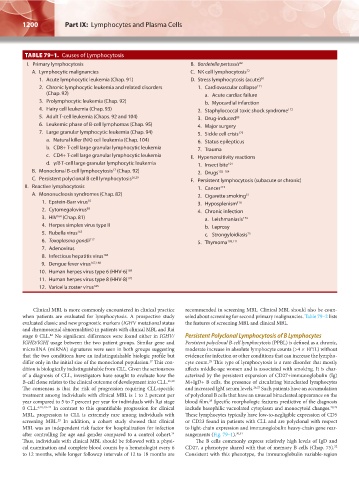
                TABLE 79–1.  Causes of Lymphocytosis
                 I.  Primary lymphocytosis                              B.  Bordetella pertussis 62
                   A.  Lymphocytic malignancies                         C.  NK cell lymphocytosis 72
                     1.  Acute lymphocytic leukemia (Chap. 91)          D.  Stress lymphocytosis (acute) 91
                     2.  Chronic lymphocytic leukemia and related disorders   1.  Cardiovascular collapse 171
                       (Chap. 92)                                            a.  Acute cardiac failure
                     3.  Prolymphocytic leukemia (Chap. 92)                  b.  Myocardial infarction
                     4.  Hairy cell leukemia (Chap. 93)                   2.  Staphylococcal toxic shock syndrome 172
                     5.  Adult T-cell leukemia (Chaps. 92 and 104)        3.  Drug-induced 89
                     6.  Leukemic phase of B-cell lymphomas (Chap. 95)    4.  Major surgery
                     7.  Large granular lymphocytic leukemia (Chap. 94)   5.  Sickle cell crisis 173
                       a.  Natural killer (NK) cell leukemia (Chap. 104)  6.  Status epilepticus
                       b.  CD8+ T-cell large granular lymphocytic leukemia  7.  Trauma
                       c.  CD4+ T-cell large granular lymphocytic leukemia  E.  Hypersensitivity reactions
                       d.  γ/δ T-cell large granular lymphocytic leukemia  1.  Insect bite 101
                   B.  Monoclonal B-cell lymphocytosis  (Chap. 92)        2.  Drugs 102–104
                                              17
                   C.  Persistent polyclonal B cell lymphocytosis 26,29  F.  Persistent lymphocytosis (subacute or chronic)
                II.  Reactive lymphocytosis                               1.  Cancer 112
                   A.  Mononucleosis syndromes (Chap. 82)                 2.  Cigarette smoking 51
                      1.  Epstein-Barr virus 55                           3.  Hyposplenism 116
                      2.  Cytomegalovirus 58                              4.  Chronic infection
                      3.  HIV  (Chap. 81)                                    a.  Leishmaniasis 174
                           164
                      4.  Herpes simplex virus type II                       b.  Leprosy
                      5.  Rubella virus 165                                  c.  Strongyloidiasis 75
                      6.  Toxoplasma gondii 117                           5.  Thymoma 109,111
                      7.  Adenovirus
                      8.  Infectious hepatitis virus 166
                      9.  Dengue fever virus 167,168
                     10.   Human herpes virus type 6 (HHV-6) 169
                     11.   Human herpes virus type 8 (HHV-8) 170
                     12.   Varicella zoster virus 165


                   Clinical MBL is more commonly encountered in clinical practice   recommended in screening MBL. Clinical MBL should also be coun-
               when patients are evaluated for lymphocytosis. A prospective study   seled about screening for second primary malignancies. Table 79–2 lists
               evaluated classic and new prognostic markers (IGHV mutational status   the features of screening MBL and clinical MBL.
               and chromosomal abnormalities) in patients with clinical MBL and Rai
               stage 0 CLL.  No significant differences were found either in IGHV/  Persistent Polyclonal Lymphocytosis of B Lymphocytes
                         16
               IGHD/IGHJ usage between the two patient groups. Similar gene and   Persistent polyclonal B-cell lymphocytosis (PPBL) is defined as a chronic,
               microRNA (miRNA) signatures were seen in both groups suggesting   moderate increase in absolute lymphocyte counts (>4 × 10 /L) without
                                                                                                                9
               that the two conditions have an indistinguishable biologic profile but   evidence for infection or other conditions that can increase the lympho-
               differ only in the initial size of the monoclonal population.  This con-  cyte count.  This type of lymphocytosis is a rare disorder that mostly
                                                          17
                                                                              25
               dition is biologically indistinguishable from CLL. Given the seriousness   affects middle-age women and is associated with smoking. It is char-
               of a diagnosis of CLL, investigators have sought to evaluate how the   acterized by the persistent expansion of CD27+immunoglobulin (Ig)
               B-cell clone relates to the clinical outcome of development into CLL. 16,18    M+IgD+ B cells, the presence of circulating binucleated lymphocytes
               The consensus is that the risk of progression requiring CLL-specific   and increased IgM serum levels. 26,27  Such patients have an accumulation
               treatment among individuals with clinical MBL is 1 to 2 percent per   of polyclonal B cells that have an unusual binucleated appearance on the
               year compared to 5 to 7 percent per year for individuals with Rai stage     blood film.  Specific morphologic features predictive of the diagnosis
                                                                              28
               0 CLL. 6,10,19–22  In contrast to this quantifiable progression for clinical   include basophilic vacuolated cytoplasm and monocytoid changes. 28,29
               MBL, progression to CLL is extremely rare among individuals with   These lymphocytes typically have low-to-negligible expression of CD5
               screening MBL.  In  addition,  a cohort study showed that  clinical   or CD23 found in patients with CLL and are polyclonal with respect
                           23
               MBL was an independent risk factor for hospitalization for infection   to light-chain expression and immunoglobulin heavy-chain gene rear-
               after controlling for age and gender compared to a control cohort.    rangements (Fig. 79–1). 30,31
                                                                 24
               Thus, individuals with clinical MBL should be followed with a physi-  The  B  cells  commonly  express  relatively  high  levels  of  IgD  and
               cal examination and complete blood counts by a hematologist every 6   CD27, a phenotype shared with that of memory B cells (Chap. 75).
                                                                                                                        32
               to 12 months, while longer followup intervals of 12 to 18 months are   Consistent with this phenotype, the immunoglobulin variable-region


          Kaushansky_chapter 79_p1199-1210.indd   1200                                                                  9/17/15   4:06 PM

