


Page 1266 - Williams Hematology ( PDFDrive )
P. 1266
1240  Part IX:  Lymphocytes and Plasma Cells  Chapter 81:  Hematologic Manifestations of Acquired Immunodeficiency Syndrome       1241


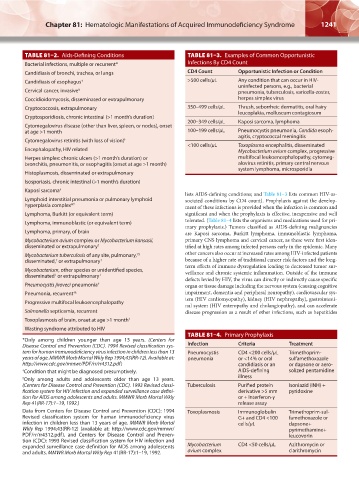
                   TABLE 81–2.  Aids-Defining Conditions                 TABLE 81–3.  Examples of Common Opportunistic
                   Bacterial infections, multiple or recurrent*          Infections By CD4 Count
                   Candidiasis of bronchi, trachea, or lungs             CD4 Count        Opportunistic Infection or Condition
                   Candidiasis of esophagus †                            >500 cells/μL    Any condition that can occur in HIV-
                                                                                          uninfected persons, e.g., bacterial
                   Cervical cancer, invasive §                                            pneumonia, tuberculosis, varicella-zoster,
                   Coccidioidomycosis, disseminated or extrapulmonary                     herpes simplex virus
                   Cryptococcosis, extrapulmonary                        350–499 cells/μL  Thrush, seborrheic dermatitis, oral hairy
                                                                                          leucoplakia, molluscum contagiosum
                   Cryptosporidiosis, chronic intestinal (>1 month’s duration)
                                                                         200–349 cells/μL  Kaposi sarcoma, lymphoma
                   Cytomegalovirus disease (other than liver, spleen, or nodes), onset
                   at age >1 month                                       100–199 cells/μL  Pneumocystis pneumonia, Candida esoph-
                                                                                          agitis, cryptococcal meningitis
                   Cytomegalovirus retinitis (with loss of vision) †
                                                                         <100 cells/μL    Toxoplasma encephalitis, disseminated
                   Encephalopathy, HIV related                                            Mycobacterium avium complex, progressive
                   Herpes simplex: chronic ulcers (>1 month’s duration) or                multifocal leukoencephalopathy, cytomeg-
                   bronchitis, pneumonitis, or esophagitis (onset at age >1 month)        alovirus retinitis, primary central nervous
                                                                                          system lymphoma, microsporidia
                   Histoplasmosis, disseminated or extrapulmonary
                   Isosporiasis, chronic intestinal (>1 month’s duration)
                   Kaposi sarcoma †
                                                                        lists AIDS-defining conditions; and Table 81–3 lists common HIV-as-
                   Lymphoid interstitial pneumonia or pulmonary lymphoid    sociated conditions by CD4 count). Prophylaxis against the develop-
                   hyperplasia complex* †                               ment of these infections is provided when the infection is common and
                   Lymphoma, Burkitt (or equivalent term)               significant and when the prophylaxis is effective, inexpensive and well
                                                                        tolerated. (Table 81–4 lists the organisms and medications used for pri-
                   Lymphoma, immunoblastic (or equivalent term)
                                                                        mary prophylaxis.) Tumors classified as AIDS-defining malignancies
                   Lymphoma, primary, of brain                          are Kaposi sarcoma, Burkitt lymphoma, immunoblastic lymphoma,
                   Mycobacterium avium complex or Mycobacterium kansasii,    primary CNS lymphoma and cervical cancer, as these were first iden-
                   disseminated or extrapulmonary †                     tified at high rates among infected persons early in the epidemic. Many
                   Mycobacterium tuberculosis of any site, pulmonary,     other cancers also occur at increased rates among HIV-infected patients
                                                        †§
                   disseminated,  or extrapulmonary †                   because of a higher rate of traditional cancer risk factors and the long-
                             †
                                                                        term effects of immune dysregulation leading to decreased tumor sur-
                   Mycobacterium, other species or unidentified species,    veillance and chronic systemic inflammation. Outside of the immune
                             †
                   disseminated  or extrapulmonary †
                                                                        defects levied by HIV, the virus can directly or indirectly cause specific
                   Pneumocystis jiroveci pneumonia †                    organ or tissue damage including the nervous system (causing cognitive
                   Pneumonia, recurrent †§                              impairment, dementia and peripheral neuropathy), cardiovascular sys-
                                                                        tem (HIV cardiomyopathy), kidney (HIV nephropathy), gastrointesti-
                   Progressive multifocal leukoencephalopathy
                                                                        nal system (HIV enteropathy and cholangiopathy), and can accelerate
                   Salmonella septicemia, recurrent                     disease progression as a result of other infections, such as hepatitides
                   Toxoplasmosis of brain, onset at age >1 month †
                   Wasting syndrome attributed to HIV
                                                                         TABLE 81–4.  Primary Prophylaxis
                  *Only among children younger than age 13 years.  (Centers  for
                  Disease Control and Prevention (CDC). 1994 Revised classification sys-  Infection  Criteria  Treatment
                  tem for human immunodeficiency virus infection in children less than 13   Pneumocystis   CD4 <200 cells/μL   Trimethoprim-
                  years of age. MMWR Morb Mortal Wkly Rep 1994;43(RR-12). Available at:   pneumonia  or <14% or oral   sulfamethoxazole
                  http://www.cdc.gov/mmwr/PDF/rr/rr4312.pdf)                              candidiasis or an   or dapsone or aero-
                  † Condition that might be diagnosed presumptively.                      AIDS-defining    solized pentamidine
                  § Only among adults and adolescents older than age 13 years.            illness
                  (Centers for Disease Control and Prevention (CDC). 1993 Revised classi-  Tuberculosis  Purified protein   Isoniazid (INH) +
                  fication system for HIV infection and expanded surveillance case defini-  derivative >5 mm   pyridoxine
                  tion for AIDS among adolescents and adults. MMWR Morb Mortal Wkly       or + Interferon-γ
                  Rep 41(RR-17):1–19, 1992.)                                              release assay
                  Data from Centers for Disease Control and Prevention (CDC): 1994   Toxoplasmosis  Immunoglobulin   Trimethoprim-sul-
                  Revised classification system for human immunodeficiency virus          G+ and CD4 <100   famethoxazole or
                  infection in children less than 13 years of age. MMWR Morb Mortal       cells/μL         dapsone+
                  Wkly Rep 1994;43(RR-12) (available at: http://www.cdc.gov/mmwr/                          pyrimethamine+
                  PDF/rr/rr4312.pdf), and Centers for Disease Control and Preven-                          leucovorin
                  tion (CDC): 1993 Revised classification system for HIV infection and
                  expanded surveillance case definition for AIDS among adolescents   Mycobacterium   CD4 <50 cells/μL  Azithromycin or
                  and adults. MMWR Morb Mortal Wkly Rep 41(RR-17):1–19, 1992.  avium complex               clarithromycin


          Kaushansky_chapter 81_p1239-1260.indd   1241                                                                  9/21/15   11:18 AM

