


Page 1268 - Williams Hematology ( PDFDrive )
P. 1268
1242  Part IX:  Lymphocytes and Plasma Cells  Chapter 81:  Hematologic Manifestations of Acquired Immunodeficiency Syndrome       1243


                  reservoir) is the impediment to cure for nearly all HIV-infected peo-  patients, supporting the importance of age-appropriate standard cancer
                  ple. 87,106–109  Although combination ART is highly effective at controlling   screening. 115
                  HIV replication in activated cells, it has no effect on the latent HIV   The Centers for Disease Control estimates that 20 percent of HIV+
                  reservoir, which will persist as long as the cells harboring HIV sur-  people in the United States do not know that they are HIV+,  and
                                                                                                                       116
                  vive. Because most HIV genomes reside in central and effector mem-  HIV testing is strongly recommended in all patients who present to the
                  ory T cells that decay at a negligible rate, there is no possibility of cure   hematologist with NHL, Hodgkin lymphoma, or idiopathic thrombo-
                                                                                                            117
                  with ART alone. The only individual cured of chronic HIV infection     cytopenic purpura (ITP), or other malignancies.  This recommenda-
                  (Timothy Brown, the Berlin patient) developed acute myelogenous leu-  tion is made because approximately 5 percent of those with diffuse large
                  kemia that was treated with high-dose conditioning and transplantation   B-cell lymphoma and 22 percent of patients with Burkitt lymphoma in
                                                              109
                  of HIV-resistant (CCR5D32/D32) allogeneic blood stem cells.  While   the United States are HIV+ (Fig. 81–1). These proportions vary sub-
                                                                                                118
                  this case provides proof-of-principle that the latent HIV reservoir can   stantially by demographic group : among men, 10 percent of those
                  be eliminated by allogeneic hematopoietic cell transplantation, the   with diffuse large B-cell lymphoma are HIV+, in contrast to 1 percent of
                  approach is impractical for widespread application because of the high   women, and approximately 40 percent of those 30 to 59 years old with
                  toxicity associated with this procedure, the morbidity of graft-versus-  Burkitt lymphoma are HIV+. It is important to diagnose HIV infection
                  host disease, and the scarcity of CCR5D32/D32 donors. To date, most   when present, as effective treatment of HIV is essential for successful
                  HIV cure efforts have focused on the strategy of reversing latency with   treatment of the malignancy or ITP.
                  the notion that once resting cells begin producing HIV they will be tar-
                  geted by the immune system or die from apoptosis. However, early stud-  HUMAN IMMUNODEFICIENCY
                  ies suggest that activating latent cells to express HIV does not reliably
                  lead to their death and additional treatments including vaccination to   VIRUS–ASSOCIATED DIFFUSE
                  boost cytotoxic responses will be needed. 109A  Gene therapy is also being   LARGE B-CELL LYMPHOMA
                  pursued as a means to control or cure HIV; specifically, DNA editing   Among HIV+ patients in the United States, diffuse large B-cell lym-
                  enzymes that disrupt CCR5 have been used to eliminate CCR5 expres-  phoma is now more common than Kaposi sarcoma, although Kaposi
                  sion in cells that are then expanded ex vivo and reinfused into patients,   sarcoma remains the most common malignancy in people living with
                  creating a population of HIV-resistant CD4+ T cells. 110,111  HIV  worldwide.   The  pathophysiology  of  diffuse  large B-cell  lym-
                                                                                    118
                                                                        phoma in HIV has been reviewed. 119,120  In a recent case series, HIV+
                       HUMAN IMMUNODEFICIENCY                           patients presented with diffuse large B-cell lymphoma at a median age
                                                                        of 43 years, 2 decades younger than HIV– patients.  Patients often
                                                                                                               121
                     VIRUS–ASSOCIATED MALIGNANCIES                      present with a rapidly growing lymph node or extranodal mass, and
                                                                        frequently have B symptoms (drenching night sweats, fever, or loss of 10
                  When AIDS was first identified as a clinical syndrome it was quickly   percent of body weight). Involvement of extranodal sites, including the
                  appreciated that these patients were at greatly increased risk for cer-  gastrointestinal tract, liver, CNS, lung, and other sites is common. 121,122
                  tain types of malignancies, including Kaposi sarcoma, various types of   Diagnosis is most commonly made by excisional lymph node biopsy.
                  non-Hodgkin lymphoma (NHL), and invasive cervical cancer. Each   Evaluation should include careful examination of all lymph nodes sites,
                  of these AIDS-defining cancers is frequently associated with an onco-  and the oral cavity. Standard staging with positron emission tomogra-
                  genic virus (Table 81–6). As effective ART was developed and patients   phy–computed tomography (PET-CT), marrow evaluation, and lum-
                  began living into their 50s, 60s, and 70s, 112,113  it became apparent that   bar  puncture  for  cerebrospinal fluid cytology  and  flow  cytometry
                                                                                                                          123
                  many non–AIDS-defining malignancies were also more common in   should be performed. Patients should be evaluated for hepatitis B prior
                  this population compared to HIV-uninfected patients. Anal cancer is    to initiation of chemotherapy. If active hepatitis B is found (hepatitis
                  120-fold more common in people living with HIV, particularly   B DNA+), it must be managed in the context of the HIV treatment,
                  among men who have sex with men. Hodgkin lymphoma incidence is   as several commonly used medications for hepatitis B are also active
                  increased approximately 20-fold, hepatocellular cancer fivefold, and the   against HIV. Although initial studies in the pre-ART era focused on
                  risk of lung cancer is increased twofold. In contrast, the risks of other   low-dose chemotherapy,  it is now appreciated that full-dose multi-
                                                                                          124
                  common cancers, including breast cancer, prostate cancer, and colon   agent systemic chemotherapy with appropriate supportive care using
                                                                   114
                  cancer, are not increased in comparison to HIV-negative people.    filgrastim or peg-filgrastim and prophylaxis against infectious com-
                  In the ART era, non–AIDS-defining malignancies comprise approxi-  plications, offers the best chance for permanent cure. Cohort studies
                  mately half of the cancers in people living with HIV, and overall can-  show that the 5-year overall survival in the ART era is far better than
                  cer causes approximately 25 to 33 percent of all deaths in HIV-infected   the pre-ART era.  A National Cancer Institute study using six cycles
                                                                                     125
                                                                        of dose-adjusted etoposide, prednisone, vincristine, cyclophosphamide,
                                                                        and doxorubicin (EPOCH), in which the initial cyclophosphamide dose
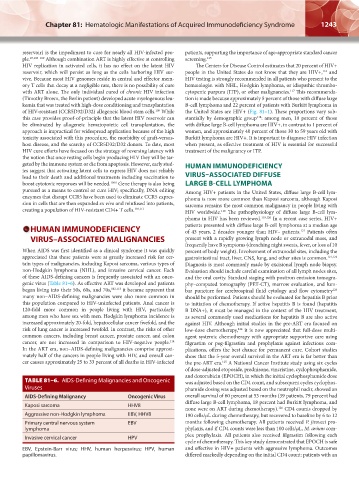
                   TABLE 81–6.  AIDS-Defining Malignancies and Oncogenic   was adjusted based on the CD4 count, and subsequent cycles cyclophos-
                   Viruses                                              phamide dosing was adjusted based on the neutrophil nadir, showed an
                   AIDS-Defining Malignancy          Oncogenic Virus    overall survival of 60 percent at 53 months (39 patients, 79 percent had
                                                                        diffuse large B-cell lymphoma, 18 percent had Burkitt lymphoma, and
                   Kaposi sarcoma                    HHV8
                                                                        none were on ART during chemotherapy).  CD4 counts dropped by
                                                                                                        126
                   Aggressive non-Hodgkin lymphoma   EBV, HHV8          190 cells/μL during chemotherapy, but recovered to baseline by 6 to 12
                   Primary central nervous system    EBV                months following chemotherapy. All patients received P. jiroveci pro-
                   lymphoma                                             phylaxis, and if CD4 counts were less than 100 cells/μL, M. avium com-
                                                                        plex prophylaxis. All patients also received filgrastim following each
                   Invasive cervical cancer          HPV
                                                                        cycle of chemotherapy. This key study demonstrated that EPOCH is safe
                  EBV, Epstein-Barr virus; HHV, human herpesvirus; HPV, human   and effective in HIV+ patients with aggressive lymphoma. Outcomes
                  papillomavirus.                                       differed markedly depending on the initial CD4 count: patients with an


          Kaushansky_chapter 81_p1239-1260.indd   1243                                                                  9/21/15   11:19 AM

