


Page 1265 - Williams Hematology ( PDFDrive )
P. 1265
1240           Part IX:  Lymphocytes and Plasma Cells                                                                                Chapter 81:  Hematologic Manifestations of Acquired Immunodeficiency Syndrome               1241


               needle sharing 0.63 percent, for needle stick 0.23 percent, for receptive   systemic inflammatory state leads to tissue fibrosis over time 43,44  that
               anal intercourse 1.38 percent, for insertive anal intercourse 0.11 percent,   is partly responsible for immune failure and the increased frequency of
               for receptive vaginal intercourse 0.08 percent, and for insertive vaginal   nonimmune, nontraditional chronic diseases that now plague an aging
               intercourse 0.04 percent.  In 2012 there were an estimated 35.3 million   HIV population. 45
                                 20
               people living with HIV, including 2.3 million newly infected persons.
                                                                 21
               Although the global incidence of HIV is thought to have peaked in 1997,     CLINICAL FEATURES AND
               the prevalence of HIV is increasing because of ongoing new infections
               and the shrinking death rate of those already infected and on ART (2.3   DISEASE PROGRESSION
               million deaths in 2005 versus 1.6 million deaths in 2012). The majority   Primary HIV infection that comes to medical attention presents as a
               of HIV-infected persons (approximately 23 million) now live in sub-Sa-  febrile illness that may include headache, pharyngitis, lymphadenopathy,
               haran Africa with 4 million in Asia and Southeast Asia and roughly 3   gastrointestinal symptoms, and rash and may be mistaken for mononu-
               million in the Americas and Caribbean.                 cleosis or other nonspecific viral infections. Key to making the diagnosis
                                                                      is taking a history for HIV risk factors and obtaining appropriate lab-
                  PATHOGENESIS                                        oratory testing (combined HIV Ag/Ab assays and plasma HIV RNA
                                                                      testing). However, in most cases, primary infection goes undiagnosed
               Eighty percent of HIV infections occur via mucosal transmission dur-  and patients are later identified in the chronic, asymptomatic phase of
               ing sex  when cell-free and cell-associated virions transverse the epi-  infection  by  routine  screening  or  later  still,  after  the  development  of
                     22
               thelium to gain access to macrophages, Langerhans cells, dendritic cells,   symptoms that are often caused by opportunistic infections. Typically,
               and CD4-expressing T lymphocytes.  To infect most cells HIV must   the asymptomatic phase of chronic infection will last for 8 to 10 years,
                                          23
               bind to CD4 and one of two major coreceptors (CCR5 or CXCR4); in   although there is great interindividual variation dictated by the effective-
               most cases, CCR5-utilizing viral strains are those that are transmitted   ness of the immune response in controlling HIV replication (the viral
               and predominate early in disease. Rare individuals who do not express   “setpoint,” see above). Long-term nonprogressors (those who maintain
               CCR5 (homozygote for a 32 bp deletion mutation in the CCR5 gene)   CD4+ T-cell counts >500 for 5 years without therapy) and elite controllers
               are highly resistant to HIV infection although they can be infected   (those with low or nondetectable plasma HIV RNA without treatment)
               with isolates utilizing CXCR4. After transmission, low-level replica-  can live for decades with limited or no disease progression, while others
               tion of HIV in tissue macrophages and dendritic cells can occur, but   with high viral setpoints in the range of 100,000 to >1,000,000 copies/
               the key role these cells play is in trapping and trafficking virions and   mL can develop AIDS-defining illnesses quickly after primary infection.
               presenting them to CD4+ T lymphocytes within regional lymphatics   In untreated individuals CD4+ T-cell counts (typically at CD4 counts)
               (e.g., gut-associated lymphoid tissue and lymph nodes where the infec-  typically decline by 50 to 100 cells/μL per year, taking 8 to 10 years before
                            24
               tion is amplified).  High-level viral replication proceeds within these   counts are in the range where symptoms develop (typically at CD4 count
               local tissues leading to profound CD4+ T-cell depletion, establish-  <500 cells/μL) or AIDS-defining illnesses occur (typically at CD4 count
               ment of a reservoir of latently infected memory T cells and eventually   <200 cells/μL). Historically, opportunistic infections provided the first
               to high plasma levels of virus that are the hallmark of acute infection.   evidence for the existence of HIV and remain the most visible mani-
               The immune response to HIV is brisk but ineffective and may, in fact,   festation of infection in countries with limited access to ART and in
               fuel the infection because the expression of inflammatory cytokines    individuals who are diagnosed late in the course of their disease. The
                                                                 25
               and migration of activated CD4+ T cells to the site of HIV-1 concentration   development of opportunistic infections and AIDS-defining conditions
               provides additional activated cells that the virus coopts for its own   is dependent on the virulence properties of the organism and the degree
                        26
               replication.   The  initial antibody response to  HIV  does  not  contain   of host immune suppression. Pathogens with high virulence potential
               neutralizing antibodies; these develop only later, months after chronic   (e.g., Mycobacterium tuberculosis, Salmonella sp., the bacterial agents of
               infection is established. Furthermore, HIV escapes these antibodies by   community-acquired pneumonia) cause disease in patients without HIV
                                                                 27
               mutations within N-glycosylation sites that prevent antibody binding.    and do so in HIV-infected persons regardless of CD4 count (although
               The CD8+ cytotoxic T-lymphocyte (CTL) cell response to HIV controls   more severe and prolonged illness occurs with more profound immu-
               high-level viral replication during primary infection and establishes the   nodeficiency). Agents with more limited pathogenic potential typically
               viral “setpoint” or plasma level of HIV RNA in chronic infection. Evi-  cause disease at lower CD4 counts, for example, P. jiroveci at CD4 counts
               dence for the controlling anti-HIV effect of CD8+ T cells includes their   below 200 cells/μL, while those that rarely cause disease in immunocom-
               detection immediately prior to peak viremia, the development of viral   petent persons, such as disseminated Mycobacterium avium complex,
               escape mutations 28–30  and the requirement for CD8+ T cells to control   Toxoplasma gondii encephalitis, and JC virus (the agent of progressive
               SIV infection in Rhesus macaques.  The rate of viral escape mutations   multifocal  leukoencephalopathy), typically occur  only in those with
                                         31
               slows during chronic infection 32,33  and is not associated with further   very advanced HIV disease and CD4 counts less than 100 cells/μL or less
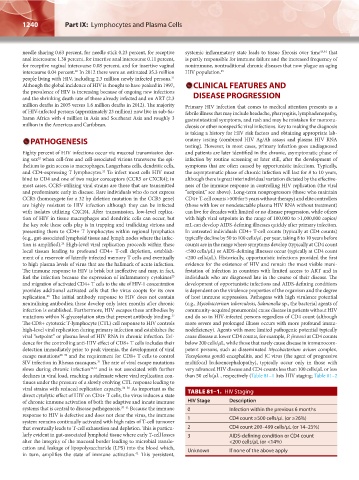
               declines in viral load, reaching a stalemate where viral replication con-  than 50 cells/μL , respectively (Table 81–1 lists HIV staging; Table 81–2
               tinues under the pressure of a slowly evolving CTL response leading to
               viral strains with reduced replication capacity. 34–36  As important as the   TABLE 81–1.  HIV Staging
               direct cytolytic effect of HIV on CD4+ T cells, the virus induces a state
               of chronic immune activation of both the adaptive and innate immune   HIV Stage  Description
               systems that is central to disease pathogenesis. 37–41  Because the immune   0  Infection within the previous 6 months
               response to HIV is defective and does not clear the virus, the immune   1  CD4 count ≥500 cells/μL (or ≥26%)
               system remains continually activated with high rates of T-cell turnover
               that eventually leads to T-cell exhaustion and depletion. This is particu-  2  CD4 count 200–499 cells/μL (or 14–25%)
               larly evident in gut-associated lymphoid tissue where early T-cell losses   3  AIDS-defining condition or CD4 count
               alter the integrity of the mucosal border leading to microbial translo-  <200 cells/μL (or <14%)
               cation and leakage of lipopolysaccharide (LPS) into the blood which,   Unknown  If none of the above apply
               in  turn,  amplifies  the  state  of  immune  activation.   This  persistent,
                                                     42


          Kaushansky_chapter 81_p1239-1260.indd   1240                                                                  9/21/15   11:18 AM

