


Page 1275 - Williams Hematology ( PDFDrive )
P. 1275
1250           Part IX:  Lymphocytes and Plasma Cells                                                                                Chapter 81:  Hematologic Manifestations of Acquired Immunodeficiency Syndrome               1251


               of whom received rituximab, the overall median survival was longer   and multicentric Castleman disease patients, and much higher than in
               than 12 years with therapy; this is much improved in comparison to 20   patients with isolated Kaposi sarcoma. Whether KICS represents a form
               years ago when Castleman disease was rapidly fatal.    fruste of multicentric Castleman disease, part of the clinical spectrum of
                   Incipient flares of Castleman disease may be heralded by cytope-  Castleman disease, or a distinct clinical syndrome requires more inves-
               nias, increased C-reactive protein, or by increased levels of HHV8 in the   tigation. There is scant information on treatment of KICS.
                    216
               blood.  Serial studies of 52 HIV+ patients with multicentric Castleman
               disease showed that approximately 75 percent had elevated C-reactive   HUMAN IMMUNODEFICIENCY
               protein and 90 percent had detectable plasma HHV8 during a flare, with   VIRUS–ASSOCIATED HEMOPHAGOCYTIC
               a median HHV8 viral load of 27,000 copies/mL. HHV8 was detectable
               in 38 percent of patients during remission. If relapse occurs, patients can   SYNDROME
                                        221
               safely be retreated with rituximab.  Up to 20 percent of HIV+ patients   Hemophagocytic syndrome is a rare and potentially fatal disorder char-
               with Castleman disease will develop lymphoma, 208,214  often primary   acterized by excess immune activation that occurs with increased fre-
               effusion lymphoma, plasmablastic lymphoma, or diffuse large B-cell   quency in people living with HIV. An autopsy study in the pre-ART
               lymphoma, but occasionally Hodgkin lymphoma, so it is important   era identified hemophagocytosis in 20 percent of 56 patients who died
               to consider this during followup. Use of rituximab to treat Castleman   of AIDS.  The pathogenesis of the hemophagocytic syndrome results
                                                                            232
                                                    214
               disease may decrease the risk of subsequent NHL.  In HIV+ patients   from failure to regulate the immune response, resulting in excess acti-
               with both Castleman disease and Kaposi sarcoma, Kaposi sarcoma   vation of T lymphocytes, increased cytokine secretion, and hyperac-
               may progress following treatment with rituximab. 218,219,222  When Kaposi   tivation of macrophages. There are primary and secondary forms of
               sarcoma involves a key clinical location such as the lungs, where pro-  hemophagocytic syndrome. Secondary forms can occur in the setting
                                                                                                                     233
               gression might result in significant respiratory compromise, a regimen   of  infection,  hematologic  malignancy,  or  autoimmune  disease.   In
               of rituximab plus liposomal doxorubicin can be considered to address   HIV+ patients, the hemophagocytic syndrome is usually secondary to
                                                       223
               both the Castleman disease flare and Kaposi sarcoma.  R-CHOP or   a viral infection, either HIV itself or, more commonly, a member of the
               other multiagent systemic chemotherapy has also been used to treat   herpes virus family (EBV, CMV, HHV8), but can also occur in patients
                                                                                                             234
               Castleman disease, but given the excellent response to rituximab alone,   with Hodgkin lymphoma, NHL, or Castleman disease.  A study of 58
               R-CHOP is usually not necessary. An alternative therapeutic approach   HIV+ patients with hemophagocytic syndrome performed in the ART
                                                                        234
               focuses on the central role of IL-6. A multiinstitution, randomized,   era  showed that the median duration of HIV at the time of diagnosis
               placebo-controlled clinical trial of an anti–IL-6 monoclonal antibody   was 4 years. Most patients were on ART, and the median CD4 count was
               siltuximab in 79 HIV– patients with Castleman disease showed a 34   91 cells/μL, demonstrating advanced HIV disease. Patients with hemo-
                               224
               percent response rate.  Siltuximab was given IV every 3 weeks and can   phagocytic syndrome are typically very ill: greater than 40 percent of
                                                  225
               be administered long-term (up to 60 months).  Siltuximab is FDA-   the patients in this series required ICU care and 31 percent died within
               approved for treatment of Castleman disease in HIV– patients but not   a year of diagnosis. The clinical features of hemophagocytic syndrome
               in HIV+ patients. Tocilizumab, an anti–IL-6 receptor monoclonal anti-  in HIV+ patients include fever, hepatosplenomegaly, and cytopenias.
               body has been FDA-approved for use in rheumatoid arthritis. Tocili-  Patients often have a markedly elevated ferritin (greater than 10-fold the
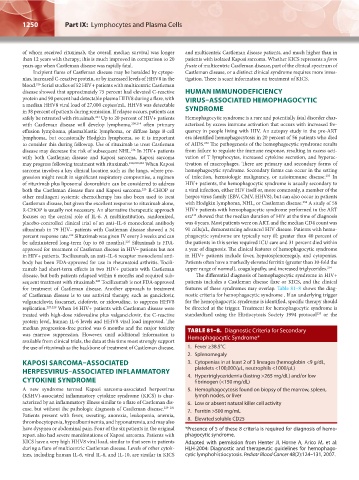
               zumab had short-term effects in two HIV+ patients with Castleman   upper range of normal), coagulopathy, and increased triglycerides. 234
               disease, but both patients relapsed within 6 months and required sub-  The differential diagnosis of hemophagocytic syndrome in HIV+
               sequent treatment with rituximab.  Tocilizumab is not FDA-approved   patients includes a Castleman disease flare or KICS, and the clinical
                                        226
               for treatment of Castleman disease. Another approach to treatment   features of these syndromes may overlap. Table 81–8 shows the diag-
               of Castleman disease is to use antiviral therapy, such as ganciclovir,   nostic criteria for hemophagocytic syndrome . If an underlying trigger
               valganciclovir, foscarnet, cidofovir, or zidovudine, to suppress HHV8   for the hemophagocytic syndrome is identified, specific therapy should
               replication. 227,228  When 14 HIV+ patients with Castleman disease were   be directed at the trigger. Treatment for hemophagocytic syndrome is
               treated with high-dose zidovudine plus valganciclovir, the C-reactive   standardized  using  the  Histiocytosis  Society 1994  protocol   or  the
                                                                                                                  235
               protein level, human IL-6 levels and HHV8 viral load improved. The
               median progression-free period was 6 months and the major toxicity   TABLE 81–8.  Diagnostic Criteria for Secondary
               was marrow suppression. However, until additional information is   Hemophagocytic Syndrome*
               available from clinical trials, the data at this time most strongly support
               the use of rituximab as the backbone of treatment of Castleman disease.  1.  Fever ≥38.5°C
                                                                       2.  Splenomegaly
               KAPOSI SARCOMA–ASSOCIATED                               3.  Cytopenias in at least 2 of 3 lineages (hemoglobin <9 g/dL,
                                                                         platelets <100,000/μL, neutrophils <1000/μL)
               HERPESVIRUS–ASSOCIATED INFLAMMATORY                     4.  Hypertriglyceridemia (fasting >265 mg/dL) and/or low
               CYTOKINE SYNDROME                                         fibrinogen (<150 mg/dL)
               A new syndrome termed Kaposi sarcoma-associated herpesvirus    5.  Hemophagocytosis found on biopsy of the marrow, spleen,
               (KSHV)-associated inflammatory cytokine syndrome (KICS) is char-  lymph nodes, or liver
               acterized by an inflammatory illness similar to a flare of Castleman dis-  6.  Low or absent natural killer cell activity
               ease, but without the pathologic diagnosis of Castleman disease. 229–231    7.  Ferritin >500 mg/mL
               Patients present with fever, sweating, anorexia, leukopenia, anemia,
               thrombocytopenia, hypoalbuminemia, and hyponatremia, and may also   8.  Elevated soluble CD25
               have dyspnea or abdominal pain. Four of the six patients in the original   *Presence of 5 of these 8 criteria is required for diagnosis of hemo-
               report also had severe manifestations of Kaposi sarcoma. Patients with   phagocytic syndrome.
               KICS have a very high HHV8 viral load, similar to that seen in patients   Adapted with permission from Henter JI, Horne A, Arico M, et al:
               during a flare of multicentric Castleman disease. Levels of other cytok-  HLH-2004: Diagnostic and therapeutic guidelines for hemophago-
               ines, including human IL-6, viral IL-6, and IL-10, are similar in KICS   cytic lymphohistiocytosis. Pediatr Blood Cancer 48(2):124–131, 2007.


          Kaushansky_chapter 81_p1239-1260.indd   1250                                                                  9/21/15   11:19 AM

