


Page 1276 - Williams Hematology ( PDFDrive )
P. 1276
1250  Part IX:  Lymphocytes and Plasma Cells  Chapter 81:  Hematologic Manifestations of Acquired Immunodeficiency Syndrome       1251


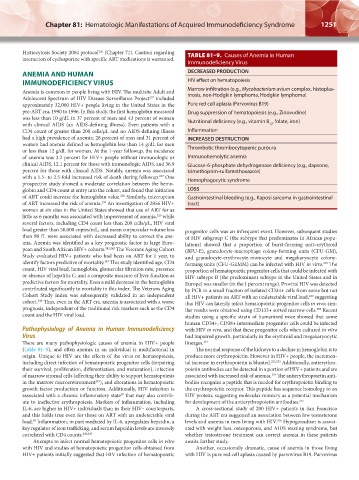
                  Histiocytosis Society 2004 protocol  (Chapter 71). Caution regarding   TABLE 81–9.  Causes of Anemia in Human
                                           236
                  interaction of cyclosporine with specific ART medications is warranted.
                                                                         Immunodeficiency Virus
                  ANEMIA AND HUMAN                                       DECREASED PRODUCTION
                  IMMUNODEFICIENCY VIRUS                                 HIV effect on hematopoiesis
                  Anemia is common in people living with HIV. The multisite Adult and   Marrow infiltration (e.g., Mycobacterium avium complex, histoplas-
                                                                         mosis, non-Hodgkin lymphoma, Hodgkin lymphoma)
                  Adolescent Spectrum of HIV Disease Surveillance Project  included
                                                            237
                  approximately 32,000 HIV+ people living in the United States in the   Pure red cell aplasia (Parvovirus B19)
                  pre-ART era, 1990 to 1996. In this study, the first hemoglobin measured   Drug suppression of hematopoiesis (e.g., Zidovudine)
                  was less than 10 g/dL in 37 percent of men and 43 percent of women   Nutritional deficiency (e.g., vitamin B , folate, iron)
                  with clinical AIDS (an AIDS-defining illness). Even patients with a                12
                  CD4 count of greater than 200 cells/μL and no AIDS-defining illness   Inflammation
                  had a high prevalence of anemia: 28 percent of men and 31 percent of   INCREASED DESTRUCTION
                  women had anemia defined as hemoglobin less than 14 g/dL for men
                  or less than 12 g/dL for women. At the 1-year followup, the incidence   Thrombotic thrombocytopenic purpura
                  of anemia was 3.2 percent for HIV+ people without immunologic or   Immunohemolytic anemia
                  clinical AIDS, 12.1 percent for those with immunologic AIDS, and 36.9   Glucose-6-phosphate dehydrogenase deficiency (e.g., dapsone,
                  percent for those with clinical AIDS. Notably, anemia was associated   trimethoprim-sulfamethoxazole)
                                                                237
                  with a 1.5- to 2.5-fold increased risk of death during followup.  One   Hemophagocytic syndrome
                  prospective study showed a moderate correlation between the hemo-
                  globin and CD4 count at entry into the cohort, and found that initiation   LOSS
                  of ART could increase the hemoglobin value.  Similarly, interruption   Gastrointestinal bleeding (e.g., Kaposi sarcoma in gastrointestinal
                                                   238
                  of ART increased the risk of anemia.  An investigation of 2056 HIV+   tract)
                                            239
                  women at six sites in the United States showed that use of ART for as
                  little as 6 months was associated with improvement of anemia,  while
                                                               240
                  several factors, including CD4 count less than 200 cells/μL, HIV viral
                  load greater than 50,000 copies/mL, and mean corpuscular volume less   progenitor cells was an infrequent event. However, subsequent studies
                  than 80 fL were associated with decreased ability to correct the ane-  of HIV subgroup C (the subtype that predominates in African popu-
                  mia. Anemia was identified as a key prognostic factor in large Euro-  lations) showed that a proportion of burst-forming unit–erythroid
                  pean and South African HIV+ cohorts. 241,242  The Veterans Aging Cohort   (BFU-E), granulocyte-macrophage colony-forming units (CFU-GM),
                  Study evaluated HIV+ patients who had been on ART for 1 year, to   and granulocyte-erythrocyte-monocyte and megakaryocyte colony-
                  identify factors predictive of mortality.  This study identified age, CD4   forming units (CFU-GEMM) can be infected with HIV in vitro.  The
                                             243
                                                                                                                       248
                  count, HIV viral load, hemoglobin, glomerular filtration rate, presence   proportion of hematopoietic progenitor cells that could be infected with
                  or absence of hepatitis C, and a composite measure of liver function as   HIV subtype B (the predominant subtype in the United States and in
                  predictive factors for mortality. Even a mild decrease in the hemoglobin   Europe) was smaller (in the 1 percent range). Proviral HIV was detected
                  contributed significantly to mortality in this index. The Veterans Aging   by PCR in a small fraction of isolated CD34+ cells from some but not
                  Cohort  Study  Index  was  subsequently  validated  in  an  independent   all HIV+ patients on ART with an undetectable viral load,  suggesting
                                                                                                                  249
                       244
                  cohort.  Thus, even in the ART era, anemia is associated with a worse   that HIV can latently infect hematopoietic progenitor cells in vivo; sim-
                  prognosis, independent of the traditional risk markers such as the CD4   ilar results were obtained using CD133+ sorted marrow cells.  Recent
                                                                                                                     250
                  count and the HIV viral load.                         studies using a specific strain of humanized mice showed that some
                                                                        human CD34+, CD38+ intermediate progenitor cells could be infected
                  Pathophysiology of Anemia in Human Immunodeficiency   with HIV in vivo, and that these progenitor cells when cultured in vitro
                  Virus                                                 had impaired growth, particularly in the erythroid and megakaryocytic
                  There are many pathophysiologic causes of anemia in HIV+ people   lineages. 251
                  (Table 81–9), and often anemia in an individual is multifactorial in   The normal response of the kidneys to a decline in hemoglobin is to
                  origin. Unique to HIV are the effects of the virus on hematopoiesis,   produce more erythropoietin. However in HIV+ people, the incremen-
                  including direct infection of hematopoietic progenitor cells (impairing   tal increase in erythropoietin is blunted. 252,253  Additionally, antierythro-
                  their survival, proliferation, differentiation, and maturation), infection   poietin antibodies can be detected in a portion of HIV+ patients and are
                  of marrow stromal cells (affecting their ability to support hematopoiesis   associated with increased risk of anemia.  The antierythropoietin anti-
                                                                                                     254
                  in the marrow microenvironment ), and alterations in hematopoietic   bodies recognize a peptide that is needed for erythropoietin binding to
                                          245
                  growth factor production or function. Additionally, HIV infection is   the erythropoietin receptor. This peptide has sequence homology to an
                                                   38
                  associated with a chronic inflammatory state  that may also contrib-  HIV protein, suggesting molecular mimicry as a potential mechanism
                  ute to ineffective erythropoiesis. Markers of inflammation, including   for development of the antierythropoietin antibodies. 255
                  IL-6, are higher in HIV+ individuals than in their HIV– counterparts,   A cross-sectional study of 200 HIV+ patients in San Francisco
                  and this holds true even for those on ART with an undetectable viral   during the ART era suggested an association between low testosterone
                  load.  Inflammation, in part mediated by IL-6, upregulates hepcidin, a   levels and anemia in men living with HIV.  Hypogonadism is associ-
                     69
                                                                                                       256
                  key regulator of iron trafficking, and serum hepcidin levels are inversely   ated with weight loss, osteoporosis, and AIDS wasting syndrome, but
                  correlated with CD4 counts. 246,247                   whether testosterone treatment can correct anemia in these patients
                     Attempts to infect normal hematopoietic progenitor cells in vitro   awaits further study.
                  with HIV and studies of hematopoietic progenitor cells obtained from   Another, occasionally dramatic, cause of anemia in those living
                  HIV+ patients initially suggested that HIV infection of hematopoietic   with HIV is pure red cell aplasia caused by parvovirus B19. Parvovirus


          Kaushansky_chapter 81_p1239-1260.indd   1251                                                                  9/21/15   11:19 AM

