


Page 1273 - Williams Hematology ( PDFDrive )
P. 1273
1248           Part IX:  Lymphocytes and Plasma Cells                                                                                Chapter 81:  Hematologic Manifestations of Acquired Immunodeficiency Syndrome               1249


                                                                                                              177
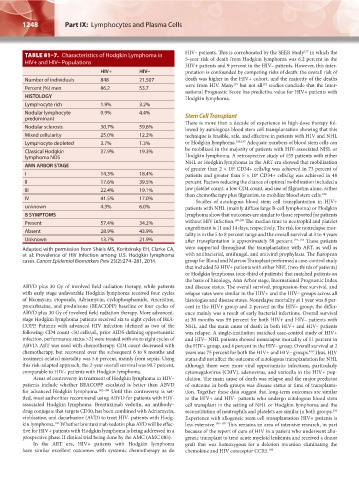
                TABLE 81–7.  Characteristics of Hodgkin Lymphoma in   HIV– patients. This is corroborated by the SEER Study  in which the
                                                                      5-year risk of death from Hodgkin lymphoma was 6.2 percent in the
                HIV+ and HIV– Populations
                                                                      HIV+ patients and 9 percent in the HIV– patients. However, this inter-
                                          HIV+         HIV–           pretation is confounded by competing risks of death: the overall risk of
                Number of individuals     848          21,507         death was higher in the HIV+ cohort, and the majority of the deaths
                                                                                      179
                                                                      were from HIV. Many  but not all  studies conclude that the Inter-
                                                                                                181
                Percent (%) men           86.2         53.7           national Prognostic Score has predictive value for HIV+ patients with
                HISTOLOGY                                             Hodgkin lymphoma.
                Lymphocyte rich           1.9%         3.2%
                Nodular lymphocyte        0.9%         4.4%
                predominant                                           Stem Cell Transplant
                                                                      There is more than a decade of experience in high-dose therapy fol-
                Nodular sclerosis         30.7%        59.6%          lowed by autologous blood stem cell transplantation showing that this
                Mixed cellularity         25.0%        12.2%          technique is feasible, safe, and effective in patients with HIV and NHL
                Lymphocyte depleted       3.7%         1.3%           or Hodgkin lymphoma. 186,187  Adequate numbers of blood stem cells can
                Classical Hodgkin         37.9%        19.3%          be mobilized in the majority of patients with HIV-associated NHL or
                lymphoma NOS                                          Hodgkin lymphoma. A retrospective study of 155 patients with either
                ANN ARBOR STAGE                                       NHL or Hodgkin lymphoma in the ART era showed that mobilization
                                                                                      6
                                                                      of greater than 2 × 10  CD34+ cells/kg was achieved in 73 percent of
                I                         14.3%        18.4%          patients and greater than 5 × 10  CD34+ cells/kg was achieved in 48
                                                                                              6
                II                        17.6%        39.5%          percent. Factors reducing the chance of optimal mobilization included a
                III                       22.4%        19.1%          low platelet count, a low CD4 count, and use of filgrastim alone, rather
                                                                                                                    188
                IV                        41.5%        17.0%          than chemotherapy plus filgrastim, to mobilize blood stem cells.
                                                                          Studies of autologous blood stem cell transplantation in HIV+
                unknown                   4.3%         6.0%           patients with NHL (mainly diffuse large B-cell lymphoma) or Hodgkin
                B SYMPTOMS                                            lymphoma show that outcomes are similar to those reported for patients
                Present                   57.4%        34.2%          without HIV infection. 189,190  The median time to neutrophil and platelet
                Absent                    28.9%        43.9%          engraftment is 11 and 14 days, respectively. The risk for nonrelapse mor-
                                                                      tality is in the 5 to 8 percent range and the overall survival at 3 to 4 years
                Unknown                   13.7%        21.9%          after transplantation is approximately 50 percent. 191–193  These patients
               Adapted with permission from Shiels MS, Koritzinsky EH, Clarke CA,   were supported throughout the transplantation with ART, as well as
               et al: Prevalence of HIV Infection among U.S. Hodgkin lymphoma   with antibacterial, antifungal, and antiviral prophylaxis. The European
               cases. Cancer Epidemiol Biomarkers Prev 23(2):274–281, 2014.   group for Blood and Marrow Transplant performed a case-control study
                                                                      that included 53 HIV+ patients with either NHL (two-thirds of patients)
                                                                      or Hodgkin lymphoma (one-third of patients) that matched patients on
                                                                      the basis of histology, Ann Arbor stage, International Prognostic Index
               ABVD plus 30 Gy of involved field radiation therapy, while patients   and disease status. The overall survival, progression-free survival, and
               with early stage unfavorable Hodgkin lymphoma received four cycles   relapse rates were similar in the HIV+ and the HIV– groups across all
               of bleomycin, etoposide, Adriamycin, cyclophosphamide, vincristine,   histologies and disease states. Nonrelapse mortality at 1 year was 8 per-
               procarbazine, and prednisone (BEACOPP) baseline or four cycles of   cent in the HIV+ group and 2 percent in the HIV– group; the differ-
               ABVD plus 30 Gy of involved field radiation therapy. More advanced-  ence mainly was a result of early bacterial infections. Overall survival
               stage Hodgkin lymphoma patients received six to eight cycles of BEA-  at 30 months was 59 percent for both HIV+ and HIV– patients with
               COPP. Patients with advanced HIV  infection (defined as two  of the   NHL, and the main cause of death in both HIV+ and HIV– patients
               following: CD4 count <50 cells/μL, prior AIDS-defining opportunistic   was relapse. A single-institution matched case-control study of HIV+
               infection, performance status >2) were treated with six to eight cycles of   and HIV– NHL patients showed nonrelapse mortality of 11 percent in
               ABVD. ART was used with chemotherapy. CD4 count decreased with   the HIV+ group, and 4 percent in the HIV– group. Overall survival at 2
               chemotherapy, but recovered over the subsequent 6 to 9 months and   years was 75 percent for both the HIV+ and HIV– groups.  Thus, HIV
                                                                                                                190
               treatment-related mortality was 5.6 percent, mainly from sepsis. Using   status did not affect the outcome of autologous transplantation for NHL
               this risk-adapted approach, the 2-year overall survival was 90.7 percent,   although there were more viral opportunistic infections, particularly
               comparable to HIV– patients with Hodgkin lymphoma.     cytomegalovirus (CMV), adenovirus, and varicella in the HIV+ pop-
                   Areas of controversy in treatment of Hodgkin lymphoma in HIV–   ulation. The main cause of death was relapse and the major predictor
               patients include whether BEACOPP escalated is better than ABVD   of outcome in both groups was disease status at time of transplanta-
               for advanced Hodgkin lymphoma. 182–184  Until this controversy is set-  tion. Together these data suggest that long-term outcomes are similar
               tled, most authorities recommend using ABVD for patients with HIV-   in the HIV+ and HIV– patients who undergo autologous blood stem
               associated Hodgkin lymphoma. Brentuximab vedotin, an antibody–  cell transplant in the setting of NHL or Hodgkin lymphoma and the
               drug conjugate that targets CD30, has been combined with Adriamycin,   reconstitution of neutrophils and platelets are similar in both groups.
                                                                                                                       194
               vinblastine, and dacarbazine (AVD) to treat HIV- patients with Hodg-  Experience with allogeneic stem cell transplantation HIV+ patients is
               kin lymphoma.  Whether brentuximab vedotin plus AVD will be effec-  less extensive. 195–197  This remains an area of intensive research, in part
                          185
               tive for HIV+ patients with Hodgkin lymphoma is being addressed in a   because of the report of cure of HIV in a patient who underwent allo-
               prospective phase II clinical trial being done by the AMC (AMC 085).  geneic transplant to treat acute myeloid leukemia and received a donor
                   In the ART era, HIV+ patients with Hodgkin lymphoma   graft that was homozygous for a deletion mutation eliminating the
               have similar excellent outcomes with systemic chemotherapy as do   chemokine and HIV coreceptor CCR5. 109


          Kaushansky_chapter 81_p1239-1260.indd   1248                                                                  9/21/15   11:19 AM

