


Page 1278 - Williams Hematology ( PDFDrive )
P. 1278
1252  Part IX:  Lymphocytes and Plasma Cells  Chapter 81:  Hematologic Manifestations of Acquired Immunodeficiency Syndrome       1253


                  thrombocytopenia, attributed to increased coinfection with hepatitis C   TABLE 81–10.  Pancytopenia in Human
                  and hepatic cirrhosis. A British study evaluated selective testing for HIV
                  in patients who presented with specific medical conditions, including   Immunodeficiency Virus
                  thrombocytopenia. They found an increased rate of HIV infection in   • Advanced HIV with high viral load
                  patients presenting with thrombocytopenia,  providing a rationale for   • Medication side effect
                                                 270
                  including HIV testing in the evaluation of patients presenting with iso-  • Malignancy in the marrow
                  lated thrombocytopenia. In the ART era, 26 percent of 5290 patients   • Non-Hodgkin lymphoma, Hodgkin lymphoma
                  followed at the British Columbia Center for Excellence in HIV/AIDS
                  had at least one platelet count less than 100,000/μL, and 3 percent had   • Infection in the marrow
                                                    271
                  at least one platelet count less than 20,000/μL.  A study of the fre-  • Mycobacterium avium complex, histoplasmosis, cytomegalovi-
                  quency and severity of thrombocytopenia in a large cohort of patients   rus, Mycobacterium tuberculosis
                  in the Collaboration in HIV Outcomes Research/U.S. study (CHORUS)   • Castleman disease
                                                     272
                  included 6300 HIV+ people from 1997 to 2006  and found a preva-  • Hemophagocytic syndrome
                  lence of thrombocytopenia (platelet count <150,000/μL) of 14 percent.   • Alcohol abuse
                  However, this cohort excluded patients who had hepatitis C or hepati-  • Vitamin B  or folate deficiency
                  tis B infection, so the prevalence of thrombocytopenia would likely be   12
                  higher if these patients had been included.  In this study, 3.1 percent
                                                 272
                  of patients had a platelet count of 50,000/μL or less, and 1.7 percent
                  of patients had a platelet count of 30,000/μL or less. The majority of   may also have a component of low-grade disseminated intravascular
                  patients with severe thrombocytopenia who had not started ART had   coagulation.
                  a CD4 count greater than 200 cells/μL, demonstrating that thrombocy-  Evaluation  of  thrombocytopenia  in  HIV+  patients  is  similar  to
                  topenia can occur prior to severe immunodepletion. These data are con-  HIV– patients and should include a thorough history and physical
                  sistent with the findings of the British Columbia Center for Excellence   exam looking for symptoms and signs of platelet-type bleeding, to
                  in AIDS/HIV study, in which the CD4 count at diagnosis of ITP was 200   assess the clinical severity of the thrombocytopenia. The blood film
                  or greater in 72 percent of patients. 271             should be reviewed to confirm that the patient does have low platelets,
                     Mild  thrombocytopenia also  occurs  during  primary HIV infec-  rather than platelet clumping, and to evaluate for abnormalities in red
                  tion, a time of unfettered HIV replication and intense immune acti-  blood cell and white blood cell numbers and morphology. If not already
                  vation.  In  one  study  of  957  patients  evaluated  during  primary  HIV   done, the patient should be tested for hepatitis C. The HIV viral load
                  infection, 9.7 percent had a platelet count of less than 150,000/μL, 2.3   and CD4 count should be determined, as noncompliance or develop-
                  percent had a platelet count of less than 100,000/μL, and none had a   ment of resistance to the current ART regimen can exacerbate HIV-
                                             273
                  platelet count of less than 50,000/μL.  Of those who started ART, the   associated thrombocytopenia. The patient should be asked what percent
                  time to platelet recovery was approximately 1 month. Of those who did   of the patient’s HIV medications are taken, or alternatively how many
                  not start ART, the time to platelet recovery was just under 2 months.   missed doses the patient has had in the past month. The medication list,
                  Those who developed thrombocytopenia during acute HIV infection   including nonprescription medications, naturopathic medications, and
                  had a threefold higher incidence of developing a low platelet count in   dietary supplements, should be thoroughly reviewed. The differential
                  the next 3 years (13.3 percent) in comparison to those who maintained   diagnosis for isolated thrombocytopenia includes HIV-associated ITP,
                  a normal platelet count throughout. Thus, most patients who develop   hepatitis C-associated ITP, Helicobacter pylori–associated ITP, medica-
                  thrombocytopenia during primary HIV infection recover quickly, even   tion side effect, or antiphospholipid antibody syndrome. If the patient
                  if ART is not started immediately. A study to evaluate the risk factors   also has anemia, immunohemolytic anemia with ITP (Evans syndrome)
                  for HIV-associated thrombocytopenia included 73 HIV+ people with   or TTP should be considered. In a febrile and ill patient who has addi-
                  a platelet count of less than 100,000/μL for 3 months matched to 73   tional cytopenias, Castleman disease and hemophagocytic syndrome
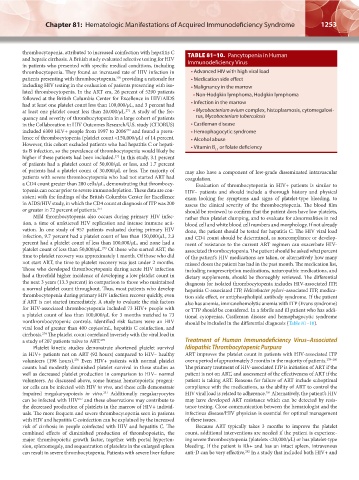
                  nonthrombocytopenic controls. Identified risk factors were an HIV   should be included in the differential diagnosis (Table 81–10).
                  viral load of greater than 400 copies/mL, hepatitis C coinfection, and
                  cirrhosis.  The platelet count correlated inversely with the viral load in
                        274
                  a study of 207 patients naïve to ART. 275             Treatment of Human Immunodeficiency Virus–Associated
                     Platelet kinetic studies demonstrate shortened platelet survival   Idiopathic Thrombocytopenic Purpura
                  in HIV+ patients not on ART (92 hours) compared to HIV– healthy   ART improves the platelet count in patients with HIV-associated ITP
                  volunteers (198 hours).  Even HIV+ patients with normal platelet   over a period of approximately 3 months in the majority of patients. 278–280
                                   276
                  counts had modestly diminished platelet survival in these studies as   The primary treatment of HIV-associated ITP is initiation of ART if the
                  well as decreased platelet production in comparison to HIV– normal   patient is not on ART, and assessment of the effectiveness of ART if the
                  volunteers. As discussed above, some human hematopoietic progeni-  patient is taking ART. Reasons for failure of ART include suboptimal
                  tor cells can be infected with HIV in vivo, and these cells demonstrate   compliance with the medications, as the ability of ART to control the
                  impaired megakaryopoiesis  in vitro.  Additionally megakaryocytes   HIV viral load is related to adherence.  Alternatively, the patient’s HIV
                                             251
                                                                                                   281
                  can be infected with HIV  and these observations may contribute to   may have developed ART resistance which can be detected by resis-
                                    277
                  the decreased production of platelets in the marrow of HIV+ individ-  tance testing. Close communication between the hematologist and the
                  uals. The more frequent and severe thrombocytopenia seen in patients   infectious disease/HIV physician is essential for optimal management
                  with HIV and hepatitis C coinfection can be explained by the increased   of these issues.
                  risk of cirrhosis in people coinfected with HIV and hepatitis C. The   Because ART typically takes 3 months to improve the platelet
                  combined effects of diminished production of thrombopoietin, the   count, additional interventions are needed if the patient is experienc-
                  major  thrombopoietic  growth  factor,  together  with  portal  hyperten-  ing severe thrombocytopenia (platelets <20,000/μL) or has platelet-type
                  sion, splenomegaly, and sequestration of platelets in the enlarged spleen   bleeding. If the patient is Rh+ and has an intact spleen, intravenous
                                                                                             282
                  can result in severe thrombocytopenia. Patients with severe liver failure   anti-D can be very effective.  In a study that included both HIV+ and


          Kaushansky_chapter 81_p1239-1260.indd   1253                                                                  9/21/15   11:19 AM

