


Page 1400 - Williams Hematology ( PDFDrive )
P. 1400
1374  Part X:  Malignant Myeloid Diseases                        Chapter 88:  Acute Myelogenous Leukemia             1375


                  probability of occurrence in each chronic myeloid neoplasm (Chap. 83).     The blood cells of more than 2 percent of individuals (5 to 6 percent
                  The frequency of clonal progression to AML is enhanced by radiation   of people older than 70 years) contain mutations that may represent
                  or chemotherapy in patients with polycythemia vera (Chap. 84) or   premalignant events that can  cause  clonal  hematopoietic  expansion.
                  essential thrombocythemia (Chap. 85).  Although some refer to this as   These events may, in part, explain the age-dependent incidence of AML
                                              29
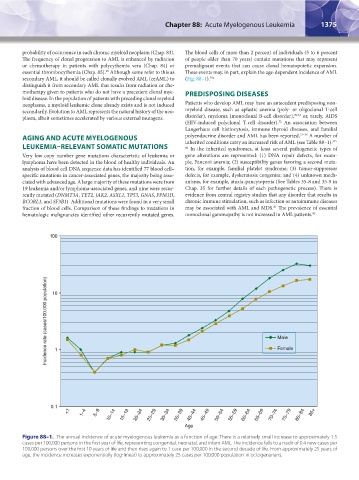
                  secondary AML, it should be called clonally evolved AML (ceAML) to   (Fig. 88–1). 29a
                  distinguish it from secondary AML that results from radiation or che-
                  motherapy given to patients who do not have a precedent clonal mye-  PREDISPOSING DISEASES
                  loid disease. In the population of patients with preceding clonal myeloid
                  neoplasms, a myeloid leukemic clone already exists and is not induced   Patients who develop AML may have an antecedent predisposing non-
                  secondarily. Evolution to AML represents the natural history of the neo-  myeloid disease, such as aplastic anemia (poly- or oligoclonal T-cell
                  plasm, albeit sometimes accelerated by various external mutagens.  disorder), myeloma (monoclonal B-cell disorder), 30,31  or, rarely, AIDS
                                                                        (HIV-induced polyclonal T-cell disorder).  An association between
                                                                                                        32
                                                                        Langerhans cell histiocytosis, immune thyroid diseases, and familial
                  AGING AND ACUTE MYELOGENOUS                           polyendocrine disorder and AML has been reported. 33–36  A number of
                                                                        inherited conditions carry an increased risk of AML (see Table  88–1).
                                                                                                                          37–
                  LEUKEMIA–RELEVANT SOMATIC MUTATIONS                   80  In the inherited syndromes, at least several pathogenetic types of
                  Very low copy number gene mutations characteristic of leukemia or   gene alterations are represented: (1) DNA repair defects, for exam-
                  lymphoma have been detected in the blood of healthy individuals. An   ple, Fanconi anemia; (2) susceptibility genes favoring a second muta-
                  analysis of blood cell DNA sequence data has identified 77 blood cell–  tion,  for  example,  familial platelet  syndrome;  (3) tumor-suppressor
                  specific mutations in cancer-associated genes, the majority being asso-  defects, for example, dyskeratosis congenita; and (4) unknown mech-
                  ciated with advanced age. A large majority of these mutations were from   anisms, for example, ataxia-pancytopenia (See Tables 35-8 and 35-9 in
                  19 leukemia and/or lymphoma-associated genes, and nine were recur-  Chap. 35 for further details of each pathogenetic process). There is
                  rently mutated (DNMT3A, TET2, JAK2, ASXL1, TP53, GNAS, PPM1D,   evidence from central registry studies that any disorder that results in
                  BCORL1, and SF3B1). Additional mutations were found in a very small   chronic immune stimulation, such as infection or autoimmune diseases
                  fraction of blood cells. Comparison of these findings to mutations in   may be associated with AML and MDS.  The prevalence of essential
                                                                                                      81
                  hematologic malignancies identified other recurrently mutated genes.   monoclonal gammopathy is not increased in AML patients. 82


                           100


                          Incidence rate (cases/100,000 population)  10                                Male


                                                                                                       Female
                             1


                           0.1
                                 <1   1–4  5–9  10–14  15–19  20–24  25–29  30–34  35–39  40–44  45–49  50–54  55–59  60–64  65–69  70–74  75–79  80–84  85+

                                                                        Age
                  Figure 88–1.  The annual incidence of acute myelogenous leukemia as a function of age. There is a relatively small increase to approximately 1.5
                  cases per 100,000 persons in the first year of life, representing congenital, neonatal, and infant AML. The incidence falls to a nadir of 0.4 new cases per
                  100,000 persons over the first 10 years of life and then rises again to 1 case per 100,000 in the second decade of life. From approximately 25 years of
                  age, the incidence increases exponentially (log-linear) to approximately 25 cases per 100,000 population in octogenarians.


          Kaushansky_chapter 88_p1373-1436.indd   1375                                                                  9/21/15   11:00 AM

