


Page 1405 - Williams Hematology ( PDFDrive )
P. 1405
1380           Part X:  Malignant Myeloid Diseases                                                                                                                           Chapter 88:  Acute Myelogenous Leukemia             1381


               in octogenarians (see Fig. 88–1). The exception to this exponential age-   variants of AML (see Chap. 83, Table  83–1 and Fig. 83–3). A cogent
               related increase in incidence is APL, which does not change greatly in   argument has been made that, for practical purposes, a classification
               incidence with age. 188                                that initially considers morphologic phenotype and immunophenotype
                   AML accounts for 15 to 20 percent of the acute leukemias in chil-  is advisable. Cytogenetics, molecular genetics, gene-expression profil-
               dren and 80 percent of the acute leukemias in adults. It is slightly more   ing, and other considerations can, and should, be layered on as available
               common in males. Little difference in incidence is seen between indi-  and useful in influencing therapy, and these features are starting to be
               viduals of African or European descent at any age. A somewhat lower   incorporated into the World Health Organization (WHO) Classifica-
                                                189
               incidence is seen in persons of Asian descent.  An increase in the fre-  tion of AML.  It is anticipated that molecular classifications will con-
                                                                                196
               quency of AML is seen in Jews, especially those of Eastern European   tinue to evolve and dominate clinical decision making in the future. 105
               descent. The acute promyelocytic variant of AML is somewhat more
               common in Latinos. 190,191  In a large population study of 426,068 patients   CLINICAL FEATURES
               treated with chemotherapy for malignancy, 301 AML cases occurred,
               4.7 times the number expected. Over time (1975 to 2008), the risks   SIGNS AND SYMPTOMS
               increased for non-Hodgkin lymphoma, declined for ovarian cancer and
               myeloma, and were heterogeneous for breast and Hodgkin lymphoma,   General
               reflecting changing treatment patterns. 192            Signs and symptoms that signal the onset of AML include pallor,
                                                                      fatigue, weakness, palpitations, and dyspnea on exertion. The signs and
                  CLASSIFICATION                                      symptoms reflect the development of anemia; however, weakness, loss
                                                                      of sense of well-being, and fatigue on exertion can be disproportionate
               Variants of AML can be identified by morphologic features of blood   to the severity of anemia. 197–201
               films using polychromatic stains and histochemical reactions,    Easy bruising, petechiae, epistaxis, gingival bleeding, conjunctival
                                                                 193
                                                   194
               monoclonal antibodies against surface markers,  or by the presence   hemorrhages, and prolonged bleeding from skin injuries reflect throm-
               of specific chromosome translocations or other molecular changes as   bocytopenia and are frequent early manifestations of the disease. Very
               discussed  above. 104,105   The epitopes  on the progenitor  cells  of  several   infrequently, gastrointestinal, genitourinary, bronchopulmonary, or
               phenotypic variants overlap, and several monoclonal antibodies are   CNS bleeding occurs at the onset of disease.
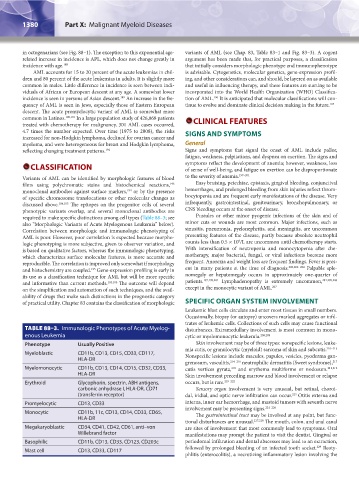
               required to make specific distinctions among cell types (Table 88–3; see   Pustules or other minor pyogenic infections of the skin and of
               also “Morphologic Variants of Acute Myelogenous Leukemia” below).   minor cuts or wounds are most common. Major infections, such as
               Correlation between morphologic and immunologic phenotyping of   sinusitis, pneumonia, pyelonephritis, and meningitis, are uncommon
               AML is poor. However, poor correlation is expected because morpho-  presenting features of the disease, partly because absolute neutrophil
                                                                                        9
               logic phenotyping is more subjective, given to observer variation, and   counts less than 0.5 × 10 /L are uncommon until chemotherapy starts.
               is based on qualitative factors, whereas the immunologic phenotyping,   With intensification of neutropenia and monocytopenia after che-
               which characterizes surface molecular features, is more accurate and   motherapy, major bacterial, fungal, or viral infections become more
               reproducible. The correlation is improved only somewhat if morphology   frequent. Anorexia and weight loss are frequent findings. Fever is pres-
               and histochemistry are coupled.  Gene-expression profiling is early in   ent in many patients at the time of diagnosis. 200,202–204  Palpable sple-
                                      195
               its use as a classification technique for AML but will be more specific   nomegaly or hepatomegaly occurs in approximately one-quarter of
               and informative than current methods. 104,105  The outcome will depend   patients. 197,198,201  Lymphadenopathy is extremely uncommon, 201,205,206
               on the simplification and automation of such techniques, and the avail-  except in the monocytic variant of AML. 207
               ability of drugs that make such distinctions in the prognostic category
               of practical utility. Chapter 83 contains the classification of morphologic   SPECIFIC ORGAN SYSTEM INVOLVEMENT
                                                                      Leukemic blast cells circulate and enter most tissues in small numbers.
                                                                      Occasionally, biopsy (or autopsy) uncovers marked aggregates or infil-
                                                                      trates of leukemic cells. Collections of such cells may cause functional
                TABLE 88–3.  Immunologic Phenotypes of Acute Myelog-  disturbances. Extramedullary involvement is most common in mono-
                enous Leukemia                                        cytic or myelomonocytic leukemia. 208,209
                Phenotype         Usually Positive                        Skin involvement may be of three types: nonspecific lesions, leuke-
                                                                      mia cutis, or granulocytic (myeloid) sarcoma of skin and subcutis. 210–213
                Myeloblastic      CD11b, CD13, CD15, CD33, CD117,     Nonspecific lesions include macules, papules, vesicles, pyoderma gan-
                                  HLA-DR
                                                                      grenosum, vasculitis, 214–216  neutrophilic dermatitis (Sweet syndrome),
                                                                                                                       217
                Myelomonocytic    CD11b, CD13, CD14, CD15, CD32, CD33,   cutis vertices gyrata,  and erythema multiforme or nodosum. 211,212
                                                                                     218
                                  HLA-DR                              Skin involvement preceding marrow and blood involvement or relapse
                Erythroid         Glycophorin, spectrin, ABH antigens,    occurs, but is rare. 219–222
                                  carbonic anhydrase I, HLA-DR, CD71      Sensory organ involvement is very unusual, but retinal, choroi-
                                  (transferrin receptor)              dal, iridial, and optic nerve infiltration can occur.  Otitis externa and
                                                                                                          223
                Promyelocytic     CD13, CD33                          interna, inner ear hemorrhage, and mastoid tumors with seventh nerve
                                                                      involvement may be presenting signs. 224–226
                Monocytic         CD11b, 11c, CD13, CD14, CD33, CD65,     The gastrointestinal tract may be involved at any point, but func-
                                  HLA-DR
                                                                      tional disturbances are unusual. 227,228  The mouth, colon, and anal canal
                Megakaryoblastic  CD34, CD41, CD42, CD61, anti–von    are sites of involvement that most commonly lead to symptoms. Oral
                                  Willebrand factor                   manifestations may prompt the patient to visit the dentist. Gingival or
                Basophilic        CD11b, CD13, CD33, CD123, CD203c    periodontal infiltration and dental abscesses may lead to an extraction,
                                                                                                                  229
                Mast cell         CD13, CD33, CD117                   followed by prolonged bleeding of an infected tooth socket.  Ileoty-
                                                                      phlitis (enterocolitis), a necrotizing inflammatory lesion involving the


          Kaushansky_chapter 88_p1373-1436.indd   1380                                                                  9/21/15   11:00 AM

