


Page 1403 - Williams Hematology ( PDFDrive )
P. 1403
1378           Part X:  Malignant Myeloid Diseases                                                                                                                           Chapter 88:  Acute Myelogenous Leukemia             1379


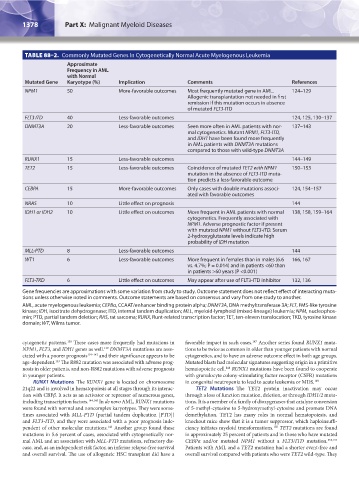
                TABLE 88–2.  Commonly Mutated Genes In Cytogenetically Normal Acute Myelogenous Leukemia
                              Approximate
                              Frequency in AML
                              with Normal
                Mutated Gene  Karyotype (%)     Implication            Comments                           References
                NPM1          50                More-favorable outcomes  Most frequently mutated gene in AML.   124–129
                                                                       Allogenic transplantation not needed in first
                                                                       remission if this mutation occurs in absence
                                                                       of mutated FLT3-ITD
                FLT3 ITD      40                Less-favorable outcomes                                   124, 125, 130–137
                DNMT3A        20                Less-favorable outcomes  Seen more often in AML patients with nor-  137–143
                                                                       mal cytogenetics. Mutant NPM1, FLT3-ITD,
                                                                       and IDH1 have been found more frequently
                                                                       in AML patients with DNMT3A mutations
                                                                       compared to those with wild-type DNMT3A
                RUNX1         15                Less-favorable outcomes                                   144–149
                TET2          15                Less-favorable outcomes  Coincidence of mutated TET2 with NPM1   150–153
                                                                       mutation in the absence of FLT3-ITD muta-
                                                                       tion predicts a less-favorable outcome
                CEBPA         15                More-favorable outcomes  Only cases with double mutations associ-  124, 154–157
                                                                       ated with favorable outcomes
                NRAS          10                Little effect on prognosis                                144
                IDH1 or IDH2  10                Little effect on outcomes  More frequent in AML patients with normal   138, 158, 159–164
                                                                       cytogenetics. Frequently associated with
                                                                       NPM1. Adverse prognostic factor if present
                                                                       with mutated NPM1 without FLT3-ITD. Serum
                                                                       2-hydroxyglutarate levels indicate high
                                                                       probability of IDH mutation
                MLL-PTD       8                 Less-favorable outcomes                                   144
                WT1           6                 Less-favorable outcomes  More frequent in females than in males (6.6   166, 167
                                                                       vs. 4.7%; P = 0.014) and in patients <60 than
                                                                       in patients >60 years (P <0.001)
                FLT3-TKD      6                 Little effect on outcomes  May appear after use of FLT3-ITD inhibitor  132, 136

               Gene frequencies are approximations with some variation from study to study. Outcome statement does not reflect effect of interacting muta-
               tions unless otherwise noted in comments. Outcome statements are based on consensus and vary from one study to another.
               AML, acute myelogenous leukemia; CEPBα, CCAAT/enhancer binding protein alpha; DNMT3A, DNA methyltransferase 3A; FLT, FMS-like tyrosine
               kinase; IDH, isocitrate dehydrogenase; ITD, internal tandem duplication; MLL, myeloid-lymphoid (mixed-lineage) leukemia; NPM, nucleophos-
               min; PTD, partial tandem deletion; RAS, rat sarcoma; RUNX, Runt-related transcription factor; TET, ten-eleven translocation; TKD, tyrosine kinase
               domain; WT, Wilms tumor.


               cytogenetic patterns.  These cases more frequently had mutations in   favorable impact in such cases.  Another series found RUNX1 muta-
                              138
                                                                                             147
               NPM1, FLT3, and IDH1 genes as well.  DNMT3A mutations are asso-  tions to be twice as common in older than younger patients with normal
                                           139
               ciated with a poorer prognosis 139–142  and their significance appears to be   cytogenetics, and to have an adverse outcome effect in both age groups.
               age-dependent.  The R882 mutation was associated with adverse prog-  Mutated blasts had molecular signatures suggesting origin in a primitive
                          143
               nosis in older patients, and non-R882 mutations with adverse prognosis   hematopoietic cell.  RUNX1 mutations have been found to cooperate
                                                                                    148
               in younger patients.                                   with granulocyte colony-stimulating factor receptor (CSFR) mutations
                   RUNX1 Mutations  The RUNX1 gene is located on chromosome   in congenital neutropenia to lead to acute leukemia or MDS. 149
               21q22 and is involved in hematopoiesis at all stages through its interac-  TET2 Mutations  The TET2 protein inactivation may occur
               tion with CBFβ. It acts as an activator or repressor of numerous genes,   through a loss of function mutation, deletion, or through IDH1/2 muta-
               including transcription factors. 144,145  In de novo AML, RUNX1 mutations   tions. It is a member of a family of dioxygenases that catalyze conversion
               were found with normal and noncomplex karyotypes. They were some-  of 5-methyl-cytosine to 5-hydroxymethyl-cytosine and promote DNA
               times  associated with  MLL-PTD (partial tandem  duplication [PTD])   demethylation. TET2 has many roles in normal hematopoiesis, and
               and FLT3-ITD, and they were associated with a poor prognosis inde-  knockout mice show that it is a tumor suppressor, which haploinsuffi-
               pendent of other molecular mutations.  Another group found these   ciency initiates myeloid transformations.  TET2 mutations are found
                                            146
                                                                                                    150
               mutations in 5.6 percent of cases, associated with cytogenetically nor-  in approximately 25 percent of patients and in those who have mutated
               mal AML and an association with MLL-PTD mutations, refractory dis-  CEBPα  and/or  mutated  NPM1  without a  FLT3/ITD  mutation. 151,152
               ease, and, as an independent risk factor, an inferior relapse-free survival   Patients with AML and a TET2 mutation had a shorter event-free and
               and overall survival. The use of allogeneic HSC transplant did have a   overall survival compared with patients who were TET2 wild-type. They


          Kaushansky_chapter 88_p1373-1436.indd   1378                                                                  9/21/15   11:00 AM

