


Page 1436 - Williams Hematology ( PDFDrive )
P. 1436
1410  Part X:  Malignant Myeloid Diseases                        Chapter 88:  Acute Myelogenous Leukemia             1411


                  Fertility and Gonadal Function                        cytogenetic abnormalities at morphologic remission after induction
                  Patients treated for AML, especially patients undergoing condition-  therapy predicts for a significantly shorter relapse-free survival and
                  ing for allogeneic stem cell transplantation, have decreased gonadal   overall survival, for example. 1135
                  function. 1121–1123  Men may develop oligospermia. Women may develop
                  ovarian dysfunction and very high gonadotropin levels. 1124  Men recover   Rates of Remission
                  gonadal function more often and sooner than do women. Recovery of   Remission rates have improved dramatically in the last 60 years, but
                  ovarian function in women is partly dependent on a younger age at the   remission, relative 5-year survival, and cure rates are most dependent
                  time of treatment. In survivors of childhood AML treated only with   on the patient’s age when AML occurs. 1136,1137  Initial remission rates now
                  chemotherapy and not transplantation, normal pubertal development   approach 90 percent in children, 70 percent in young adults, 60 percent
                  and fertility are found, but antimüllerian hormone was low in some   in middle-aged patients, and 40 percent in older patients. Within age
                  women. 1125  Women in remission following treatment for AML with   groups, remission is related to other variables such as cytogenetic risk
                  allogeneic  transplantation can  become pregnant and  deliver  healthy   category and expression of MDR genes in leukemic cells, but these vari-
                  infants 1126,1127 ; however, this preservation of fertility is rare. 1128  Histologic   ables also are correlated with age at onset. For example, the more favor-
                  studies of the testes show marked suppression of spermatogenesis as a   able cytogenetic patterns t(8;21), t(15;17), inv16, or t(16;16) are present
                  function of duration of treatment for AML and not of the specific agents   in approximately 30 percent of patients between 10 and 39 years old,
                  used or the patient’s age. Residual spermatogenesis in intensively treated   15 percent of patients between 40 and 59 years old, and 5 percent of
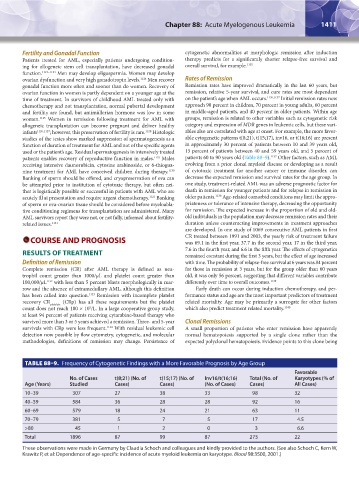
                  patients enables recovery of reproductive function in males. 1129  Males   patients 60 to 90 years old (Table 88–9). 1137  Other factors, such as AML
                  receiving intensive daunorubicin, cytosine arabinoside, or 6-thiogua-  evolving from a prior clonal myeloid disease or developing as a result
                  nine treatment for AML have conceived children during therapy. 1130    of cytotoxic treatment for another cancer or immune disorder, can
                  Banking of sperm should be offered, and cryopreservation of ova can   decrease the expected remission and survival rates for the age group. In
                  be attempted prior to institution of cytotoxic therapy, but often nei-  one study, treatment-related AML was an adverse prognostic factor for
                  ther is logistically possible or successful in patients with AML who are   death in remission for younger patients and for relapse in remission in
                  acutely ill at presentation and require urgent chemotherapy. 1121  Banking   older patients. 1138  Age-related comorbid conditions may limit the appro-
                  of sperm or ova-ovarian tissue should be considered before myeloabla-  priateness or tolerance of intensive therapy, decreasing the opportunity
                  tive conditioning regimens for transplantation are administered. Many   for remission. The expected increase in the proportion of old and old-
                  AML survivors report they were not, or not fully, informed about fertility-   old individuals in the population may decrease remission rates and their
                  related issues. 1131                                  duration unless counteracting improvements in treatment approaches
                                                                        are developed. In one study of 1069 consecutive AML patients in first
                     COURSE AND PROGNOSIS                               CR treated between 1991 and 2003, the yearly risk of treatment failure
                                                                        was 69.1 in the first year, 37.7 in the second year, 17 in the third year,
                  RESULTS OF TREATMENT                                  7.6 in the fourth year, and 6.6 in the fifth year. The effects of cytogenetics
                                                                        remained constant during the first 3 years, but the effect of age increased
                  Definition of Remission                               with time. The probability of relapse-free survival at 6 years was 84 percent
                  Complete remission (CR) after AML therapy is defined as neu-  for those in remission at 3 years, but for the group older than 60 years
                  trophil count greater than 1000/μL and platelet count greater than   old, it was only 56 percent, suggesting that different variables contribute
                  100,000/μL 1132  with less than 5 percent blasts morphologically in mar-  differently over time to overall outcomes. 1139
                  row and the absence of extramedullary AML, although this definition   Early death can occur during induction chemotherapy, and per-
                  has been called  into question. 1133  Remission  with incomplete  platelet   formance status and age are the most important predictors of treatment
                  recovery CR platelets  (CRp) has all these requirements but the platelet   related mortality. Age may be primarily a surrogate for other factors
                  count does not reach 100 × 10 /L. In a large cooperative group study,   which also predict treatment related mortality. 1140
                                        9
                  at least 94 percent of patients receiving cytarabine-based therapy who
                  survived more than 3 or 5 years achieved a remission. Three- and 5-year   Clonal Remissions
                  survivals with CRp were less frequent. 1134  With residual leukemic cell   A small proportion of patients who enter remission have apparently
                  detection now possible by flow cytometry, cytogenetic, and molecular   normal  hematopoiesis  supported  by  a  single  clone  rather  than  the
                  methodologies,  definitions  of  remission may  change.  Persistence  of   expected polyclonal hematopoiesis. Evidence points to this clone being


                   TABLE 88–9.  Frequency of Cytogenetic Findings with a More Favorable Prognosis by Age Group
                                                                                                             Favorable
                                  No. of Cases   t(8;21) (No. of   t(15;17) (No. of   Inv16/t(16;16)   Total (No. of   Karyotypes (% of
                   Age (Years)    Studied        Cases)         Cases)         (No. of Cases)  Cases)        All Cases)
                   10–39            307          27             38             33               98           32
                   40–59            584          36             28             28               92           16
                   60–69            579          18             24             21               63           11
                   70–79            381            5              7              5              17            4.5
                   >80               45            1              2              0               3            6.6
                   Total          1896           87             99             87             273            22
                  These observations were made in Germany by Claudia Schoch and colleagues and kindly provided to the authors. (See also Schoch C, Kern W,
                  Krawitz P, et al: Dependence of age-specific incidence of acute myeloid leukemia on karyotype. Blood 98:3500, 2001.)


          Kaushansky_chapter 88_p1373-1436.indd   1411                                                                  9/21/15   11:02 AM

