


Page 1437 - Williams Hematology ( PDFDrive )
P. 1437
1412           Part X:  Malignant Myeloid Diseases                                                                                                                           Chapter 88:  Acute Myelogenous Leukemia             1413


               a preleukemic cell rather than a normal stem cell. 1141–1144  This finding   groups, and the proportion of AML patients receiving transplantation
               is in keeping with previous hypotheses about the possible patterns of   is very small. 1136,1158–1161  Abnormalities of chromosomes 17p and –5/5q–
               remission and relapse in AML 1145–1148  and has implications for minimal   have negative impact on outcomes after allogeneic transplant.  1162,1163
               residual disease detection.                                In contrast to other AML subtypes, APL has had an increased
                                                                      incidence as well as improved survival since the introduction of ATRA.
               Spontaneous Remissions                                 In one large study, relative survival rates were 0.18 for the period 1975
               Spontaneous disappearance of AML has been reported for more than   to 1990, with increase to 0.64 from 2000 to 2008. Age did remain an
               100 years; however, most cases reported before 1960 had poor doc-  important predictor of survival; 0.38 in those older than age 60 years
               umentation of the diagnosis. Bona fide cases of AML patients who   and 0.73 for those 20 to 29 years old. 1164
               entered CR, usually after or concurrent with an infection, occur but are   Relapse (or a new leukemic event) in long-term survivors occur-
               very rare. 1148–1151  The occurrence of spontaneous remission with infec-  ring as late as 8 years after remission has been reported in adults 1153,1154
               tion is consistent with the observation that the antibody response to   and after more than 16 years in children. 1153,1154  Relapse in long-term
               Pseudomonas vaccine 1152  correlates with improved probability of che-  survivors nearly always occurs in the marrow in adults and usually in the
               motherapy-induced remission. Spontaneous remissions often are short   marrow in children, with occasional childhood cases of CNS or gonadal
               lived but have lasted up to 3 years in adults and more than 9 years in   relapses occurring initially, followed by relapse in the marrow. 1159  Stud-
               children. 1153  A particularly notable case of remission for more than 60   ies of long-term survivors of AML show that most can return to work
               years has been documented following “treatment” prior to the intro-  and that, at a median followup of 9 years, no increased risk of secondary
               duction of chemotherapeutic drugs. The regimen included arsenic. 1154  invasive cancer or secondary AML had occurred. 1160,1161  An exception
                                                                      to this finding is the occasional report of myelodysplasia or presumably
               LONG-TERM SURVIVAL                                     secondary AML in long-term survivors of APL. Health-related quality
               Prior to the introduction of chemotherapy for AML 60 years ago, the   of life in long-term survivors appears to recover completely as related to
                                                                      physical, psychological, and emotional well-being, but continued sexual
               median survival of patients was approximately 6 weeks, 1155  the 1-year   dysfunction has been reported. 1165  The quality of life at the time of diag-
               survival was approximately 3 percent, and longer survival occurred   nosis and during the course of therapy usually is poor. 1165,1166
               in less than 1 percent of patients. Five-year relative survival rates of
               patients in the United States from 2004 to 2010, based on the Surveil-
               lance, Epidemiology, and End Results Program of the National Can-  FEATURES INFLUENCING OUTCOME OF
               cer  Institute, are  56  percent  for  patients  younger  than  age  45  years,   THERAPY IN ACUTE MYELOGENOUS LEUKEMIA
               39 percent for patients 45 to 54 years old, 27 percent for patients 55
               to 64 years old, 11 percent for patients 65 to 74 years old, and 1.8     Numerous features are related to outcome of AML treatment. Older
               percent for patients older than age 75 years at the time of diagnosis   age and less-favorable cytogenetic risk group are the two most com-
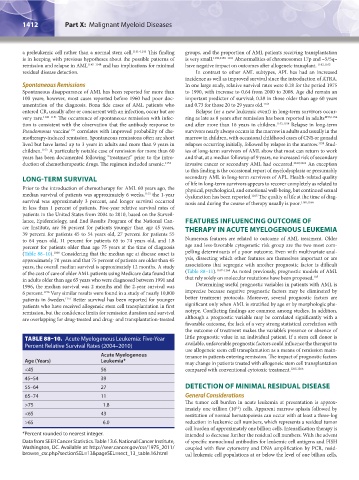
               (Table 88–10). 1069  Considering that the median age at disease onset is   pelling determinants of a poor outcome. Even with multivariate anal-
               approximately 70 years and that 75 percent of patients are older than 45   ysis, dissecting which other features are themselves important or are
               years, the overall median survival is approximately 12 months. A study   associations that segregate with another prognostic factor is difficult
               of the cost of care of older AML patients using Medicare data found that   (Table 88–11). 1167–1264  As noted previously, prognostic models of AML
               in adults older than age 65 years who were diagnosed between 1991 and   that rely solely on molecular mutations have been proposed. 105
               1996, the median survival was 2 months and the 2-year survival was     Determining useful prognostic variables in patients with AML is
               6 percent. 1156  Very similar results were found in a study of nearly 10,000   imprecise because negative prognostic factors may be eliminated by
               patients in Sweden. 1157  Better survival has been reported for younger   better treatment protocols. Moreover, several prognostic factors are
               patients who have received allogeneic stem cell transplantation in first   significant only when AML is stratified by age or by morphologic phe-
               remission, but the confidence limits for remission duration and survival   notype. Conflicting findings are common among studies. In addition,
               are overlapping for drug-treated and drug- and transplantation-treated   although a prognostic variable may be correlated significantly with a
                                                                      favorable outcome, the lack of a very strong statistical correlation with
                                                                      the outcome of treatment makes the variable’s presence or absence of
                TABLE 88–10.  Acute Myelogenous Leukemia: Five-Year   little prognostic value in an individual patient. If a stem cell donor is
                Percent Relative Survival Rates (2004–2010)           available, unfavorable prognostic factors could influence the therapist to
                                                                      use allogeneic stem cell transplantation as a means of remission main-
                                          Acute Myelogenous           tenance in patients entering remission. The impact of prognostic factors
                Age (Years)               Leukemia*                   may change in patients treated with allogeneic stem cell transplantation
                <45                       56                          compared with conventional cytotoxic treatment. 1265,1266
                45–54                     39
                55–64                     27                          DETECTION OF MINIMAL RESIDUAL DISEASE
                65–74                     11                          General Considerations
                                                                      The tumor cell burden in acute leukemia at presentation is approx-
                >75                       1.8
                                                                      imately one trillion (10 ) cells. Apparent marrow aplasia followed by
                                                                                       12
                <65                       43                          restitution of normal hematopoiesis can occur with at least a three-log
                >65                       6.0                         reduction in leukemic cell numbers, which represents a residual tumor
                                                                      cell burden of approximately one billion cells. Intensification therapy is
               *Percent rounded to nearest integer.                   intended to decrease further the residual cell numbers. With the advent
               Data from SEER Cancer Statistics. Table 13.6. National Cancer Institute,   of specific monoclonal antibodies for leukemic cell antigens and FISH
               Washington, DC. Available at: http://seer.cancer.gov/csr/1975_2011/  coupled with flow cytometry and DNA amplification by PCR, resid-
               browse_csr.php?sectionSEL=13&pageSEL=sect_13_table.16.html  ual leukemic cell populations at or below the level of one billion cells,


          Kaushansky_chapter 88_p1373-1436.indd   1412                                                                  9/21/15   11:02 AM

