


Page 1464 - Williams Hematology ( PDFDrive )
P. 1464
1438  Part X:  Malignant Myeloid Diseases  Chapter 89:  Chronic Myelogenous Leukemia and Related Disorders           1439


                          100

                                                              Chronic myelogenous leukemia


                          Incidence rate (cases/100,000 population)  10 1                              Male


                                                                                                       Female


                           0.1
                               <1 1–4 5–9 10–1415–19 20–24 25–29 30–34 35–39 40–44 45–49 50–54 55–59 60–64 65–69 70–74 75–79 80–84 85+
                                                                        Age
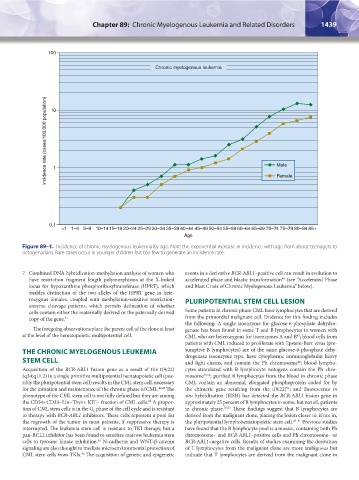
                  Figure 89–1.  Incidence of chronic myelogenous leukemia by age. Note the exponential increase in incidence with age from about teenagers to
                  octogenarians. Rare cases occur in younger children but too few to generate an incidence rate.


                  7.  Combined DNA hybridization-methylation analysis of women who   events in a derivative BCR-ABL1–positive cell can result in evolution to
                    have restriction fragment length polymorphisms at the X-linked   accelerated phase and blastic transformation  (see “Accelerated Phase
                                                                                                         46
                    locus for hypoxanthine phosphoribosyltransferase (HPRT), which   and Blast Crisis of Chronic Myelogenous Leukemia” below).
                    enables distinction of the two alleles of the HPRT gene in hete-
                    rozygous females, coupled with methylation-sensitive restriction-   PLURIPOTENTIAL STEM CELL LESION
                    enzyme cleavage patterns, which permits delineation of whether
                    cells contain either the maternally derived or the paternally derived   Some patients in chronic phase CML have lymphocytes that are derived
                    copy of the gene. 41                                from the primordial malignant cell. Evidence for this finding includes
                                                                        the following: A single isoenzyme for glucose-6-phosphate dehydro-
                     The foregoing observations place the parent cell of the clone at least   genase has been found in some T and B lymphocytes in women with
                  at the level of the hematopoietic multipotential cell.  CML who are heterozygous for isoenzymes A and B ; blood cells from
                                                                                                              47
                                                                        patients with CML induced to proliferate with Epstein-Barr virus (pre-
                  THE CHRONIC MYELOGENOUS LEUKEMIA                      sumptive B lymphocytes) are of the same glucose-6-phosphate dehy-
                                                                        drogenase isoenzyme type, have cytoplasmic immunoglobulin heavy
                  STEM CELL                                             and light chains, and contain the Ph chromosome ; blood lympho-
                                                                                                              48
                  Acquisition of the  BCR-ABL1 fusion gene as a result of the t(9;22)   cytes stimulated with B lymphocyte mitogens contain the Ph chro-
                  (q34;q11.2) in a single primitive multipotential hematopoietic cell (pos-  mosome 49,50 ; purified B lymphocytes from the blood in chronic phase
                  sibly the pluripotential stem cell) results in the CML stem cell, necessary   CML contain an abnormal, elongated phosphoprotein coded for by
                  for the initiation and maintenance of the chronic phase of CML. 42,43  The   the chimeric gene resulting from the t(9;22) ; and fluorescence  in
                                                                                                          51
                  phenotype of the CML stem cell is not fully defined but they are among   situ hybridization (FISH) has detected the BCR-ABL1 fusion gene in
                  the CD34+CD33−Lin−Thy1+ KIT− fraction of CML cells.  A propor-  approximately 25 percent of B lymphocytes in some, but not all, patients
                                                            43
                  tion of CML stem cells is in the G  phase of the cell cycle and is resistant   in chronic phase. 52,53  These findings suggest that B lymphocytes are
                                          0
                  to therapy with BCR-ABL1 inhibitors. These cells represent a pool for   derived from the malignant clone, placing the lesion closer to, if not in,
                  the regrowth of the tumor in most patients, if suppressive therapy is   the pluripotential lymphohematopoietic stem cell. 47–51  Previous studies
                  interrupted. The leukemia stem cell is resistant to TKI therapy, but a   have found that the B lymphocyte pool is a mosaic, containing both Ph
                  pan-BCL2 inhibitor has been found to sensitize marrow leukemia stem   chromosome– and BCR-ABL1–positive cells and Ph chromosome– or
                  cells to tyrosine kinase inhibition.  N-cadherin and WNT-β-catenin   BCR-ABL1–negative cells. Results of studies examining the derivation
                                           44
                  signaling are also thought to mediate microenvironmental protection of   of T lymphocytes from the malignant clone are more ambiguous but
                  CML stem cells from TKIs.  The acquisition of genetic and epigenetic   indicate that T lymphocytes are derived from the malignant clone in
                                      45


          Kaushansky_chapter 89_p1437-1490.indd   1439                                                                  9/18/15   3:41 PM

