


Page 1466 - Williams Hematology ( PDFDrive )
P. 1466
1440  Part X:  Malignant Myeloid Diseases  Chapter 89:  Chronic Myelogenous Leukemia and Related Disorders           1441


                  p210 BCR-ABL  interacts with actin filaments through an actin-binding   chromosome and its normal counterpart, 22.  Using quinacrine (Q)
                                                                                                          138
                                                                                                 12
                  domain.  BCR-ABL1 transfection is associated with increased spon-  and Giemsa (G) banding, Rowley  reported in 1973 that the material
                  taneous motility, membrane ruffling, formation of long actin exten-  missing from chromosome 22 was not lost (deleted) from the cell, but
                  sions (filopodia), and accelerated rate of protrusion and retraction of   was translocated to the distal portion of the long arm of chromosome 9.
                  pseudopodia on fibronectin-coated surfaces. IFN-α treatment slowly   The amount of material translocated to chromosome 9 was approxi-
                  converts the abnormal motility phenotype of BCR-ABL1–transformed   mately equivalent to that lost from chromosome 22, and the transloca-
                                 132
                                                                                                 12
                  cells toward normal.  Integrins regulate the c-ABL–encoded tyrosine   tion was predicted to be balanced.  Moreover, the breaks were localized
                  kinase activity and its cytoplasmic nuclear transport.  The p210 BCR-ABL1    to band 34 on the long arm of chromosome 9 and band 11 on the long
                                                        133
                  abrogates the anchorage requirement but not the growth factor require-  arm of chromosome 22. Therefore, the classic Ph chromosome is t(9;22)
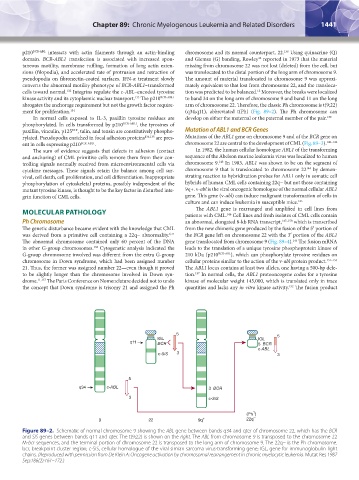
                  ment for proliferation. 134                           (q34;q11), abbreviated t(Ph) (Fig. 89–2). The Ph chromosome can
                     In  normal  cells  exposed  to  IL-3,  paxillin  tyrosine  residues  are   develop on either the maternal or the paternal member of the pair. 139
                  phosphorylated. In cells transformed by p210 BCR-ABL1 , the tyrosines of
                  paxillin, vinculin, p125 FAK , talin, and tensin are constitutively phospho-  Mutation of ABL1 and BCR Genes
                  rylated. Pseudopodia enriched in focal adhesion proteins 134,135  are pres-  Mutations of the ABL1 gene on chromosome 9 and of the BCR gene on
                  ent in cells expressing p210 BCR-ABL1 .               chromosome 22 are central to the development of CML (Fig. 89–3). 140–142
                     The sum of evidence suggests that defects in adhesion (contact   In 1982, the human cellular homologue ABL1 of the transforming
                  and anchoring) of CML primitive cells remove them from their con-  sequence of the Abelson murine leukemia virus was localized to human
                                                                                    143
                  trolling signals normally received from microenvironmental cells via   chromosome 9.  In 1983, ABL1 was shown to be on the segment of
                                                                                                                 144
                  cytokine messages. These signals retain the balance among cell sur-  chromosome 9 that is translocated to chromosome 22  by demon-
                  vival, cell death, cell proliferation, and cell differentiation. Inappropriate   strating reaction to hybridization probes for ABL1 only in somatic cell
                  phosphorylation of cytoskeletal proteins, possibly independent of the   hybrids of human CML cells containing 22q− but not those containing
                  mutant tyrosine kinase, is thought to be the key factor in disturbed inte-  9q+. v-abl is the viral oncogenic homologue of the normal cellular ABL1
                  grin function of CML cells.                           gene. This gene (v-abl) can induce malignant transformation of cells in
                                                                        culture and can induce leukemia in susceptible mice. 145
                                                                            The  ABL1 gene is rearranged and amplified in cell lines from
                  MOLECULAR PATHOLOGY                                   patients with CML.  Cell lines and fresh isolates of CML cells contain
                                                                                      146
                  Ph Chromosome                                         an abnormal, elongated 8-kb RNA transcript, 147–150  which is transcribed
                  The genetic disturbance became evident with the knowledge that CML   from the new chimeric gene produced by the fusion of the 5′ portion of
                  was derived from a primitive cell containing a  22q− abnormality.    the BCR gene left on chromosome 22 with the 3′ portion of the ABL1
                                                                   6,11
                  The abnormal chromosome contained only 60 percent of the DNA   gene translocated from chromosome 9 (Fig. 89–4).  The fusion mRNA
                                                                                                            144
                                          136
                  in other G-group chromosomes.  Cytogenetic analysis indicated the   leads to the translation of a unique tyrosine phosphoprotein kinase of
                  G-group chromosome involved was different from the extra G-group   210 kDa (p210 BCR-ABL ), which can phosphorylate tyrosine residues on
                  chromosome in Down syndrome, which had been assigned number   cellular proteins similar to the action of the v-abl protein product. 151–155
                  21. Thus, the former was assigned number 22—even though it proved   The ABL1 locus contains at least two alleles, one having a 500-bp dele-
                  to be slightly longer than the chromosome involved in Down syn-  tion.  In normal cells, the ABL1 protooncogene codes for a tyrosine
                                                                            157
                  drome. 11,137  The Paris Conference on Nomenclature decided not to undo   kinase of molecular weight 145,000, which is translated only in trace
                                                                                                           152
                  the concept that Down syndrome is trisomy 21 and assigned the Ph   quantities and lacks any in vitro kinase activity.  The fusion product


                                                                     5                                 5
                                                               IGL                               IGL
                                                      q11      BCR                               5 BCR
                                                                                                 c-ABL
                                                               c-SiS  3                                3


                                                     5
                                     q34      c-ABL                             3 BCR
                                                      3                         c-SiS

                                                                                               1
                                                                                             (Ph )
                                           9                22               9q +            22q –
                  Figure 89–2.  Schematic of normal chromosome 9 showing the ABL gene between bands q34 and qter of chromosome 22, which has the BCR
                  and SIS genes between bands q11 and qter. The t(9;22) is shown on the right. The ABL from chromosome 9 is transposed to the chromosome 22
                  M-bcr sequences, and the terminal portion of chromosome 22 is transposed to the long arm of chromosome 9. The 22q− is the Ph chromosome.
                  bcr, breakpoint cluster region; c-SiS, cellular homologue of the viral simian sarcoma virus-transforming gene; IGL, gene for immunoglobulin light
                  chains. (Reproduced with permission from De Klein A: Oncogene activation by chromosomal rearrangement in chronic myelocytic leukemia. Mutat Res 1987
                  Sep;186(2):161–172.)


          Kaushansky_chapter 89_p1437-1490.indd   1441                                                                  9/18/15   3:41 PM

