


Page 1480 - Williams Hematology ( PDFDrive )
P. 1480
1454  Part X:  Malignant Myeloid Diseases  Chapter 89:  Chronic Myelogenous Leukemia and Related Disorders           1455


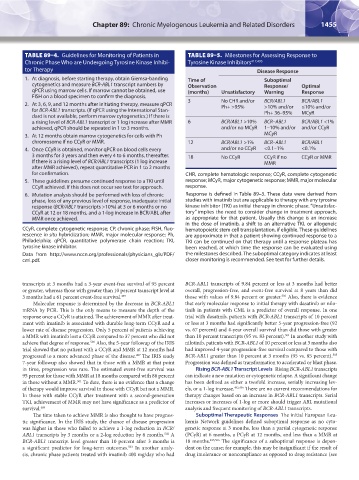
                   TABLE 89–4.  Guidelines for Monitoring of Patients in   TABLE 89–5.  Milestones for Assessing Response to
                   Chronic Phase Who are Undergoing Tyrosine Kinase Inhibi-  Tyrosine Kinase Inhibitors 417,495
                   tor Therapy                                                                   Disease Response
                   1.  At diagnosis, before starting therapy, obtain Giemsa-banding   Time of      Suboptimal
                     cytogenetics and measure BCR-ABL1 transcript numbers by   Observation         Response/   Optimal
                     qPCR using marrow cells. If marrow cannot be obtained, use   (months)  Unsatisfactory  Warning  Response
                     FISH on a blood specimen to confirm the diagnosis.
                   2.  At 3, 6, 9, and 12 months after initiating therapy, measure qPCR   3  No CHR and/or   BCR/ABL1   BCR/ABL1
                                                                                                               ≤10% and/or
                                                                                                   >10% and/or
                                                                                     Ph+ >95%
                     for BCR-ABL1 transcripts. (If qPCR using the International Stan-              Ph+ 36–95%  MCyR
                     dard is not available, perform marrow cytogenetics.) If there is
                     a rising level of BCR-ABL1 transcript or 1 log increase after MMR   6  BCR/ABL1 >10%   BCR–ABL1   BCR/ABL1 <1%
                     achieved, qPCR should be repeated in 1 to 3 months.             and/or no MCyR  1–10% and/or  and/or CCyR
                   3.  At 12 months obtain marrow cytogenetics for cells with Ph                   MCyR
                     chromosome if no CCyR or MMR.                       12          BCR/ABL1 >1%   BCR–ABL1   BCR/ABL1
                   4.  Once CCyR is obtained, monitor qPCR on blood cells every      and/or no CCyR  <0.1–1%   <0.1%
                     3 months for 3 years and then every 4 to 6 months, thereafter.   18  No CCyR  CCyR if no   CCyR or MMR
                     If there is a rising level of BCR/ABL1 transcripts (1 log increase            MMR
                     after MMR achieved), repeat quantitative PCR in 1 to 2 months
                     for confirmation.                                   CHR, complete hematologic response; CCyR, complete cytogenetic
                   5.  These guidelines presume continued response to a TKI until   response; MCyR, major cytogenetic response; MMR, major molecular
                     CCyR achieved. If this does not occur see text for approach.  response.
                   6.  Mutation analysis should be performed with loss of chronic   Response  is  defined  in Table  89–3. These  data were  derived from
                     phase, loss of any previous level of response, inadequate initial   studies with imatinib but are applicable to therapy with any tyrosine
                     response (BCR/ABL1 transcripts >10%) at 3 or 6 months or no   kinase inhibitor (TKI) as initial therapy in chronic phase. “Unsatisfac-
                     CCyR at 12 or 18 months, and a 1-log increase in BCR/ABL after   tory” implies the need to consider change in treatment approach,
                     MMR once achieved.                                  as appropriate for that patient. Usually this change is an increase
                                                                         in the dose of imatinib, a shift to an alternative TKI, or allogeneic
                  CCyR, complete cytogenetic response; CP, chronic phase; FISH, fluo-  hematopoietic stem cell transplantation, if eligible. These guidelines
                  rescence in situ hybridization; MMR, major molecular response; Ph,   are approximate in that a patient showing continued response to a
                  Philadelphia; qPCR, quantitative polymerase chain reaction;  TKI,   TKI can be continued on that therapy until a response plateau has
                  tyrosine kinase inhibitor.                             been reached, at which time the response can be evaluated using
                  Data from http://www.nccn.org/professionals/physicians_gls/PDF/  the milestones described. The suboptimal category indicates at least
                  cml.pdf.                                               closer monitoring is recommended. See text for further details.


                  transcripts at 3 months had a 3-year event-free survival of 95 percent   BCR-ABL1 transcripts of 9.84 percent or less at 3 months had better
                  or greater, whereas those with greater than 10 percent transcript level at     overall, progression-free, and event-free survival at 8 years than did
                                                                                                         503
                  3 months had a 61 percent event-free survival. 499    those with values of 9.84 percent or greater.  Also, there is evidence
                     Molecular response is determined by the decrease in BCR-ABL1   that early molecular response to initial therapy with dasatinib or nilo-
                  mRNA by PCR. This is the only means to measure the depth of the   tinib in patients with CML is a predictor of overall response. In one
                  response once a CCyR is attained. The achievement of MMR after treat-  trial with dasatinib, patients with BCR-ABL1 transcripts of 10 percent
                  ment with imatinib is associated with durable long-term CCyR and a   or less at 3 months had significantly better 5-year progression-free (92
                  lower rate of disease progression. Only 5 percent of patients achieving   vs. 67 percent) and 4-year overall survival than did those with greater
                                                                                                          504
                  a MMR with imatinib lost a CCyR compared to 37 percent who did not   than 10 percent transcripts (95 vs. 83 percent).  In another study with
                                         500
                  achieve that degree of response.  Also, the 5-year followup of the IRIS   nilotinib, patients with BCR-ABL1 of 10 percent or less at 3 months also
                  trial showed that no patient with a CCyR and MMR at 12 months had   had improved 4-year progression-free survival compared to those with
                                                        497
                  progressed to a more advanced phase of the disease.  The IRIS study   BCR-ABL1 greater than 10 percent at 3 months (95 vs. 85 percent).
                                                                                                                          505
                  7-year followup also showed that in those with a MMR at that point   Progression was defined as transformation to accelerated or blast phase.
                  in time, progression was rare. The estimated event-free survival was    Rising BCR-ABL1 Transcript Levels  Rising BCR-ABL1 transcripts
                  95 percent for those with MMR at 18 months compared with 86 percent   can indicate a new mutation or cytogenetic relapse. A significant change
                  in those without a MMR.  To date, there is no evidence that a change   has been defined as either a twofold increase, serially increasing lev-
                                    501
                  of therapy would improve survival in those with CCyR but not a MMR.   els, or a 1-log increase. 492,495  There are no current recommendations for
                  In those with stable CCyR after treatment with a second-generation   therapy changes based on an increase in BCR-ABL1 transcripts. Serial
                  TKI, achievement of MMR may not have significance as a predictor of   increases or increases of 1-log or more should trigger ABL mutational
                  survival. 499                                         analysis and frequent monitoring of BCR-ABL1 transcripts.
                     The time taken to achieve MMR is also thought to have prognos-  Suboptimal Therapeutic Responses  The initial European Leu-
                  tic  significance. In the IRIS  study, the  chance of  disease  progression   kemia Network guidelines defined suboptimal response as no cyto-
                  was higher in those who failed to achieve a 1-log reduction in BCR/  genetic response at 3 months, less than a partial cytogenetic response
                  ABL1 transcripts by 3 months or a 2-log reduction by 6 months.  A   (PCyR) at 6 months, a PCyR at 12 months, and less than a MMR at
                                                                 502
                  BCR-ABL1 transcript level greater than 10 percent after 3 months is   18 months. 495,506  The significance of a suboptimal response is depen-
                  a significant predictor for long-term outcomes.  In another analy-  dent on the cause; for example, this may be insignificant if the result of
                                                     503
                  sis, chronic phase patients treated with imatinib 400 mg/day who had   drug intolerance or noncompliance as opposed to drug resistance (see


          Kaushansky_chapter 89_p1437-1490.indd   1455                                                                  9/18/15   3:41 PM

