


Page 1476 - Williams Hematology ( PDFDrive )
P. 1476
1450  Part X:  Malignant Myeloid Diseases  Chapter 89:  Chronic Myelogenous Leukemia and Related Disorders           1451


                  TKI is initiated, combination with anagrelide is associated with a nor-  or blast phase as compared with imatinib. Thus far, an overall survival
                  malization of platelet counts. 414                    advantage of dasatinib or nilotinib compared with imatinib has not
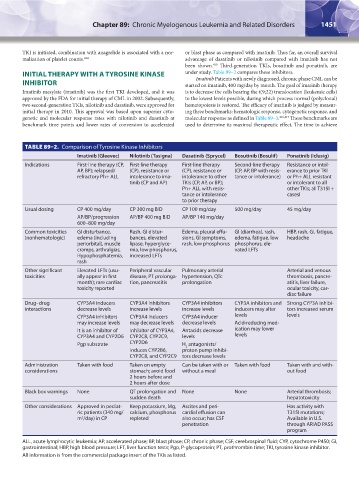
                                                                        been  shown.  Third-generation TKIs,  bosutinib and ponatinib, are
                                                                                  415
                  INITIAL THERAPY WITH A TYROSINE KINASE                under study. Table 89–2 compares these inhibitors.
                                                                            Imatinib Patients with newly diagnosed, chronic phase CML can be
                  INHIBITOR                                             started on imatinib, 400 mg/day by mouth. The goal of imatinib therapy
                  Imatinib mesylate (imatinib) was the first TKI developed, and it was   is to decrease the cells bearing the t(9;22) translocation (leukemic cells)
                  approved by the FDA for initial therapy of CML in 2002. Subsequently,   to the lowest levels possible, during which process normal (polyclonal)
                  two second-generation TKIs, nilotinib and dasatinib, were approved for   hematopoiesis is restored. The efficacy of imatinib is judged by measur-
                  initial therapy in 2010. This approval was based upon superior cyto-  ing three benchmarks: hematologic response, cytogenetic response, and
                  genetic and molecular response rates with nilotinib and dasatinib at   molecular response as defined in Table 89–3. 416,417  These benchmarks are
                  benchmark time points and lower rates of conversion to accelerated   used to determine its maximal therapeutic effect. The time to achieve


                   TABLE 89–2.  Comparison of Tyrosine Kinase Inhibitors
                                    Imatinib (Gleevec)  Nilotinib (Tasigna)  Dasatinib (Sprycel)  Bosutinib (Bosulif)  Ponatinib (Iclusig)
                   Indications      First-line therapy (CP,  First-line therapy   First-line therapy   Second-line therapy   Resistance or intol-
                                    AP, BP); relapsed/  (CP), resistance or   (CP), resistance or   (CP, AP, BP with resis-  erance to prior TKI
                                    refractory Ph+ ALL  intolerance to ima-  intolerance to other   tance or intolerance)  or Ph+ ALL resistant
                                                      tinib (CP and AP)  TKIs (CP, AP, or BP);             or intolerant to all
                                                                       Ph+ ALL with resis-                 other TKIs; all T315I +
                                                                       tance or intolerance                casesI
                                                                       to prior therapy
                   Usual dosing     CP 400 mg/day     CP 300 mg BID    CP 100 mg/day     500 mg/day        45 mg/day
                                    AP/BP/progression   AP/BP 400 mg BID  AP/BP 140 mg/day
                                    600–800 mg/day
                   Common toxicities   GI disturbance,   Rash, GI distur-  Edema, pleural effu-  GI (diarrhea), rash,   HBP, rash, GI, fatigue,
                   (nonhematologic)  edema (including   bances, elevated   sions, GI symptoms,   edema, fatigue, low   headache
                                    periorbital), muscle   lipase, hyperglyce-  rash, low phosphorus phosphorus, ele-
                                    cramps, arthralgias,   mia, low phosphorus,          vated LFTs
                                    Hypophosphatemia,   increased LFTs
                                    rash
                   Other significant   Elevated LFTs (usu-  Peripheral vascular   Pulmonary arterial       Arterial and venous
                   toxicities       ally appear in first   disease, PT prolonga- hypertension, QTc         thrombosis, pancre-
                                    month); rare cardiac   tion, pancreatitis  prolongation                atitis, liver failure,
                                    toxicity reported                                                      ocular toxicity, car-
                                                                                                           diac failure
                   Drug–drug        CYP3A4 inducers   CYP3A4 inhibitors   CYP3A4 inhibitors   CYP3A inhibitors and  Strong CYP3A inhibi-
                   interactions     decrease levels   increase levels  increase levels   inducers may alter   tors increased serum
                                    CYP3A4 inhibitors   CYP3A4 inducers   CYP3A4 inducer   levels          levels
                                    may increase levels  may decrease levels  decrease levels  Acid-reducing med-
                                    It is an inhibitor of   Inhibitor of CYP3A4,   Antacids decrease   ication may lower
                                    CYP3A4 and CYP2D6  CYP2C8, CYP2C9,   levels          levels
                                    Pgp substrate     CYP2D6           H  antagonists/
                                                                         2
                                                      Induces CYP2B6,   proton pump inhibi-
                                                      CYP2C8, and CYP2C9  tors decrease levels
                   Administration   Taken with food   Taken on empty   Can be taken with or  Taken with food  Taken with and with-
                   considerations                     stomach; avoid food   without a meal                 out food
                                                      2 hours before and
                                                      2 hours after dose
                   Black box warnings  None           QT prolongation and  None          None              Arterial thrombosis;
                                                      sudden death                                         hepatotoxicity
                   Other considerations  Approved in pediat-  Keep potassium, Mg,  Ascites and peri-       Has activity with
                                    ric patients (340 mg/  calcium, phosphorus  cardial effusion can       T315I mutations;
                                    m /day) in CP     repleted         also occur; has CSF                 Available in U.S.
                                      2
                                                                       penetration                         through ARIAD PASS
                                                                                                           program
                  ALL, acute lymphocytic leukemia; AP, accelerated phase; BP, blast phase; CP, chronic phase; CSF, cerebrospinal fluid; CYP, cytochrome P450; GI,
                  gastrointestinal; HBP, high blood pressure; LFT, liver function tests; Pgp, P-glycoprotein; PT, prothrombin time; TKI, tyrosine kinase inhibitor.
                  All information is from the commercial package insert of the TKIs as listed.


          Kaushansky_chapter 89_p1437-1490.indd   1451                                                                  9/18/15   3:41 PM

