


Page 1477 - Williams Hematology ( PDFDrive )
P. 1477
1452           Part X:  Malignant Myeloid Diseases                                                                                                   Chapter 89:  Chronic Myelogenous Leukemia and Related Disorders             1453


                                                                                                              421
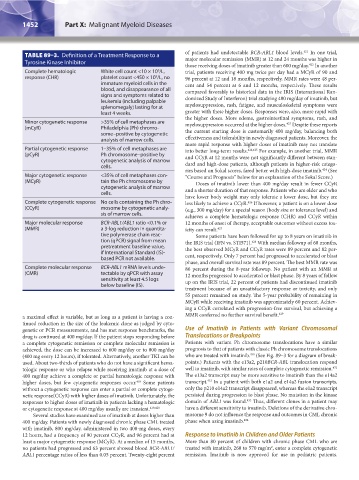
                TABLE 89–3.  Definition of a Treatment Response to a   of patients had undetectable  BCR-ABL1 blood levels.  In one trial,
                                                                      major molecular remission (MMR) at 12 and 24 months was higher in
                Tyrosine Kinase Inhibitor
                                                                                                                422
                                                                      those receiving doses of imatinib greater than 600 mg/day.  In another
                Complete hematologic      White cell count <10 × 10 /L,   trial, patients receiving 400 mg twice per day had a MCyR of 90 and
                                                             9
                response (CHR)            platelet count <450 × 10 /L, no   96 percent at 12 and 18 months, respectively. MMR rates were 48 per-
                                                            9
                                          immature myeloid cells in the   cent and 54 percent at 6 and 12 months, respectively. These results
                                          blood, and disappearance of all   compared favorably to historical data in the IRIS (International Ran-
                                          signs and symptoms related to   domized Study of Interferon) trial studying 400 mg/day of imatinib, but
                                          leukemia (including palpable
                                          splenomegaly) lasting for at   myelosuppression, rash, fatigue, and musculoskeletal symptoms were
                                          least 4 weeks.              greater with these higher doses. Responses were, also, more rapid with
                                                                      the higher doses.  More edema,  gastrointestinal symptoms,  rash, and
                Minor cytogenetic response   >35% of cell metaphases are   myelosuppression occurred at the higher doses.  Despite these reports
                                                                                                        423
                (mCyR)                    Philadelphia (Ph) chromo-
                                          some–positive by cytogenetic   the current starting dose is customarily 400 mg/day, balancing both
                                          analysis of marrow cells.   effectiveness and tolerability in newly diagnosed patients. Moreover, the
                                                                      more rapid response with higher doses of imatinib may not translate
                Partial cytogenetic response   1–35% of cell metaphases are   into better long-term results. 424,425  For example, in another trial, MMR
                (pCyR)                    Ph chromosome–positive by   and CCyR at 12 months were not significantly different between stan-
                                          cytogenetic analysis of marrow
                                          cells.                      dard and high-dose patients, although patients in higher-risk catego-
                                                                      ries based on Sokal scores, fared better with high-dose imatinib.  (See
                                                                                                                    424
                Major cytogenetic response   <35% of cell metaphases con-  “Course and Prognosis” below for an explanation of the Sokal Score.)
                (MCyR)                    tain the Ph chromosome by       Doses of imatinib lower than 400 mg/day result in fewer CCyR
                                          cytogenetic analysis of marrow   and a shorter duration of that response. Patients who are older and who
                                          cells.
                                                                      have lower body weight may only tolerate a lower dose, but they are
                Complete cytogenetic response  No cells containing the Ph chro-  less likely to achieve a CCyR.  If however, a patient is on a lower dose
                                                                                           426
                (CCyR)                    mosome by cytogenetic analy-  (e.g., 300 mg/day) for a special reason (body size or tolerance level) and
                                          sis of marrow cells.
                                                                      achieves a complete hematologic response (CHR) and CCyR within
                Major molecular response   BCR-ABL1/ABL1 ratio <0.1% or   12 months of onset of therapy, acceptable outcomes without excess tox-
                (MMR)                     a 3-log reduction in quantita-  icity can result. 427
                                          tive polymerase chain reac-     Some patients have been followed for up to 8 years on imatinib in
                                          tion (qPCR) signal from mean   the IRIS trial (IFN vs. STI571).  With median followup of 60 months,
                                                                                            428
                                          pretreatment baseline value,   the best observed MCyR and CCyR rates were 89 percent and 82 per-
                                          if International Standard (IS)-
                                          based PCR not available.    cent, respectively. Only 7 percent had progressed to accelerated or blast
                                                                      phase, and overall survival rate was 89 percent. The best MMR rate was
                Complete molecular response   BCR-ABL1 mRNA levels unde-  86 percent during the 8-year followup. No patient with an MMR at
                (CMR)                     tectable by qPCR with assay   12 months progressed to accelerated or blast phase. By 8 years of follow
                                          sensitivity at least 4.5 logs   up on the IRIS trial, 22 percent of patients had discontinued imatinib
                                          below baseline (IS).
                                                                      treatment because of an unsatisfactory response or toxicity, and only
                                                                      55 percent remained on study. The 5-year probability of remaining in
                                                                      MCyR while receiving imatinib was approximately 60 percent. Achiev-
                                                                      ing a CCyR correlated with progression-free survival, but achieving a
               a maximal effect is variable, but as long as a patient is having a con-  MMR conferred no further survival benefit. 429
               tinued reduction in the size of the leukemic clone as judged by cyto-
               genetic or PCR measurements, and has met response benchmarks, the   Use  of  Imatinib  in  Patients  with  Variant  Chromosomal
               drug is continued at 400 mg/day. If the patient stops responding before   Translocations or Breakpoints
               a complete cytogenetic remission or complete molecular remission is   Patients  with  variant  Ph  chromosome  translocations  have  a  similar
               achieved, the dose can be increased to 600 mg/day or to 800 mg/day     prognosis to that of patients with classic Ph chromosome translocations
                                                                                            430
               (400 mg every 12 hours), if tolerated. Alternatively, another TKI can be   who are treated with imatinib.  (See Fig. 89–3 for a diagram of break-
               used. About two-thirds of patients who do not have a significant hema-  points.) Patients with the e13a2, p210BCR-ABL translocation respond
                                                                                                                       431
               tologic response or who relapse while receiving imatinib at a dose of   well to imatinib, with similar rates of complete cytogenetic remission.
               400 mg/day achieve a complete or partial hematologic response with   The e13a2 transcript may be more sensitive to imatinib than the e14a2
                                                                             432
               higher doses, but few cytogenetic responses occur.  Some patients   transcript.  In a patient with both e1a2 and e14a2 fusion transcripts,
                                                      418
               without a cytogenetic response can enter a partial or complete cytoge-  only the p210 e14a2 transcript disappeared, whereas the e1a2 transcript
               netic response(CCyR) with higher doses of imatinib. Unfortunately, the   persisted during progression to blast phase. No mutation in the kinase
                                                                                           433
               responses to higher doses of imatinib in patients lacking a hematologic   domain of ABL1 was found.  Thus, different clones in a patient may
               or cytogenetic response at 400 mg/day usually are transient. 419,420  have a different sensitivity to imatinib. Deletions of the derivative chro-
                   Several studies have examined use of imatinib at doses higher than   mosome 9 do not influence the response and outcomes in CML chronic
               400 mg/day. Patients with newly diagnosed chronic phase CML treated   phase when using imatinib. 434
               with imatinib, 800 mg/day, administered in two 400-mg doses, every
               12 hours, had a frequency of 90 percent CCyR, and 96 percent had at   Response to Imatinib in Children and Older Patients
               least a major cytogenetic response (MCyR). At a median of 15 months,   More than 80 percent of children with chronic phase CML who are
               no patients had progressed and 63 percent showed blood BCR-ABL1/  treated with imatinib, 260 to 570 mg/m , enter a complete cytogenetic
                                                                                                   2
               ABL1 percentage ratios of less than 0.05 percent. Twenty-eight percent   remission. Imatinib is now approved for use in pediatric patients.


          Kaushansky_chapter 89_p1437-1490.indd   1452                                                                  9/18/15   3:41 PM

