


Page 1555 - Williams Hematology ( PDFDrive )
P. 1555
1530           Part XI:  Malignant Lymphoid Diseases                                                                                                                        Chapter 92:  Chronic Lymphocytic Leukemia            1531


                    CLINICAL PRESENTATION OF CHRONIC

                  LYMPHOCYTIC LEUKEMIA
               CLL is a disease of the elderly with the median age at diagnosis being 72
               years. Most patients are asymptomatic at diagnosis and are diagnosed
               as a result of incidental finding of lymphadenopathy and lymphocytosis
               of uncertain etiology as part of an evaluation unrelated to CLL. A vast
               majority of patients may not have any significant symptoms related to
               the disease but some patients may experience mild fatigue or minor lim-
               itations in their activities of daily living. A subset of patients may present
               with recurring infectious complications, especially upper respiratory
               tract infections. Patients with advanced disease can uncommonly pres-
               ent with drenching night sweats, fevers, and weight loss (B symptoms),
               and signs and symptoms related to anemia, thrombocytopenia, and
               lymphadenopathy. The lymphadenopathy typically observed in patients
               with CLL is generally not fixed or tender and very rarely causes symp-
               toms of organ dysfunction or resulting dependent-limb lymphedema.
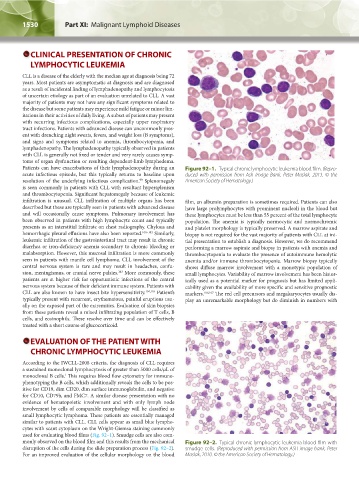
               Patients can have exacerbations of their lymphadenopathy during an   Figure 92–1.  Typical chronic lymphocytic leukemia blood film. (Repro-
               acute infectious episode, but this typically returns to baseline upon   duced with permission from Ash Image Bank, Peter Maslak, 2013, © the
               resolution of the underlying infectious complication.  Splenomegaly   American Society of Hematology.)
                                                       99
               is seen commonly in patients with CLL with resultant hypersplenism
               and thrombocytopenia. Significant hepatomegaly because of leukemic
               infiltration is unusual. CLL infiltration of multiple organs has been   film, an albumin preparation is sometimes required. Patients can also
               described but these are typically seen in patients with advanced disease   have large prolymphocytes with prominent nucleoli in the blood but
               and will occasionally cause symptoms. Pulmonary involvement has   these lymphocytes must be less than 55 percent of the total lymphocyte
               been observed in patients with high lymphocyte count and typically   population. The anemia is typically normocytic and normochromic
               presents as an interstitial infiltrate on chest radiography. Chylous and   and platelet morphology is typically preserved. A marrow aspirate and
               hemorrhagic pleural effusions have also been reported. 100–102  Similarly,   biopsy is not required for the vast majority of patients with CLL at ini-
               leukemic infiltration of the gastrointestinal tract may result in chronic   tial presentation to establish a diagnosis. However, we do recommend
               diarrhea or iron-deficiency anemia secondary to chronic bleeding or   performing a marrow aspirate and biopsy in patients with anemia and
               malabsorption. However, this mucosal infiltration is more commonly   thrombocytopenia to evaluate the presence of autoimmune hemolytic
               seen in patients with mantle cell lymphoma. CLL involvement of the   anemia and/or immune thrombocytopenia. Marrow biopsy typically
               central nervous system is rare and may result in headaches, confu-  shows diffuse marrow involvement with a monotypic population of
               sion, meningismus, or cranial nerve palsies.  More commonly, these   small lymphocytes. Variability of marrow involvement has been histor-
                                                103
               patients are at higher risk for opportunistic infections of the central   ically used as a potential marker for prognosis but has limited appli-
               nervous system because of their deficient immune system. Patients with   cability given the availability of more specific and sensitive prognostic
               CLL are also known to have insect bite hypersensitivity. 104,105  Patient’s   markers. 106,107  The red cell precursors and megakaryocytes usually dis-
               typically present with recurrent, erythematous, painful eruptions usu-  play an unremarkable morphology but do diminish in numbers with
               ally on the exposed part of the extremities. Evaluation of skin biopsies
               from these patients reveal a mixed infiltrating population of T cells, B
               cells, and eosinophils. These resolve over time and can be effectively
               treated with a short course of glucocorticoid.

                    EVALUATION OF THE PATIENT WITH
                  CHRONIC LYMPHOCYTIC LEUKEMIA

               According to the IWCLL-2008 criteria, the diagnosis of CLL requires
               a sustained monoclonal lymphocytosis of greater than 5000 cells/μL of
               monoclonal B cells.  This requires blood flow cytometry for immuno-
                              1
               phenotyping the B cells, which additionally reveals the cells to be pos-
               itive for CD19, dim CD20, dim surface immunoglobulin, and negative
               for CD10, CD79b, and FMC7. A similar disease presentation with no
               evidence of hematopoietic involvement and with only lymph node
               involvement by cells of comparable morphology will be classified as
               small lymphocytic lymphoma. These patients are essentially managed
               similar to patients with CLL. CLL cells appear as small blue lympho-
               cytes with scant cytoplasm on the Wright-Giemsa staining commonly
               used for evaluating blood films (Fig. 92–1). Smudge cells are also com-
               monly observed on the blood film and this results from the mechanical   Figure 92–2.  Typical chronic lymphocytic leukemia blood film with
               disruption of the cells during the slide preparation process (Fig. 92–2).   smudge cells. (Reproduced with permission from ASH image bank, Peter
               For an improved evaluation of the cellular morphology on the blood   Maslak, 2010. © the American Society of Hematology.)


          Kaushansky_chapter 92_p1527-1552.indd   1530                                                                  9/18/15   10:47 AM

