


Page 1557 - Williams Hematology ( PDFDrive )
P. 1557
1532           Part XI:  Malignant Lymphoid Diseases                                                                                                                        Chapter 92:  Chronic Lymphocytic Leukemia            1533


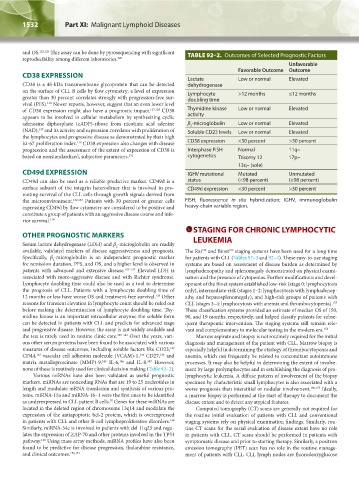
               and OS. 125,126  This assay can be done by pyrosequencing with significant   TABLE 92–2.  Outcomes of Selected Prognostic Factors
               reproducibility among different laboratories. 126
                                                                                                         Unfavorable
                                                                                        Favorable Outcome  Outcome
               CD38 EXPRESSION                                         Lactate          Low or normal    Elevated
               CD38 is a 45-kDa transmembrane glycoprotein that can be detected   dehydrogenase
               on the surface of CLL B cells by flow cytometry; a level of expression   Lymphocyte    >12 months  ≤12 months
               greater than 30 percent correlates strongly with progression-free sur-  doubling time
               vival (PFS).  Newer reports, however, suggest that an even lower level
                        118
               of CD38 expression might also have a prognostic impact. 127,128  CD38   Thymidine kinase   Low or normal  Elevated
               appears to be involved in cellular metabolism by synthesizing cyclic   activity
               adenosine  diphosphate  (cADP)-ribose  from  nicotinic  acid  adenine   β -microglobulin  Low or normal  Elevated
                                                                        2
               (NAD),  and its activity and expression correlates with proliferation of   Soluble CD23 levels  Low or normal  Elevated
                     129
               the lymphocytes and progressive disease as demonstrated by their high
               Ki-67 proliferation index.  CD38 expression also changes with disease   CD38 expression  <30 percent  >30 percent
                                  130
               progression and the assessment of the extent of expression of CD38 is   Interphase FISH   Normal  11q–
               based on nonstandardized, subjective parameters. 131    cytogenetics     Trisomy 12       17p–
                                                                                        13q– (sole)
               CD49d EXPRESSION                                        IGHV mutational   Mutated         Unmutated

               CD49d can also be used as a reliable predictive marker. CD49d is a   status  (<98 percent)  (≥98 percent)
               surface subunit of the integrin heterodimer that is involved in pro-  CD49d expression  <30 percent  >30 percent
               moting survival of the CLL cells through growth signals derived from
               the microenvironment. 132,133  Patients with 30 percent or greater cells   FISH, fluorescence  in situ hybridization; IGHV, immunoglobulin
               expressing CD49d by flow cytometry are considered to be positive and   heavy-chain variable region.
               constitute a group of patients with an aggressive disease course and infe-
               rior survival. 134
                                                                           STAGING FOR CHRONIC LYMPHOCYTIC
               OTHER PROGNOSTIC MARKERS

               Serum lactate dehydrogenase (LDH) and β -microglobulin are readily   LEUKEMIA
                                               2
               available, validated markers of disease aggressiveness and prognosis.   The Rai  and Binet  staging systems have been used for a long time
                                                                            152
                                                                                     153
               Specifically,  β -microglobulin is an independent prognostic marker   for patients with CLL (Tables 92–3 and 92–4). These easy-to-use staging
                          2
               for remission duration, PFS, and OS, and a higher level is observed in   systems are based on assessment of disease burden as determined by
               patients with advanced and extensive disease. 135–137  Elevated LDH is   lymphadenopathy and splenomegaly demonstrated on physical exami-
               associated with more-aggressive disease and with Richter syndrome.   nation and the presence of cytopenias. Further modifications and devel-
               Lymphocyte doubling time could also be used as a tool to determine   opment of the Binet system established low-risk (stage 0: lymphocytosis
               the prognosis of CLL. Patients with a lymphocyte doubling time of     only), intermediate-risk (stages 1–2: lymphocytosis with lymphadenop-
               12 months or less have worse OS and treatment-free survival.  Other   athy and hepatosplenomegaly), and high-risk groups of patients with
                                                            138
               reasons for transient elevation in lymphocyte count should be ruled out   CLL (stages 3–4: lymphocytosis with anemia and thrombocytopenia).
                                                                                                                       153
               before making the determination of lymphocyte doubling time. Thy-  These classification systems provided an estimate of median OS of 150,
               midine kinase is an important intracellular enzyme; the soluble form   90, and 19 months, respectively, and helped classify patients for subse-
               can be detected in patients with CLL and predicts for advanced stage   quent therapeutic intervention. The staging systems still remain rele-
               and progressive disease. However, the assay is not widely available and   vant and complementary to molecular testing in the modern era. 154
               the test is rarely used in routine clinic care. 139–141  Over the years, vari-  Marrow aspirate and biopsy is not routinely required for the initial
               ous other serum proteins have been found to be associated with various   diagnosis and management of the patient with CLL. Marrow biopsy is
               measures of disease outcomes, including soluble factors like CD23,    especially helpful in determining the etiology of thrombocytopenia and
                                                                 142
               CD44,  vascular cell adhesion molecule (VCAM)-1,  CD27,  and   anemia, which can frequently be related to concomitant autoimmune
                                                              144
                                                       144
                    143
               matrix  metalloproteinase  (MMP)-9,   IL-6,   and IL-8.   However,   processes. It may also be helpful in determining the extent of involve-
                                          145
                                                146
                                                         147
               none of these is routinely used for clinical decision making (Table 92–2).  ment by large prolymphocytes and in establishing the diagnosis of pro-
                   Various miRNAs have also  been validated as useful prognostic   lymphocytic leukemia. A diffuse pattern of involvement of the biopsy
               markers. miRNAs are noncoding RNAs that are 19 to 25 nucleotides in   specimen by characteristic small lymphocytes is also associated with a
               length and modulate mRNA translation and synthesis of various pro-  worse prognosis than interstitial or nodular involvement. 106,155  Ideally,
               teins. miRNA-15a and miRNA-16–1 were the first ones to be identified   a marrow biopsy is performed at the start of therapy to document the
               as underexpressed in CLL patient B cells.  Genes for these miRNAs are   disease extent and to detect any atypical features.
                                             76
               located in the deleted region of chromosome 13q14 and modulate the   Computed tomography (CT) scans are generally not required for
               expression of the antiapoptotic bcl-2 protein, which is overexpressed   the routine initial evaluation of patients with CLL and conventional
               in patients with CLL and other B-cell lymphoproliferative disorders.    staging systems rely on physical examination findings. Similarly, rou-
                                                                 148
               Similarly, miRNA-34c is involved in patients with del 11q23 and regu-  tine CT scans for the serial evaluation of disease extent have no role
               lates the expression of ZAP-70 and other proteins involved in the TP53   in patients with CLL. CT scans should be performed in patients with
               pathway.  Using mass array methods, miRNA profiles have also been   symptomatic disease and prior to starting therapy. Similarly, a positron
                      149
               found to be predictive for disease progression, fludarabine resistance,   emission tomography (PET) scan has no role in the routine manage-
               and clinical outcomes. 150,151                         ment of patients with CLL. CLL lymph nodes are fluorodeoxyglucose


          Kaushansky_chapter 92_p1527-1552.indd   1532                                                                  9/18/15   10:47 AM

