


Page 1556 - Williams Hematology ( PDFDrive )
P. 1556
1530  Part XI:  Malignant Lymphoid Diseases                    Chapter 92:  Chronic Lymphocytic Leukemia             1531


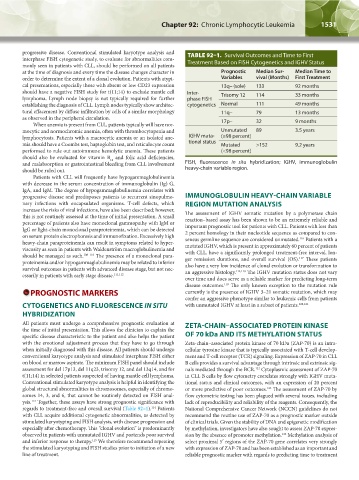
                  progressive  disease.  Conventional  stimulated  karyotype  analysis  and   TABLE 92–1.  Survival Outcomes and Time to First
                  interphase FISH cytogenetic study, to evaluate for abnormalities com-
                  monly seen in patients with CLL, should be performed on all patients   Treatment Based on FISH Cytogenetics and IGHV Status
                  at the time of diagnosis and every time the disease changes character in   Prognostic   Median Sur-  Median Time to
                  order to determine the extent of a clonal evolution. Patients with atypi-  Variables  vival (Months)  First Treatment
                  cal presentations, especially those with absent or low CD23 expression   13q– (sole)  133  92 months
                  should have a negative FISH study for t(11;14) to exclude mantle cell   Inter-  Trisomy 12  114  33 months

                  lymphoma. Lymph node biopsy is not typically required for further   phase FISH
                  establishing the diagnosis of CLL. Lymph nodes typically show architec-    cytogenetics  Normal  111  49 months
                  tural effacement by diffuse infiltration by cells of a similar morphology      11q–  79    13 months
                  as observed in the peripheral circulation.                        17p–        32           9 months
                     When anemia is present from CLL, patients typically will have nor-
                  mocytic and normochromic anemia, often with thrombocytopenia and   Unmutated   89          3.5 years
                  lymphocytosis. Patients with a macrocytic anemia or an isolated ane-  IGHV muta-  (≥98 percent)
                  mia should have a Coombs test, haptoglobin test, and reticulocyte count     tional status  Mutated   >152  9.2 years
                  performed to rule out autoimmune hemolytic anemia. These patients   (<98 percent)
                  should also be evaluated for vitamin B  and folic acid deficiencies,
                                               12
                  and malabsorption or gastrointestinal bleeding from CLL involvement   FISH, fluorescence  in situ hybridization; IGHV, immunoglobulin
                  should be ruled out.                                  heavy-chain variable region.
                     Patients with CLL will frequently have hypogammaglobulinemia
                  with decrease in the serum concentration of immunoglobulin (Ig) G,
                  IgA, and IgM. The degree of hypogammaglobulinemia correlates with
                  progressive disease and predisposes patients to recurrent sinopulmo-  IMMUNOGLOBULIN HEAVY-CHAIN VARIABLE
                  nary infections with encapsulated organisms. T-cell defects, which   REGION MUTATION ANALYSIS
                  increase the risks of viral infections, have also been described; however,   The assessment of IGHV somatic mutation by a polymerase chain
                  this is not routinely assessed at the time of initial presentation. A small   reaction–based assay has been shown to be an extremely reliable and
                  percentage of patients also have monoclonal gammopathy with IgM or   important prognostic tool for patients with CLL. Patients with less than
                  IgG or light-chain monoclonal paraproteinemia, which can be detected   2 percent homology in their nucleotide sequence as compared to con-
                  on serum protein electrophoresis and immunofixation. Excessively high   sensus germline sequence are considered unmutated.  Patients with a
                                                                                                               116
                  heavy-chain paraproteinemia can result in symptoms related to hyper-  mutated IGHV, which is present in approximately 60 percent of patients
                  viscosity as seen in patients with Waldenström macroglobulinemia and   with CLL, have a significantly prolonged treatment-free interval, lon-
                  should be managed as such. 108–110  The presence of a monoclonal para-  ger remission durations, and overall survival (OS).  These patients
                                                                                                               117
                  proteinemia and/or hypogammaglobulinemia may be related to inferior   also have a very low incidence of clonal evolution or transformation to
                  survival outcomes in patients with advanced disease stage, but not nec-  an aggressive histology. 114,118  The IGHV mutation status does not vary
                  essarily in patients with early stage disease. 111,112
                                                                        over time and does serve as a reliable marker for predicting long-term
                                                                        disease outcomes.  The only known exception to the mutation rule
                                                                                      119
                     PROGNOSTIC MARKERS                                 currently is the presence of IGHV 3–21 somatic mutation, which may
                                                                        confer an aggressive phenotype similar to leukemic cells from patients
                  CYTOGENETICS AND FLUORESCENCE IN SITU                 with unmutated IGHV at least in a subset of patients. 120,121
                  HYBRIDIZATION
                  All patients must undergo a comprehensive prognostic evaluation at   ZETA-CHAIN–ASSOCIATED PROTEIN KINASE
                  the time of initial presentation. This allows the clinician to explain the
                  specific disease characteristic to the patient and also helps the patient   OF 70 kDa AND ITS METHYLATION STATUS
                  with the emotional adjustment process that they have to go through   Zeta-chain–associated protein kinase of 70 kDa (ZAP-70) is an intra-
                  when initially diagnosed with this disease. All patients should undergo   cellular tyrosine kinase that is typically associated with T-cell develop-
                  conventional karyotype analysis and stimulated interphase FISH either   ment and T-cell receptor (TCR) signaling. Expression of ZAP-70 in CLL
                  on blood or marrow aspirate. The minimum FISH panel should include   B cells provides a survival advantage through intrinsic and extrinsic sig-
                  assessment for del 17p13, del 11q23, trisomy 12, and del 13q14, and for   nals mediated through the BCR.  Cytoplasmic assessment of ZAP-70
                                                                                                122
                  t(11;14) in selected patients suspected of having mantle cell lymphoma.   in CLL B cells by flow cytometry correlates strongly with IGHV muta-
                  Conventional stimulated karyotype analysis is helpful in identifying the   tional status and clinical outcomes, with an expression of 20 percent
                  global structural abnormalities in chromosomes, especially of chromo-  or more predictive of poor outcomes.  The assessment of ZAP-70 by
                                                                                                    123
                  somes 14, 3, and 6, that cannot be routinely detected on FISH anal-  flow cytometric testing has been plagued with several issues, including
                  ysis.  Together, these assays have strong prognostic significance with   lack of reproducibility and reliability of the reagents. Consequently, the
                     113
                                                             114
                  regards to treatment-free and overall survival (Table 92–1).  Patients   National Comprehensive Cancer Network (NCCN) guidelines do not
                  with CLL acquire additional cytogenetic abnormalities, as detected by   recommend the routine use of ZAP-70 as a prognostic marker outside
                  stimulated karyotyping and FISH analysis, with disease progression and   of clinical trials. Given the stability of DNA and epigenetic modification
                  especially after chemotherapy. This “clonal evolution” is predominantly   by methylation, investigators have also sought to assess ZAP-70 expres-
                  observed in patients with unmutated IGHV and portends poor survival   sion by the absence of promoter methylation.  Methylation analysis of
                                                                                                         124
                  and inferior response to therapy.  We therefore recommend repeating   select proximal 5′ regions of the ZAP-70 gene correlates very strongly
                                         115
                  the stimulated karyotyping and FISH studies prior to initiation of a new   with expression of ZAP-70 and has been established as an important and
                  line of treatment.                                    reliable prognostic marker with regards to predicting time to treatment


          Kaushansky_chapter 92_p1527-1552.indd   1531                                                                  9/18/15   10:47 AM

