


Page 158 - Williams Hematology ( PDFDrive )
P. 158
132  Part III:  Epochal Hematology                                 Chapter 9:  Hematology in Older Persons            133


                  in several organs, but after birth this function is subsumed by the mar-  senescence and that such changes are responsible for the development of
                  row. 142–148  The process of embryonic and fetal hematopoiesis is described   immune senescence, as well as the increased occurrence of age-associ-
                  in Chap. 7. Hematopoietic cells appear in the medullary cavities of bone   ated diseases such as myelodysplasia and leukemia. Thus, the process of
                  around 14 weeks of gestation,  and by birth the marrow is the primary   “immunosenescence,” as it affects the innate and adaptive immune sys-
                                       149
                  site of hematopoiesis.                                tem, may result from HSC aging. For example, an age-related decrease
                     Unlike the commonly held notion that stem cell compartments   in the provision of B-cell precursors may be the result of HSC aging. 148
                  diminish either in number or function with age ultimately resulting in
                  an inability to meet homeostatic demands, age-related hematopoietic
                  stem cell (HSC) changes appear to be an exception, at least for murine   MARROW DURING ADULT LIFE
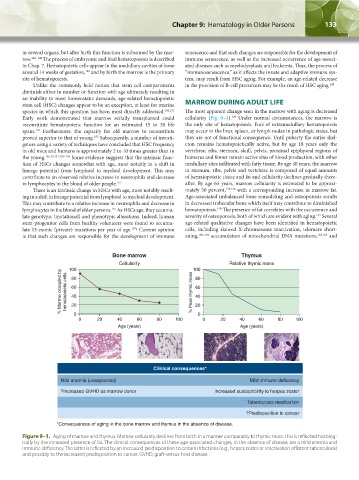
                  species in which this question has been most directly addressed. 150,151    The most apparent change seen in the marrow with aging is decreased
                                                                                        135
                  Early work demonstrated that marrow serially transplanted could   cellularity (Fig. 9–1).  Under normal circumstances, the marrow is
                  reconstitute hematopoietic function for an estimated 15 to 20 life   the only site of hematopoiesis. Foci of extramedullary hematopoiesis
                      152
                  spans.  Furthermore, the capacity for old marrow to reconstitute   may occur in the liver, spleen, or lymph nodes in pathologic states, but
                  proved superior to that of young.  Subsequently, a number of investi-  they are not of functional consequence. Until puberty the entire skel-
                                          153
                  gators using a variety of techniques have concluded that HSC frequency   eton remains hematopoietically active, but by age 18 years only the
                  in old mice and humans is approximately 2 to 10 times greater than in   vertebrae, ribs, sternum, skull, pelvis, proximal epiphyseal regions of
                  the young. 16,150,151,154–156  Some evidence suggests that the intrinsic func-  humerus and femur remain active sites of blood production, with other
                  tion of HSCs changes somewhat with age, most notably in a shift in   medullary sites infiltrated with fatty tissue. By age 40 years, the marrow
                  lineage potential from lymphoid to myeloid development. This may   in sternum, ribs, pelvis and vertebrae is composed of equal amounts
                  contribute to an observed relative increase in neutrophils and decrease   of hematopoietic tissue and fat and cellularity declines gradually there-
                  in lymphocytes in the blood of older people. 157      after. By age 65 years, marrow cellularity is estimated to be approxi-
                     There is an intrinsic change in HSCs with age, most notably result-  mately 30 percent, 135,136  with a corresponding increase in marrow fat.
                  ing in a shift in lineage potential from lymphoid to myeloid development.   Age-associated imbalanced bone remodeling and osteoporosis results
                  This may contribute to a relative increase in neutrophils and decrease in   in decreased trabecular bone which itself may contribute to diminished
                                                157
                  lymphocytes in the blood of older persons.  As HSCs age, they accumu-  hematopoiesis.  The presence of fat correlates with the occurrence and
                                                                                   158
                  late genotypic (mutational) and phenotypic alterations. Indeed, human   severity of osteoporosis, both of which are evident with aging.  Several
                                                                                                                    159
                  stem-progenitor cells from healthy volunteers were found to accumu-  age-related qualitative changes have been identified in hematopoietic
                  late 13 exonic (private) mutations per year of age. 157a  Current opinion   cells, including skewed X-chromosome inactivation, telomere short-
                  is that such changes are responsible for the development of immune   ening, 160–162  accumulation of mitochondrial DNA mutations, 163,164  and
                                                Bone marrow                                Thymus
                                                  Cellularity                          Relative thymic mass
                                 100                                       100
                               % Marrow occupied by  hematopoietic cells  60  % Peak thymic mass  60
                                  80
                                                                            80

                                                                            40
                                  40
                                                                            20
                                  20
                                   0
                                     0     20     40    60     80    100     0  0   20     40    60    80    100
                                                  Age (years)                              Age (years)


                                                              Clinical consequences*
                               Mild anemia (unexplained)                                      Mild immune deficiency

                               ?Increased GVHD as marrow donor                     Increased susceptibility to herpes zoster
                                                                                             Tuberculosis reactivation
                                                                                             ?Predisposition to cancer
                             *Consequences of aging in the bone marrow and thymus in the absence of disease.

                  Figure 9–1.  Aging of marrow and thymus. Marrow cellularity declines from birth in a manner comparably to thymic mass. This is reflected histolog-
                  ically by the increased presence of fat. The clinical consequences of these age-associated changes, in the absence of disease, are a mild anemia and
                  immune deficiency. The latter is reflected by an increased predisposition to certain infections (e.g., herpes zoster or reactivation of latent tuberculosis)
                  and possibly to the increased predisposition to cancer. GVHD, graft-versus-host disease.


          Kaushansky_chapter 09_p0129-0142.indd   133                                                                   17/09/15   6:16 pm

