


Page 159 - Williams Hematology ( PDFDrive )
P. 159
134            Part III:  Epochal Hematology                                                                                                                                   Chapter 9:  Hematology in Older Persons             135


                                165
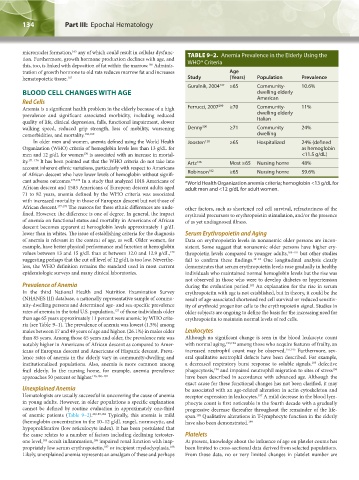
               micronuclei formation,  any of which could result in cellular dysfunc-  TABLE 9–2.  Anemia Prevalence in the Elderly Using the
               tion. Furthermore, growth hormone production declines with age, and
                                                          166
               this, too, is linked with deposition of fat within the marrow.  Adminis-  WHO* Criteria
               tration of growth hormone to old rats reduces marrow fat and increases   Age
               hematopoietic tissue. 167                               Study         (Years)  Population     Prevalence
                                                                       Guralnik, 2004 127  ≥65  Community-   10.6%
               BLOOD CELL CHANGES WITH AGE                                                    dwelling elderly
               Red Cells                                                                      American
               Anemia is a significant health problem in the elderly because of a high   Ferrucci, 2007 299  ≥70  Community-   11%
               prevalence  and  significant  associated  morbidity,  including  reduced       dwelling elderly
               quality of life, clinical depression, falls, functional impairment, slower     Italian
               walking speed, reduced grip strength, loss of mobility, worsening   Denny 300  ≥71  Community   24%
               comorbidities, and mortality. 168,169                                          dwelling
                   In older men and women, anemia defined using the World Health   Joosten 128  ≥65  Hospitalized  24% (defined
               Organization (WHO) criteria of hemoglobin levels less than 13 g/dL for                        as hemoglobin
               men and 12 g/dL for women  is associated with an increase in mortal-                          <11.5 g/dL)
                                    170
               ity. 171–176  It has been pointed out that the WHO criteria do not take into   Artz 126  Most ≥65  Nursing home  48%
               account inherent ethnic variations, particularly with respect to Americans
               of African descent who have lower levels of hemoglobin without signifi-  Robinson 182  ≥65  Nursing home  59.6%
               cant adverse outcomes. 177,178  In a study that analyzed 1018 Americans of   *World Health Organization anemia criteria; hemoglobin <13 g/dL for
               African descent and 1583 Americans of European descent adults aged   adult men and <12 g/dL for adult women.
               71 to 82 years, anemia defined by the WHO criteria was associated
               with increased mortality in those of European descent but not those of
               African descent. 177,178  The reasons for these ethnic differences are unde-  other factors, such as shortened red cell survival, refractoriness of the
               fined. However, the difference is one of degree. In general, the impact   erythroid precursors to erythropoietin stimulation, and/or the presence
               of anemia on functional status and mortality in Americans of African   of as yet undiagnosed illness.
               descent becomes apparent at hemoglobin levels approximately 1 g/dL
               lower than in whites. The issue of establishing criteria for the diagnosis   Serum Erythropoietin and Aging
               of anemia is relevant in the context of age, as well. Older women, for   Data on erythropoietin levels in nonanemic older persons are incon-
               example, have better physical performance and function at hemoglobin   sistent. Some suggest that nonanemic older persons have higher ery-
               values between 13 and 15 g/dL than at between 12.0 and 12.9 g/dL,    thropoietin levels compared to younger adults, 189–191  but other studies
                                                                 179
               suggesting perhaps that the cut off level of 12 g/dL is too low. Neverthe-  fail to confirm these findings. 10–12  One longitudinal analysis clearly
               less, the WHO definition remains the standard used in most current   demonstrates that serum erythropoietin levels rose gradually in healthy
               epidemiologic surveys and many clinical laboratories.  individuals who maintained normal hemoglobin levels but the rise was
                                                                      not observed in those who were to develop diabetes or hypertension
               Prevalence of Anemia                                   during the evaluation period.  An explanation for the rise in serum
                                                                                            192
               In  the  third  National  Health  and  Nutrition  Examination  Survey   erythropoietin with age is not established, but in theory, it could be the
               (NHANES III) database, a nationally representative sample of commu-  result of age-associated shortened red cell survival or reduced sensitiv-
               nity-dwelling persons and determined age- and sex-specific prevalence   ity of erythroid progenitor cells to the erythropoietin signal. Studies in
               rates of anemia in the total U.S. population,  of those individuals older   older subjects are ongoing to define the basis for the increasing need for
                                              127
               than age 65 years approximately 11 percent were anemic by WHO crite-  erythropoietin to maintain normal levels of red cells.
               ria (see Table  9–1). The prevalence of anemia was lowest (1.5%) among
               males between 17 and 49 years of age and highest (26.1%) in males older   Leukocytes
               than 85 years. Among those 65 years and older, the prevalence rate was   Although no significant change is seen in the blood leukocyte count
               notably higher in Americans of African descent as compared to Amer-  with normal aging, 193,194  among those who acquire features of frailty, an
               icans of European descent and Americans of Hispanic descent. Preva-  increased neutrophil count may be observed. 157,195  Furthermore, sev-
               lence rates of anemia in the elderly vary in community-dwelling and   eral qualitative neutrophil defects have been described. For example,
               institutionalized populations. Also, anemia is more common among   a decreased respiratory burst response to soluble signals,  defective
                                                                                                                193
               frail elderly. In the nursing home, for example, anemia prevalence   phagocytosis,  and impaired neutrophil migration to sites of stress
                                                                                194
                                                                                                                       196
               approaches 50 percent or higher. 126,180–182           have been described in accordance with advanced age. Although the
                                                                      exact cause for these functional changes has not been clarified, it may
               Unexplained Anemia                                     be associated with an age-related alteration in actin cytoskeleton and
               Hematologists are usually successful in uncovering the cause of anemia   receptor expression in leukocytes.  A mild decrease in the blood lym-
                                                                                              197
               in young adults. However, in older populations a specific explanation   phocyte count is first noticeable in the fourth decade with a gradually
               cannot be defined by routine evaluation in approximately one-third   progressive decrease thereafter throughout the remainder of the life-
               of anemic patients (Table 9–2). 20,183,184  Typically, this anemia is mild   span.  Qualitative alterations in T-lymphocyte function in the elderly
                                                                          198
               (hemoglobin concentration in the 10–12 g/dL range), normocytic, and   have also been demonstrated. 199
               hypoproliferative (low reticulocyte index). It has been postulated that
               the cause relates to a number of factors including declining testoster-  Platelets
               one level,  occult inflammation,  impaired renal function with inap-  At present, knowledge about the influence of age on platelet counts has
                                       186
                      185
                                           187
               propriately low serum erythropoietin,  or incipient myelodysplasia.     been limited to cross-sectional data derived from selected populations.
                                                                 188
               Likely, unexplained anemia represents an amalgam of these and perhaps   From those data, no or very limited changes in platelet number are


          Kaushansky_chapter 09_p0129-0142.indd   134                                                                   17/09/15   6:16 pm

