


Page 161 - Williams Hematology ( PDFDrive )
P. 161
136            Part III:  Epochal Hematology                                                                                                                                   Chapter 9:  Hematology in Older Persons             137


                                                                      CLINICAL CONSEQUENCES
                          ? Replicative
                          senescence  Environmental                   Marrow Aging
                 Genetic factors      factors, ROS  Genetic factors   Although a number of measureable changes occur in the marrow, not
                                                                      the least of which is a reduction in cellularity, apparent compensatory
                                          Chronic Ag  Endocrine
                                           exposure  senescence       stem cell changes allow the sustenance of normal or near-normal blood
                                                                      counts throughout the life span. It is notable from transplant experi-
                        Thymic involution                             ence that even when marrow is donated from a 65-year-old person to an
                                                                      human leukocyte antigen (HLA)-matched younger recipient, the donor
                                     Immune or inflammatory           marrow supports hematopoiesis for the life of the recipient, although
                  Qualitative            dysregulation                allogeneic  marrow  from  older  donors  has  a  greater  chance  of  being
                 T-cell defects                                       associated with graft-versus-host disease. 276
                Accumulation of memory  Cytokine  Autoantibody
                 cells, fewer naïve cells  imbalance                  Unexplained Anemia
                                                      Paraproteinemia  To the extent that marrow contains continuously repopulating cell lines,
                                                                      it is quite remarkable that changes attributable to aging alone (i.e., in the
                  Mild to moderate       Chronic low-level            absence of disease) are quite subtle. Nonetheless “unexplained anemia”
                  immune deficiency       inflammation                (UA) accounts for up to one-third of cases of anemia in older patients
                                                                      and its frequency increases with advancing age. 20
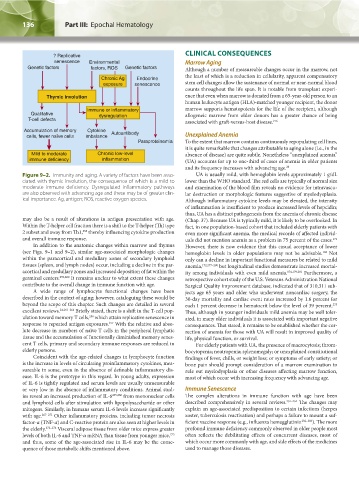
               Figure 9–2.  Immunity and aging. A variety of factors have been asso-  UA is usually mild, with hemoglobin levels approximately 1 g/dL
               ciated with thymic involution, the consequence of which is a mild to   lower than the WHO standard. The red cells are typically of normal size
               moderate immune deficiency. Dysregulated inflammatory pathways   and examination of the blood film reveals no evidence for intravascu-
               are also observed with advancing age and these may be of greater clin-  lar destruction or morphologic features suggestive of myelodysplasia.
               ical importance. Ag, antigen; ROS, reactive oxygen species.  Although inflammatory cytokine levels may be elevated, the intensity
                                                                      of inflammation is insufficient to produce increased levels of hepcidin;
                                                                      thus, UA has a distinct pathogenesis from the anemia of chronic disease
               may also be a result of alterations in antigen presentation with age.   (Chap. 37). Because UA is typically mild, it is likely to be overlooked. In
               Within the T-helper cell fraction there is a shift to the T-helper (Th) type   fact, in one population-based cohort that included elderly patients with
               2 subset and away from Th1,  thereby influencing cytokine production   even more significant anemia, the medical records of affected individ-
                                    258
               and overall immune response.                           uals did not mention anemia as a problem in 75 percent of the cases.
                                                                                                                       171
                   In addition to the anatomic changes within marrow and thymus   However, there is now evidence that this casual acceptance of lower
               (see Figs. 9–1 and 9–2), similar age-associated morphologic changes   hemoglobin levels in older populations may not be advisable.  Not
                                                                                                                    168
               within the paracortical and medullary zones of secondary lymphoid   only can a decline in important functional measures be related to mild
               tissues (spleen, and lymph nodes) occur, including a decline in the par-  anemia, 172,277–280  but longitudinal studies demonstrate increased mortal-
               acortical and medullary zones and increased deposition of fat within the   ity among individuals with even mild anemia. 174,179,281  Furthermore, a
               germinal centers. 259,260  It remains unclear to what extent these changes   retrospective cohort study of the U.S. Veterans Administration National
               contribute to the overall change in immune function with age.  Surgical Quality Improvement database, indicated that of 310,311 sub-
                   A wide range of lymphocyte functional changes have been   jects age 65 years and older who underwent noncardiac surgery, the
               described in the context of aging; however, cataloguing these would be   30-day mortality and cardiac event rates increased by 1.6 percent for
               beyond the scope of this chapter. Such changes are detailed in several   each 1 percent decrease in hematocrit below the level of 39 percent.
                                                                                                                       275
               excellent reviews. 24,261–264  Briefly stated, there is a shift in the T-cell pop-  Thus, although in younger individuals mild anemia may be well toler-
               ulation toward memory T cells,  which attain replicative senescence in   ated, in many older individuals it is associated with important negative
                                      256
               response to repeated antigen exposures.  With the relative and abso-  consequences. That stated, it remains to be established whether the cor-
                                            257
               lute decrease in numbers of naïve T cells in the peripheral lymphatic   rection of anemia for those with UA will result in improved quality of
               tissue and the accumulation of functionally diminished memory senes-  life, physical function, or survival.
               cent T cells, primary and secondary immune responses are reduced in   For elderly patients with UA, the presence of macrocytosis; throm-
               elderly persons.                                       bocytopenia; neutropenia; splenomegaly; or unexplained constitutional
                   Coincident with the age-related changes in lymphocyte function   findings of fever, chills, or weight loss; or symptoms of early satiety; or
               is the increase in levels of circulating proinflammatory cytokines, mea-  bone pain should prompt consideration of a marrow examination to
               sureable in some, even in the absence of definable inflammatory dis-  rule out myelodysplasia or other diseases affecting marrow function,
               ease. IL-6 is the prototype in this regard. In young adults, expression   most of which occur with increasing frequency with advancing age.
               of IL-6 is tightly regulated and serum levels are usually unmeasurable
               or very low in the absence of inflammatory conditions. Animal stud-  Immune Senescence
               ies reveal an increased production of IL-6 265,266  from mononuclear cells   The complex alterations in immune function with age have been
               and lymphoid cells after stimulation with lipopolysaccharide or other   described comprehensively in several reviews. 261–264  The changes may
               mitogens. Similarly, in humans serum IL-6 levels increase significantly   explain an age-associated predisposition to certain infections (herpes
               with age. 267–271  Other inflammatory proteins, including tumor necrosis   zoster, tuberculosis reactivation) and perhaps a failure to mount a suf-
               factor-α (TNF-α) and C-reactive protein are also seen at higher levels in   ficient vaccine response (e.g., influenza hemagglutinin 282–286 ). The more
               the elderly. 272–274  Visceral adipose tissue from older mice express greater   profound immune deficiency commonly observed in older people most
               levels of both IL-6 and TNF-α mRNA than tissue from younger mice,    often reflects the debilitating effects of concurrent diseases, most of
                                                                 275
               and thus, some of the age-associated rise in IL-6 may be the conse-  which occur more commonly with age, and side effects of the medicines
               quence of those metabolic shifts mentioned above.      used to manage those diseases.


          Kaushansky_chapter 09_p0129-0142.indd   136                                                                   17/09/15   6:16 pm

