


Page 1589 - Williams Hematology ( PDFDrive )
P. 1589
1564           Part XI:  Malignant Lymphoid Diseases                                                                                                                 Chapter 94:  Large Granular Lymphocytic Leukemia            1565


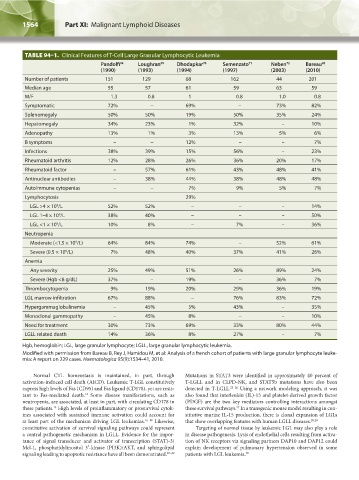
                TABLE 94–1.  Clinical Features of T-Cell Large Granular Lymphocytic Leukemia
                                                              69
                                                68
                                          Pandolfi    Loughran     Dhodapkar       Semenzato       Neben      Bareau
                                                                                                        72
                                                                                                                    48
                                                                            70
                                                                                           71
                                          (1990)      (1993)       (1994)          (1997)          (2003)     (2010)
                Number of patients         151          129           68             162             44        201
                Median age                  55           57           61              59             63         59
                M/F                          1.3         0.8           1               0.8           1.0         0.8
                Symptomatic                 72%           –           69%                  –         73%        82%
                Splenomegaly                50%          50%          19%             50%            35%        24%
                Hepatomegaly                34%          23%           1%             32%             –         10%
                Adenopathy                  13%          1%            3%             13%            5%          6%
                B symptoms                    –           –           12%               –             –          7%
                Infections                  38%          39%          15%             56%             –         23%
                Rheumatoid arthritis        12%          28%          26%             36%            20%        17%
                Rheumatoid factor             –          57%          61%             43%            48%        41%
                Antinuclear antibodies        –          38%          44%             38%            48%        48%
                Autoimmune cytopenias         –           –            7%              9%            5%          7%
                Lymphocytosis                                         29%
                           9
                  LGL >4 × 10 /L            52%          52%            –               –             –         14%
                  LGL 1–4 × 10 /L           38%          40%            –               –             –         50%
                            9
                           9
                  LGL <1 × 10 /L            10%          8%             –              7%             –         36%
                Neutropenia
                  Moderate (<1.5 × 10 /L)   64%          84%          74%               –            52%        61%
                                 9
                  Severe (0.5 × 10 /L)       7%          48%          40%             37%            41%        26%
                              9
                Anemia
                  Any severity              25%          49%          51%             26%            89%        24%
                  Severe (Hgb <8 g/dL)      37%           –           19%               –            36%         7%
                Thrombocytopenia             9%          19%          20%             29%            36%        19%
                LGL marrow infiltration     67%          88%            –             76%            83%        72%
                Hypergammaglobulinemia        –          45%           5%             43%             –         35%
                Monoclonal gammopathy         –          45%           8%               –             –         10%
                Need for treatment          30%          73%          69%             33%            80%        44%
                LGLL related death          14%          36%           8%             27%             –          7%
               Hgb, hemoglobin; LGL, large granular lymphocyte; LGLL, large granular lymphocytic leukemia.
               Modified with permission from Bareau B, Rey J, Hamidou M, et al: Analysis of a french cohort of patients with large granular lymphocyte leuke-
               mia: A report on 229 cases. Haematologica 95(9):1534–41, 2010.

                   Normal CTL homeostasis is maintained, in part, through     Mutations in STAT3 were identified in approximately 40 percent of
               activation-induced cell death (AICD). Leukemic T-LGL constitutively   T-LGLL and in CLPD-NK, and STAT5b mutations have also been
               express high levels of Fas (CD95) and Fas ligand (CD178), yet are resis-  detected in T-LGLL. 23–26  Using a network modeling approach, it was
               tant to Fas-mediated death.  Some disease manifestations, such as   also found that interleukin (IL)-15 and platelet-derived growth factor
                                    14
               neutropenia, are associated, at least in part, with circulating CD178 in   (PDGF) are the two key mediators controlling interactions amongst
               these patients.  High levels of proinflammatory or prosurvival cytok-  these survival pathways.  In a transgenic mouse model resulting in con-
                                                                                       27
                          15
               ines associated with sustained immune activation could account for   stitutive murine IL-15 production, there is clonal expansion of LGLs
               at  least  part  of  the  mechanism  driving  LGL  leukemias. 16–19   Likewise,     that show overlapping features with human LGLL diseases. 28,29
               constitutive activation of survival signaling pathways could represent   Targeting of normal tissue by leukemic LGL may also play a role
               a central pathogenetic mechanism in LGLL. Evidence for the impor-  in disease pathogenesis. Lysis of endothelial cells resulting from activa-
               tance of signal transducer and activator of transcription (STAT)-3/  tion of NK receptors via signaling partners DAP10 and DAP12 could
               Mcl-1, phosphatidylinositol 3′-kinase (PI3K)/AKT, and sphingolipid   explain development of pulmonary hypertension observed in some
               signaling leading to apoptotic resistance have all been demonstrated. 20–22    patients with LGL leukemia. 30


          Kaushansky_chapter 94_p1563-1568.indd   1564                                                                  9/18/15   10:52 AM

