


Page 1638 - Williams Hematology ( PDFDrive )
P. 1638
1612  Part XI:  Malignant Lymphoid Diseases                                Chapter 97:  Hodgkin Lymphoma             1613


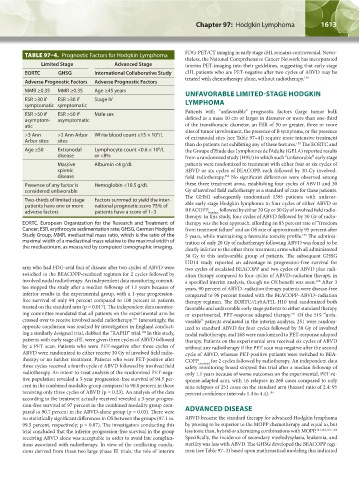
                   TABLE 97–4.  Prognostic Factors for Hodgkin Lymphoma  FDG-PET/CT imaging in early stage cHL remains controversial. Never-
                                                                        theless, the National Comprehensive Cancer Network has incorporated
                        Limited Stage            Advanced Stage         interim PET-imaging into their guidelines, suggesting that early stage
                   EORTC      GHSG        International Collaborative Study  cHL patients who are PET-negative after two cycles of ABVD may be
                                                                        treated with chemotherapy alone, without radiotherapy. 158
                   Adverse Prognostic Factors  Adverse Prognostic Factors
                   MMR ≥0.35  MMR ≥0.35   Age ≥45 years                 UNFAVORABLE LIMITED-STAGE HODGKIN
                   ESR >30 if   ESR >30 if   Stage IV                   LYMPHOMA
                   symptomatic symptomatic
                   ESR >50 if   ESR >50 if   Male sex                   Patients  with “unfavorable” prognostic  factors  (large  tumor  bulk
                   asymptom-  asymptomatic                              defined as a mass 10 cm or larger in diameter or more than one-third
                   atic                                                 of the transthoracic diameter, an ESR of 50 or greater, three or more
                                                                        sites of tumor involvement, the presence of B symptoms, or the presence
                   >3 Ann     >2 Ann Arbor   White blood count ≥15 × 10 /L  of extranodal sites [see Table  97–4]) require more intensive treatment
                                                               9
                   Arbor sites  sites
                                                                        than do patients not exhibiting any of these features.  The EORTC and
                                                                                                              158
                   Age ≥50    Extranodal   Lymphocyte count <0.6 × 10 /L   the Groupe d’Etude des Lymphomes de l’Adulte (GELA) reported results
                                                               9
                              disease     or <8%                        from a randomized study (H9U) in which such “unfavorable” early stage
                              Massive     Albumin <4 g/dL               patients were randomized to treatment with either four or six cycles of
                              splenic                                   ABVD or six cycles of BEACOPP, each followed by 30-Gy involved-
                              disease                                   field radiotherapy.  No significant differences were observed among
                                                                                      156
                   Presence of any factor is    Hemoglobin <10.5 g/dL   these three treatment arms, establishing four cycles of ABVD and 30
                   considered unfavorable                               Gy of involved field radiotherapy as a standard of care for these patients.
                                                                        The GHSG subsequently randomized 1395  patients  with  unfavor-
                   Two-thirds of limited stage   Factors summed to yield the inter-
                   patients have one or more   national prognostic score 75% of   able early stage Hodgkin lymphoma to four cycles of either ABVD or
                   adverse factors        patients have a score of 1–3  BEACOPP baseline  followed by either 20 Gy or 30 Gy of involved field radio-
                                                                        therapy. In this study, four cycles of ABVD followed by 30 Gy of radio-
                  EORTC, European Organization for the Research and Treatment of   therapy was the best approach, affording an 85 percent rate of “freedom
                  Cancer; ESR, erythrocyte sedimentation rate; GHSG, German Hodgkin   from treatment failure” and an OS rate of approximately 95 percent after
                  Study Group; MMR, mediastinal mass ratio, which is the ratio of the   5 years, while maintaining a favorable toxicity profile.  The adminis-
                                                                                                                159
                  maximal width of a mediastinal mass relative to the maximal width of   tration of only 20 Gy of radiotherapy following ABVD was found to be
                  the mediastinum, as measured by computed tomographic imaging.
                                                                        clearly inferior to the other three treatment arms which all administered
                                                                        30  Gy to this unfavorable group of patients. The subsequent GHSG
                                                                        HD14 study reported an advantage in progression-free survival for
                  arm who had FDG-avid foci of disease after two cycles of ABVD were   two cycles of escalated BEACOPP and two cycles of ABVD plus radi-
                  switched to the BEACOPP-escalated regimen for 2 cycles followed by   ation therapy compared to four cycles of ABVD–radiation therapy, in
                  involved nodal radiotherapy. An independent data monitoring commit-  a specified interim analysis, though no OS benefit was seen.  After 3
                                                                                                                    160
                  tee stopped the study after a median followup of 1.1 years because of   years, 90 percent of ABVD–radiation therapy patients were disease-free
                  inferior results in the experimental group, with a 1-year progression-  compared to 96 percent treated with the BEACOPP–ABVD–radiation
                  free survival of only 94 percent compared to 100 percent in patients   therapy regimen. The EORTC//LySA/FIL H10 trial randomized both
                  treated on the standard arm (p = 0.017). The independent data monitor-  favorable and unfavorable early stage patients to either standard therapy
                  ing committee mandated that all patients on the experimental arm be   or experimental, PET-response adapted therapy.  Of the 519 “unfa-
                                                                                                            101
                  crossed over to receive involved nodal radiotherapy.  Interestingly, the   vorable” patients evaluated in the interim analysis, 251 were random-
                                                       101
                  opposite conclusion was reached by investigators in England conduct-  ized to standard ABVD for four cycles followed by 30 Gy of involved
                  ing a similarly designed trial, dubbed the “RAPID” trial.  In this study,   nodal radiotherapy, and 268 were randomized to PET-response adapted
                                                          102
                  patients with early stage cHL were given three cycles of ABVD followed   therapy. Patients on the experimental arm received six cycles of ABVD
                  by a PET scan. Patients who were PET-negative after three cycles of   without any radiotherapy if the PET scan was negative after the second
                  ABVD were randomized to either receive 30 Gy of involved field radio-  cycle of ABVD, whereas PET-positive patients were switched to BEA-
                  therapy or no further treatment. Patients who were PET-positive after   COPP   for 2 cycles followed by radiotherapy. An independent data
                                                                             escalated
                  three cycles received a fourth cycle of ABVD followed by involved field   safety monitoring board stopped this trial after a median followup of
                  radiotherapy. An intent-to-treat analysis of the randomized PET-nega-  only 1.1 years because of worse outcomes on the experimental, PET-re-
                  tive population revealed a 3-year progression-free survival of 94.5 per-  sponse adapted arm, with 16 relapses in 268 cases compared to only
                  cent in the combined modality group compared to 90.8 percent in those   nine relapses of 251 cases on the standard arm (hazard ratio of 2.4; 95
                  receiving only three cycles of ABVD (p = 0.23). An analysis of the data   percent confidence intervals 1.4 to 4.4). 101
                  according to the treatment actually received revealed a 3-year progres-
                  sion-free survival of 97 percent in the combined modality group com-
                  pared to 90.7 percent in the ABVD-alone group (p = 0.03). There were   ADVANCED DISEASE
                  no statistically significant differences in OS between the groups (97.1 vs.   ABVD became the standard therapy for advanced Hodgkin lymphoma
                  99.5 percent, respectively; p = 0.07). The investigators conducting this   by proving to be superior to the MOPP chemotherapy and equal to, but
                  trial concluded that the inferior progression-free survival in the group   less toxic than, hybrid or alternating combinations with MOPP. 141,142,161–164
                  receiving ABVD alone was acceptable in order to avoid late complica-  Specifically, the incidence of secondary myelodysplasia, leukemia, and
                  tions associated with radiotherapy. In view of the conflicting conclu-  sterility was less with ABVD. The GHSG developed the BEACOPP regi-
                  sions derived from these two large phase III trials, the role of interim   men (see Table  97–3) based upon mathematical modeling that indicated


          Kaushansky_chapter 97_p1603-1624.indd   1613                                                                  9/18/15   11:12 PM

