


Page 1635 - Williams Hematology ( PDFDrive )
P. 1635
1610           Part XI:  Malignant Lymphoid Diseases                                                                                                                                   Chapter 97:  Hodgkin Lymphoma             1611


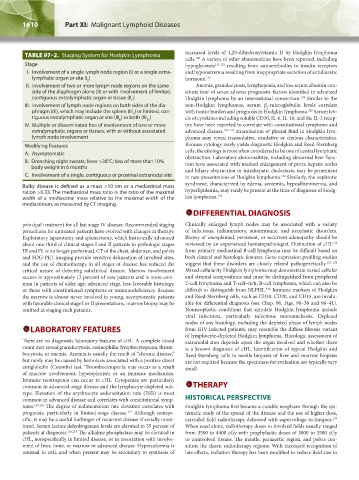
                TABLE 97–2.  Staging System for Hodgkin Lymphoma      increased levels of 1,25-dihydroxyvitamin  D  by  Hodgkin  lymphoma
                                                                      cells.  A variety of other abnormalities have been reported, including
                                                                          120
                Stage                                                 hypoglycemia 121,122  resulting from autoantibodies to insulin receptors
                 I.  Involvement of a single lymph node region (I) or a single extra-  and hyponatremia resulting from inappropriate secretion of antidiuretic
                   lymphatic organ or site (I )                       hormone. 123
                                     E
                 II.  Involvement of two or more lymph node regions on the same   Anemia, granulocytosis, lymphopenia, and low serum albumin con-
                   side of the diaphragm alone (II) or with involvement of limited,   stitute four of seven adverse prognostic factors identified in advanced
                   contiguous extralymphatic organ or tissue (II )    Hodgkin lymphoma by an international consortium.  Similar to the
                                                                                                             124
                                                    E
                III.  Involvement of lymph node regions on both sides of the dia-  non-Hodgkin lymphomas, serum  β -microglobulin levels correlate
                                                                                                 2
                                                                                                               125
                   phragm (III), which may include the spleen (III ) or limited, con-  with tumor burden and prognosis in Hodgkin lymphoma.  Serum lev-
                                                    S
                   tiguous extralymphatic organ or site (III ) or both (III )  els of cytokines including soluble CD30, IL-6, IL-10, and the IL-2 recep-
                                                E        ES
                IV.  Multiple or disseminated foci of involvement of one or more   tor, have been reported to correlate with constitutional symptoms and
                   extralymphatic organs or tissues, with or without associated   advanced disease. 126–129  Examination of pleural fluid in Hodgkin lym-
                   lymph node involvement                             phoma may reveal transudative, exudative or chylous characteristics.
                Modifying Features                                    Because cytology rarely yields diagnostic Hodgkin and Reed-Sternberg
                A.   Asymptomatic                                     cells, the etiology is most often considered to be one of central lymphatic
                B.   Drenching night sweats; fever >38°C; loss of more than 10%   obstruction. Laboratory abnormalities, including abnormal liver func-
                                                                      tion tests associated with marked enlargement of porta hepatis nodes
                  body weight in 6 months                             and biliary obstruction or intrahepatic cholestasis, may be prominent
                C.  Involvement of a single, contiguous or proximal extranodal site  in rare presentations of Hodgkin lymphoma.  Similarly, the nephrotic
                                                                                                      130
               Bulky disease is defined as a mass >10 cm or a mediastinal mass   syndrome, characterized by edema, azotemia, hypoalbuminemia, and
               ration >0.33. The mediastinal mass ratio is the ratio of the maximal   hyperlipidemia, may rarely be present at the time of diagnosis of Hodg-
               width of a mediastinal mass relative to the maximal width of the   kin lymphoma. 131
               mediastinum, as measured by CT imaging.
                                                                         DIFFERENTIAL DIAGNOSIS
               principal treatment for all but stage IV disease. Recommended staging   Clinically  enlarged lymph  nodes  may  be  associated  with  a  variety
               procedures for untreated patients have evolved with changes in therapy.   of infectious, inflammatory, autoimmune, and neoplastic disorders.
               Exploratory laparotomy and splenectomy, which historically advanced   Biopsy of unexplained, persistent, or recurrent adenopathy should be
               about one-third of clinical stages I and II patients to pathologic stages   reviewed by an experienced hematopathologist. Distinction of cHL
                                                                                                                       132
               III and IV, is no longer performed. CT of the chest, abdomen, and pelvis   from primary mediastinal B-cell lymphoma may be difficult based on
               and FDG-PET imaging provide sensitive delineation of involved sites,   both clinical and histologic features. Gene expression profiling studies
               and the use of chemotherapy in all stages of disease has reduced the   suggest that these disorders are closely related pathogenetically. 132–135
               critical  nature of detecting  subclinical  disease.  Marrow  involvement   Mixed cellularity Hodgkin lymphoma may demonstrate varied cellular
               occurs in approximately 12 percent of new patients and is more com-  and stromal compositions and must be distinguished from peripheral
               mon in patients of older age, advanced stage, less-favorable histology,   T-cell lymphoma and T-cell–rich, B-cell lymphoma, which can also be
               or those with constitutional symptoms or immunodeficiency. Because   difficult to distinguish from NLPHL.  Immune markers of Hodgkin
                                                                                                 136
               the marrow is almost never involved in young, asymptomatic patients   and Reed-Sternberg cells, such as CD30, CD20, and CD15, are invalu-
               with favorable clinical stage I or II presentations, marrow biopsy may be   able for differential diagnosis (see Chap. 96, Figs. 96–36 and 96–41).
               omitted in staging such patients.                      Nonneoplastic conditions that simulate Hodgkin lymphoma include
                                                                      viral infections, particularly infectious mononucleosis. Depleted
                                                                      nodes of any histology, including the depleted phase of lymph nodes
                  LABORATORY FEATURES                                 from HIV-infected patients, may resemble the diffuse fibrosis variant
                                                                      of lymphocyte-depleted Hodgkin lymphoma. Histologic assessment of
               There are no diagnostic laboratory features of cHL. A complete blood   extranodal sites depends upon the organ involved and whether there
               count may reveal granulocytosis, eosinophilia, lymphocytopenia, throm-  is a known diagnosis of cHL. Identification of typical Hodgkin and
               bocytosis, or anemia. Anemia is usually the result of “chronic disease,”   Reed-Sternberg cells in needle biopsies of liver and marrow biopsies
               but rarely may be caused by hemolysis associated with a positive direct   are not required because the specimens for evaluation are typically very
               antiglobulin (Coombs) test. Thrombocytopenia may occur as a result   small.
               of marrow involvement, hypersplenism or an immune mechanism.
               Immune neutropenia can occur in cHL. Cytopenias are particularly
               common in advanced-stage disease and the lymphocyte-depleted sub-  THERAPY
               type. Elevation of the erythrocyte sedimentation rate (ESR) is most
               common in advanced disease and correlates with constitutional symp-  HISTORICAL PERSPECTIVE
               toms. 115,116  The degree of sedimentation rate elevation correlates with   Hodgkin lymphoma first became a curable neoplasm through the sys-
               prognosis, particularly in limited-stage disease.  Although nonspe-  tematic study of the spread of the disease and the use of higher dose,
                                                   117
               cific, it may be a useful harbinger of recurrent disease if serially moni-  extended field radiotherapy delivered with supervoltage techniques.
                                                                                                                       137
               tored. Serum lactate dehydrogenase levels are elevated in 35 percent of   When used alone, radiotherapy doses to involved fields usually ranged
               patients at diagnosis. 118,119  The alkaline phosphatase may be elevated in   from 3500 to 4400 cGy with prophylactic doses of 3000 to 3500 cGy
               cHL, nonspecifically in limited disease, or in association with involve-  to uninvolved tissues. The mantle, paraaortic region, and pelvis con-
               ment of liver, bone, or marrow in advanced disease. Hypercalcemia is   stitute the classic radiotherapy regions. With increased recognition of
               unusual in cHL and when present may be secondary to synthesis of   late effects, radiation therapy has been modified to reduce field size to


          Kaushansky_chapter 97_p1603-1624.indd   1610                                                                  9/18/15   11:12 PM

